
Repairing the launch pad at the Baikonur Cosmodrome may take from several months to several years. Therefore, upcoming launches of Russian spacecraft to the International Space Station (ISS) are likely to be postponed, writes Focus.
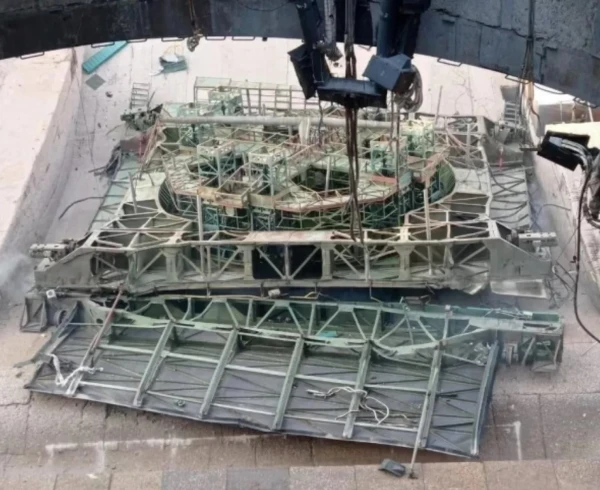
On November 27, after the launch of the Soyuz-2.1a rocket with the Soyuz MS-28 spacecraft, an accident occurred at launch pad 31 of the Baikonur Cosmodrome. The maintenance cabin of the cosmodrome collapsed. Although the astronauts aboard Soyuz MS-28, Russians Sergey Kud-Sverchkov, Sergey Mikaev, and American Christopher Williams, successfully arrived at the ISS. As a result of the accident, Russia has lost access to the ISS for an indefinite period, writes New Atlas.
Launch pad 31 at the Baikonur Cosmodrome is the only one from which Russia can send astronauts and cargo to the International Space Station. Due to the accident, the launch pad cannot be used until it is repaired. Although Russia has other cosmodromes, for example, Plesetsk is at an unsuitable latitude for launching spacecraft to the ISS, and Vostochny is not designed for launching astronauts into orbit. Therefore, the Russian Federation will not be able to send crewed Soyuz spacecraft and Progress cargo ships to the ISS for some time.
The maintenance cabin is a metal platform measuring 19.06 m × 16.92 m and weighing 144 tons, which has two lifting platforms. During the preparation of the rocket for launch, the maintenance cabin is retracted under the rocket, and the platforms are raised, providing access to the engines of the first and second stages of the Soyuz rocket. From here, the launch team conducts all pre-launch operations with the lower part of the rocket.
After the completion of pre-launch preparation, the lifting platforms are lowered, and the service cabin moves along special rails under the launch table. There it is secured by two locks.
On November 27, the maintenance cabin was moved under the launch table, but a preliminary investigation showed that either it was not securely fastened in the niche, or the locks holding it in place could not withstand the load. As a result, the cabin collapsed down from a height of 20 meters.
The maintenance cabin, judging by the photographs, sustained serious damage, which experts believe is too significant to allow for repairs. The only way to resume launches from pad 31 is to install a spare cabin or build a new one. Two similar maintenance cabins were recently manufactured, which took about two years to create.
According to a statement from Roscosmos, all necessary spare parts are available for restoring the launch complex, and it will be repaired in the near future. Different experts provide varying estimates for the possible timelines for restoring pad 31 at the Baikonur Cosmodrome: from several months to three years.
It is likely that the launch of the Progress MS-33 cargo spacecraft to the ISS, scheduled for December 21, 2025, will be postponed. Therefore, astronauts in orbit will not receive the necessary supplies and equipment by the end of the year.
Roscosmos has a chance to restore pad 31 before the launch of the crewed spacecraft Soyuz MS-29, scheduled for July 14, 2026, although the likelihood of postponing this mission is also high.
So far, neither Roscosmos nor NASA has published any changes to the flight schedule to the ISS.
Theoretically, Russia could send astronauts and cargo from the Kourou spaceport of the European Space Agency located in South America. But the Russian Federation cannot do this due to sanctions imposed in connection with the invasion of Ukraine.








Leave a comment