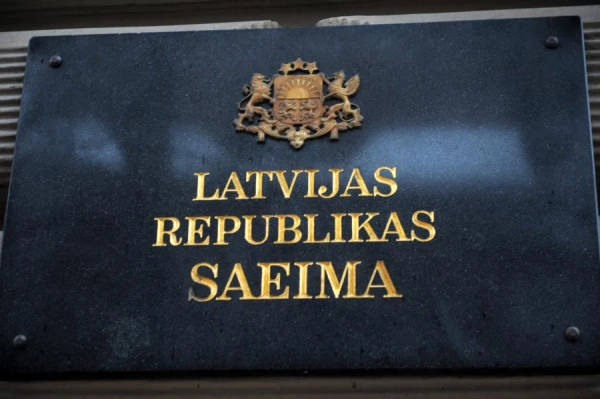
On Thursday, in the final reading, the Saeima adopted a new immigration law that provides for significant strengthening of migration control, revision of the entry and stay procedures for third-country nationals, and also grants foreigners the opportunity to obtain a temporary residence permit (TRP) for up to five years in exchange for investments.
The authors of the amendments explain that the new law introduces a clearer and more transparent immigration system, regulating entry, stay, employment, education, and expulsion procedures for foreigners while simultaneously reducing the risks of fictitious immigration.
The law provides for several significant practical changes. Screening of third-country nationals will be introduced at external borders along with a border return procedure, and biometric data and information exchange with European Union databases will be used more extensively, improving the identification of individuals.
The procedure for granting residence permits will be clarified, stricter conditions for their issuance will be established, and the list of cases in which a permit may be denied or revoked on security grounds will be expanded. At the same time, it is planned to strengthen control even before a person enters Latvia - more detailed information about the purpose of entry and conditions of stay will be requested.
Stricter requirements are also provided in the areas of education and employment. Higher education institutions will be required to report unexcused absences of foreign students within three days, instead of the previous 14 days. In turn, expelled students, with some exceptions, will have to leave Latvia.
The law establishes integration requirements, providing for early integration programs and state language learning for foreigners, and strengthens oversight of the employment of third-country nationals, increasing employer responsibility.
In the third reading, a previously approved proposal by the Defense, Internal Affairs, and Corruption Prevention Committee was supported to amend the immigration law with a new provision allowing foreigners to obtain a temporary residence permit for up to five years in exchange for investments.
Changes to the first part of Article 26 of the law include a new clause stating that a temporary residence permit may be granted to a foreigner who has entered into a contract and made investments of at least 150,000 euros for a period of at least five years in a state-created company managing alternative investment funds. Additionally, the foreigner will be required to contribute 10,000 euros to the state budget.
At the same time, it is stipulated that the issued residence permit will only be valid if, during its validity, the respective fund manager confirms that the investment contract has not been terminated and the investment amount is at least 150,000 euros.
This regulation aims to attract investments into the national economy while ensuring stricter control over the preservation of investments throughout the validity of the residence permit.
Furthermore, when reapplying for a temporary or permanent residence permit, documents will need to be submitted in Latvian, while for the first permit, they can still be submitted in English.
Saeima deputies also approved in the third reading a proposal by former Minister of the Interior Richard Kozlovskis (New Unity) to clarify the immigration law regarding cases when a foreigner may be denied a residence permit or when a residence permit may be revoked, with the aim of tightening security requirements.
The adopted changes provide for the rewording of point 8 of the first part of Article 33 of the law, establishing that the issuance of a residence permit may be denied if the foreigner has been found guilty of committing a criminal offense in Latvia or abroad for which Latvian laws provide for criminal punishment.
At the same time, exceptions have been defined in which this condition will not apply. They will concern individuals with the status of non-citizens of Latvia, cases where a person's stay is in the state’s interest or related to certain special categories defined by law, as well as situations where a conviction has been expunged or removed. For criminal offenses committed abroad, there are time limits - at least one year after serving the sentence, and in the case of imprisonment - at least five years.
Deputies agreed to supplement Article 33 of the law with a new provision that provides for a stricter assessment in cases of reapplying for a temporary residence permit. Specifically, a permit may be denied if the foreigner has been subjected to administrative punishment for glorifying military aggression or war crimes, as well as for using symbols of totalitarian regimes in public places, or has been found guilty of a criminal offense punishable by imprisonment for more than three years or classified as an intentional crime.
In this case, exceptions are also provided, for example, if a person has been granted non-citizen status, their stay is in the state’s interest of Latvia, or a denial contradicts international obligations, as well as in cases where a conviction has been expunged or removed in accordance with established regulations.
On Thursday, Saeima deputies supported a proposal from the Saeima Legal Bureau, which aims to strengthen the protection of children's rights in the field of immigration. The supported amendments to Article 57 of the immigration law include a provision stating that the detention of minor foreigners is allowed only as a last resort and only in cases where it is in the best interests of the child.
On Thursday, Saeima deputies rejected a proposal from the National Alliance that aimed to prohibit a certain group of foreigners from engaging in economic activities as self-employed individuals. The proposal sought to amend the immigration law with a provision stating that a foreigner, including a citizen or permanent resident of a candidate country for European Union membership, who is in Latvia with a temporary residence permit or long-term visa, would not have the right to conduct economic activities as self-employed.
The goal of the proposal was to limit the possibilities of using regulation for conducting economic activities; however, the parliamentary majority disagreed.
The work on the draft law in the Saeima took place over several readings. The Defense, Internal Affairs, and Corruption Prevention Committee reviewed a total of more than 170 proposals, most of which were editorial, while some were rejected or withdrawn. Decisions on proposals were made both in the committee and in the final reading at the Saeima session.
Several proposals were not supported in the committee and the Saeima, including a proposal to establish that foreigners with a planned stay of at least three years must mandatorily complete an early integration program. A proposal for partial compensation of expenses for integration courses was also rejected. At the same time, proposals from the Ministry of the Interior for stricter control over the stay and employment of third-country nationals were supported.
The new regulation also provides for restrictions on the employment of third-country nationals in simple professions and tightening sanctions for violations, as well as strengthening control in the field of education, including additional safety mechanisms.
The most significant provisions of the law will come into force on January 1, 2027.