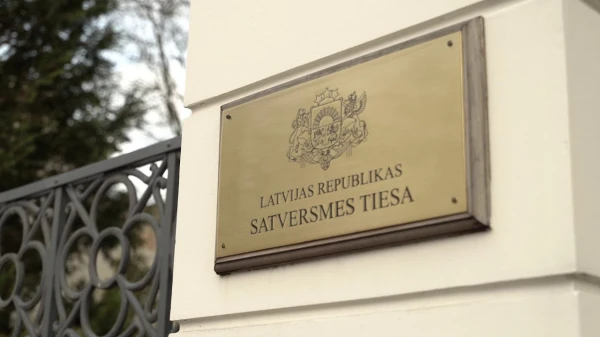
The Constitutional Court issued a verdict on the lawsuit of the National Alliance and the United List — now the Russian language may completely disappear from public media.
Battle with a Dead Man?
To some extent, nationalist deputies... are fighting windmills, as the Russian language, which irritates them, has disappeared from public media by 90 percent — it still exists on a separate internet platform for national minorities. Let us recall that broadcasting on LTV-7 in Russian was discontinued last year, and the program "Doma Square" on Latvian Radio-4 closed on January 1 of this year. Nevertheless, the parliamentarians believed that the articles of the Public Media Law that require the state to finance broadcasting in the languages of national minorities contradict the Constitution.
And yesterday, the Constitutional Court essentially agreed with the plaintiffs. The Constitutional Court concluded that the language articles of the law do not comply with the Satversme. Here are selected excerpts from the Constitutional Court's decision:
"The foundations and national-cultural identity of the Latvian state are defined by the Latvian language as the only state language, without which the existence of the state, enshrined in the Constitution, is impossible. Latvia is the only place in the world where the existence and development of the Latvian language can be guaranteed, and, as a consequence, the indigenous nation through the ages.
The Constitutional Court emphasized that the constitutional mission of public media is to strengthen the values characteristic of a democratic state, including caring for the Latvian language, fostering a sense of belonging among the population to the Latvian state. The essence of public media is to provide society with reliable information, especially on issues significant to society. From the essence of the constitutional identity of the Latvian state, it follows that the content of public media should primarily be in the Latvian language, so that it truly serves as a common language for communication and democratic participation of the entire society, including national minorities. A departure from this principle is allowed only to fulfill other obligations of the state arising from the Constitution and only to the extent that does not threaten the status and functions of the state language.
But we respect national minorities...
At the same time, Latvia, as a democratic rule of law, respects national minorities and their right to preserve and develop their language and culture, enshrined in Article 114 of the Constitution. The state must take appropriate measures to ensure access for national minorities to media, to increase tolerance and cultural diversity. However, the scope of state obligations regarding the rights of national minorities depends on the actual situation of a specific national minority in the country, such as numerical composition, language prevalence, media accessibility, willingness and ability to independently ensure access to information in their language, as well as other circumstances.
In the case at hand, the Constitutional Court noted that the Russian language in Latvian media is self-sufficient — commercial media in Russian are still widely available. Moreover, there are print, audiovisual, and digital media, as well as dozens of programs created by electronic media from other countries that offer content in Russian. Thus, the existence of the relevant language of the national minority and the preservation and development of national identity are not under threat, and individuals belonging to the Russian national minority are able to effectively exercise their rights in the media space without significant state support.
In assessing the constitutionality of the contested norms, the court emphasized that it is necessary to consider the constitutional obligation of the state to care for its security, as only in this way can the existence of the Latvian state and its democratic order be guaranteed.
This also applies to a national minority whose language is self-sufficient in the media in Latvia, namely the Russian language. Conducting aggressive and hostile activities for war propaganda and disinformation is one of the main directions of Russia's activities directed against Latvia and the Baltic states. It is expected that Russia will continue such measures. Therefore, in cases where, for example, it is necessary to protect society from propaganda and disinformation, it is public media that have the task of providing fact-based objective information and clarifying its political, legal, and social context."
One way or another, by May 1, 2027, that is, within a year, the Saeima must approve new language regulations in public media. We dare to assume that the new law will provide for the possibility of broadcasting in the languages of national minorities only in exceptional (special) cases. But the new law will apparently be adopted by the next parliament.