Last week, 69 Saeima deputies voted "for" and 18 "against" considering the draft decision "On the publication of the list of importers and exporters conducting transactions with the Russian Federation and the Republic of Belarus" this Thursday.
The authors of the initiative are the following parliamentarians, here is the list of the most conscientious and principled: Arturs Butans, Janis Grasbergs, Edvards Smiltenš, Jurģis Klotiņš, Raivis Dzintars, Janis Dombrova, Edvins Šnere, Ilze Indrikson, Edmunds Teirumnieks, Andris Kulbergs, and Inara Murniece.
"Connections with high-risk states"
The deadline for the decision is set for March 29. In the document considered by the Saeima, the initiative is justified as follows: "The publication of the list of importing and exporting enterprises trading with the Russian Federation and the Republic of Belarus is justified by the principle of information openness, which provides the public with the right to receive significant information about commercial activities that may have a significant impact on state interests, the economic environment, and public trust in market participants, including their participation in public procurement and other forms of cooperation with government administration. The publication of such information promotes transparency, strengthens public awareness, and enables consumers, cooperation partners, and public authorities to make informed and responsible decisions."
The deputies also emphasize: "The publication of the aforementioned list is also justified by the principle of national security, as economic relations with the Russian Federation and the Republic of Belarus under the current geopolitical circumstances are not assessed solely as an individual, private-law, or commercial choice. Trade relations with high-risk states, whose actions pose a threat to regional security and international legal order, affect the broadest interests of society. Therefore, the availability of information about such transactions is one of the tools that can strengthen economic security, reduce indirect support for the economies of aggressor states, and promote responsible business practices."
"At the same time," the group of politicians points out, "the publication of such information also corresponds to the legal principle if it is produced on a clear legal basis, ensuring proportional requirements, equal competition, and treatment, as well as data protection requirements. The published information must be accurate, verifiable, and based on objective data so that the rights and legitimate interests of individuals are not unjustifiably affected. Thus, the publication of the list is a legally justified and relevant mechanism for ensuring transparency that has been used before, but with the change of government, these standards of openness have been lost."
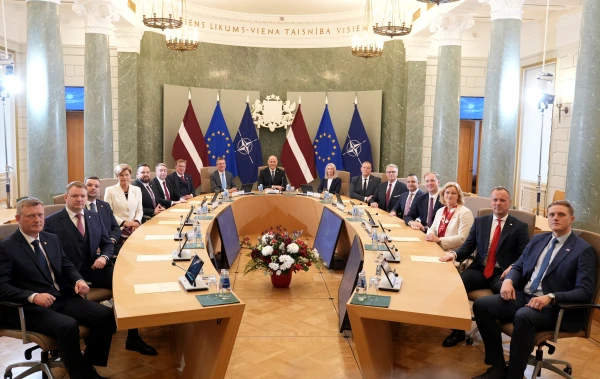
Former Speaker of the Parliament and ex-Minister of Defense Inara Murniece (National Alliance) spoke on behalf of the initiators: – I really hope that the Saeima has reached a consensus here, that we can all vote "for." I hope that this is also reflected in the decisions made by the Foreign Affairs Committee… We appeal to our Prime Minister Evika Silina and ask her to resume the previously implemented practice within two weeks – to publish once a month the list of enterprises registered in Latvia that export goods from Latvia to aggressor states – the Russian Federation and the Republic of Belarus.
Did the lists have an effect?
"It is indeed obvious that the initial practice, when the publication of such information began – let me remind you that Ilze Indrikson was the Minister of Economy at that time – brought the expected effect. For various reasons, exports to Russia and Belarus have decreased. But I hope that our entrepreneurs also understood the situation and sought other cooperation partners, diversifying their businesses.
Now we must say clearly – we want more openness. And if there was some misunderstanding or statistical data that painted a picture that was not so clear, whether it was export or re-export, or some companies tried to use this system to hide their actions, then I think that the Prime Minister, as the head of the government team, can sort this out with the responsible ministries, various agencies, and institutions and return to this system so that we could say... and so that the public knows which enterprises are still exporting to Russia and Belarus.
This is not such a simple question. Here we are both buyers and part of our society. And it is also very important to ensure that these companies do not receive state support as entrepreneurs in various formats. And here I am talking about possible support – from the Latvian Investment and Development Agency and other various formats."
L. Murniece is confident in the success of the initiative: – Clarity will show this picture, I think, also this landscape in such a way that there will be no more opportunity to manipulate statistical data or hide behind tasks given to other entrepreneurs and other enterprises. And it will be clear to us where those are who are still not shy about fueling Russia's military machine. And we as deputies will have the opportunity to monitor that these entrepreneurs and these enterprises do not receive any state support.
In the electoral competition
Some of what Ms. Murniece said points to the real reasons for such a sudden excitement about trade with neighboring countries: "If 'New Unity' as the ruling party said: we will cut ties with Russia, then we cut these ties quickly, sharply! And here, well, colleagues, there is no delay, also mentioning that you could have done this a long time ago!"
It is clear that such simple tricks are intended to accuse the head of the Cabinet of Ministers of inaction by the current opposition – the National Alliance and the 'United List'. The vote count when submitting the project was such that this Thursday the decision should pass, so to speak, through one gate. If, of course, the ruling coalition does not throw a counter – releasing its own project, already about a complete ban on trade with the Russian Federation and Belarus.
Although, let’s be honest – what do the Belarusians have to do with it? After all, Minsk has caused much less harm to international security in recent years than a couple of states with which the current government of Latvia collaborates and solidarizes in every way.