
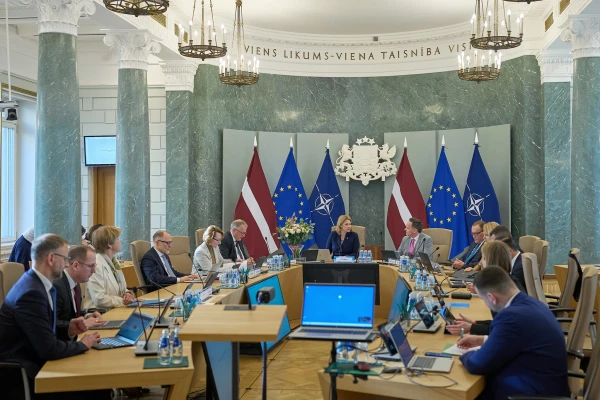
"Green Farmers" opposed their coalition partners. The Prime Minister tried to find a compromise
For an hour and a half today, the discussion of the "reform" initiated by the Minister of Finance, with the active support of the Bank of Latvia, continued at the government meeting. The saga of the "reform" began last year when the Ministry of Finance proposed to "take away" the function of oversight of financial companies from the Consumer Rights Protection Center and transfer this function to the Bank of Latvia. Despite objections and protests from industry representatives, the Consumer Rights Protection Center, and the Ministry of Economics, the Ministry of Finance prepared an informational report, which, after revision, was nonetheless included in the agenda today.
Today at the government meeting, Minister of Finance Arvils Ašeradens ("New Unity") tried to present this reform as insignificant. However, the head of the Ministry of Finance diplomatically noted that "nevertheless, this reform has generated great public interest." In fact, it has caused not just interest but a wave of discontent - in fact, the majority of feedback on the informational report was negative. Reasoned objections were voiced by the Ministry of Economics and its structural units, as well as by the Fintech Latvia non-bank sector association, the Latvian Consumer Rights Protection Society, the Latvian Bar Association, and the financial companies themselves. Minister of Economics Viktor Valainis emphasized during the heated discussion today that, firstly, why is this change in the supervisory structure needed if no problems have been identified so far with the oversight function of the non-bank sector by the Consumer Rights Protection Center? Secondly, the non-bank sector is developing very actively - with a growth of 16 percent per year, and there is a risk that changing the supervisory structure will simply slow down the development of the non-bank sector, which, by the way, actively provides credit to businesses in the regions. "We remain skeptical about this reform, but we cannot slow it down since we are in the minority on this issue in the government," stated V. Valainis.
In turn, the President of the Bank of Latvia, Mārtiņš Kazāks, and the Vice President of the Bank of Latvia, Sanita Purgaile, assured that changing the supervisory authority would not harm the non-bank sector and that everything would be done to ensure the continued development of the industry. According to the central bank's leadership, it is completely logical that the entire financial sector is regulated and controlled by one institution that has accumulated experience in checking clients of financial institutions.
Representatives of the Consumer Rights Protection Center expressed concern about how the rights and interests of consumers of financial services would be protected, especially considering that the Bank of Latvia has no experience in consumer rights protection.
The head of Fintech Latvia, Tina Luse, once again emphasized that she sees no need for this "reform"; these changes have only caused fear and uncertainty in the non-bank sector, and most importantly, it is unclear what the benefit of such a "reform" is for consumers and the non-bank lending business itself. It should be emphasized that non-bank companies do not deal with deposit services and do not have accounts for individuals and legal entities - all accounts remain in commercial banks, which in any case fulfill all requirements for checking clients and cash flows, including the origin of funds.
Notably, initially, Prime Minister Evika Siliņa ("New Unity") clearly sided with the Ministry of Finance during the meeting and even interrupted the speeches of opponents. However, when the heated discussion was nearing its end, the head of government actually heeded the objections of opponents and proposed a longer transitional period, that is, transferring oversight functions to the Bank of Latvia not from January 1, 2027, but from January 1, 2028. To this, Minister of Finance Arvils Ašeradens essentially responded with agreement, stating that "then we support a two-year transitional period."
However, "the devil is in the details" - we need to wait to see how this will ultimately be recorded in the relevant draft law, which is not yet available. Pushing this reform through the Saeima for its supporters - primarily in the form of "New Unity" and "Progressives" - will not be easy: Minister of Agriculture Armands Krauze warned that he himself and the majority of Saeima deputies from the Union of Greens and Farmers are negatively inclined. It is known that almost the entire parliamentary opposition is ready to oppose the reform...











Leave a comment