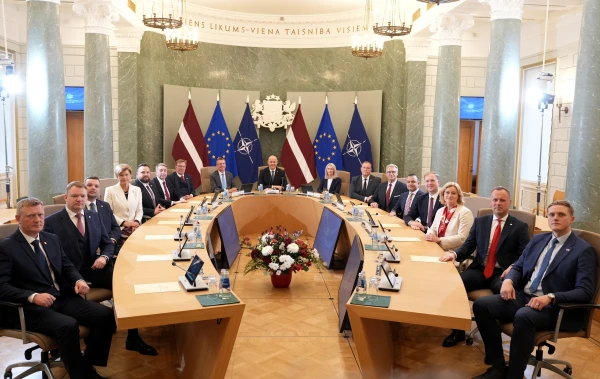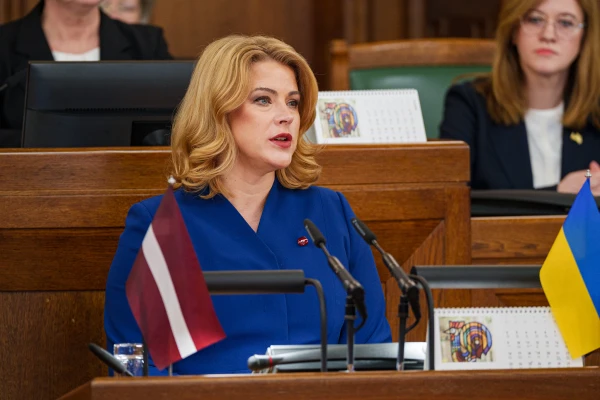
Thus, yesterday in parliament, Evika Silina reported on the successes of her government. The debates, as expected, stretched for several hours — by the time of preparing this material, there were still... 20 deputies signed up to speak from the podium! Meanwhile, 25 speakers had already managed to delight each other and their voters with their speeches.
You won’t praise yourself...
It is clear that the heroine of the day, Evika Silina, confidently praised her government and herself. The minimum wage has increased from 620 to 780 over nearly three years of her premiership, the non-taxable minimum for salaries has risen to 510 euros, and the non-taxable minimum for pensions now stands at 1000 euros. The amount of pensions has also been increased, which are indexed annually... In her list of achievements, the Prime Minister included the successful fight against bureaucracy, decisions made in the field of demographics, and the completion of the construction of the fence on the border with Belarus and Russia...
“This is all a lie...”
The opposition, however, disagreed with this rosy picture. The head of the “Latvia First” faction, Linda Liepina, ironically noted that the Prime Minister seems to live in some other Latvia. “Show me on the map the Latvia you are talking about! Where is it?!” the deputy asked. After that, the politician quoted several statements from Silina’s recent remarks. “Our demographic situation is not so bad. Europe envies us. The economy is growing, the reform is underway. You will put ‘Rail Baltica’ on the rails. Which country are you talking about?!” continued Linda Liepina, reminding: “We continue to live in Latvia, where the demographic situation is simply critical, where poverty rates are becoming increasingly alarming, where inequality is growing, and where one has to wait four years to see a doctor.”
The head of another opposition faction in the Saeima, the United List, Edgars Tavars, also spoke harshly. He stated that all the achievements listed by the Prime Minister are “lies.” The deputy reminded about the huge queues to doctors, the significant problems with Rail Baltica, and the terrible financial indicators of airBaltic, which will soon require taxpayers' money again... Among the government’s “achievements” is also the failure to construct the new building of the Stradins Hospital — with the construction process itself having increased in cost by 100 million...
“We are on the right track”
Notably, with less than 7 months remaining until the elections, most deputies from the “New Unity” party decided to participate in the debates and did not hold back their praises for the government. The Vice-Speaker of the Saeima, Zanda Kalnina-Lukasevica (“New Unity”), confidently stated that “Latvia is moving in the right direction of development.”
“In 2025, our country rose 7 places in the global competitiveness ranking. Compared to 2023, Latvia's position has improved by 13 places. This confirms that the improvements led by Prime Minister Evika Silina in the public sector and business environment are beginning to yield results. This means that entrepreneurs and investors have become more optimistic about the potential for Latvia’s future development,” said the Vice-Speaker from the Saeima podium, concluding: “Our country is a reliable, strong, and friendly country for people and families, and economically competitive.”
Meanwhile, the leader of the National Alliance faction, Ilze Indrikson, believes that the priorities outlined by Silina for the restart remain at the level of declarations: “In demographics, the government has formally increased support for families, but this does not ensure income replacement for middle-income parents. Support measures in education also remain at the level of declarations, as the ‘Program in School’ will be, the Cabinet of Ministers’ rules have not been approved, and full funding has still not been allocated. In the economy, the restart plan shows partially symbolic initiatives. The artificial intelligence center has started working, but without a team and a program.”
No punishment for betrayal...
Notably, the deputy from the ruling party “Progressives,” Antonina Nenashova, decided to throw a stone at... coalition partners - the “Green Farmers” and “New Unity.” The former were criticized for... “betrayal,” and the latter for their inability... to hold accountable “for betrayal.”
“The initial works of this government indeed brought new trends. There was a movement towards a policy centered on the individual.
In the first half of the year, the Istanbul Convention was ratified, regulations on partnership relations were adopted, a tax on banks’ super-profits was introduced, a preferential transition for the population from one bank to another was implemented, state support for thermal energy tariffs was introduced, and a new education financing model was developed. It seemed that there would be changes not only in the content of the policy but perhaps even in the style of politics itself.
However, soon the government began to test everyday reality. At the moment when it was necessary to move from the initial idea to disciplined cooperation, the instincts of old politics prevailed – procrastination, evasion of responsibility, the hope that problems would resolve themselves... A serious signal was the inability to demand accountability for betrayal regarding the Istanbul Convention. Since the government was able to take this step, since there was political courage to do so, there should have been the same readiness to advocate for this agreement and demand accountability from those who deviated from their promises to protect women and children from violence...” said A. Nenashova.
What assessment did the people give?
It is worth noting that not only politicians but also ordinary Latvians largely assessed the work of Silina’s government extremely negatively. A survey conducted in January showed that almost 70 percent of respondents gave a negative or extremely negative assessment of the government!
As a result of the debates, no voting was planned. However, a vote is expected at the next government meeting — the opposition demanded the resignation of the Minister of Transport, Atis Shvinka (“Progressives”), due to another scandal surrounding Rail Baltica.