
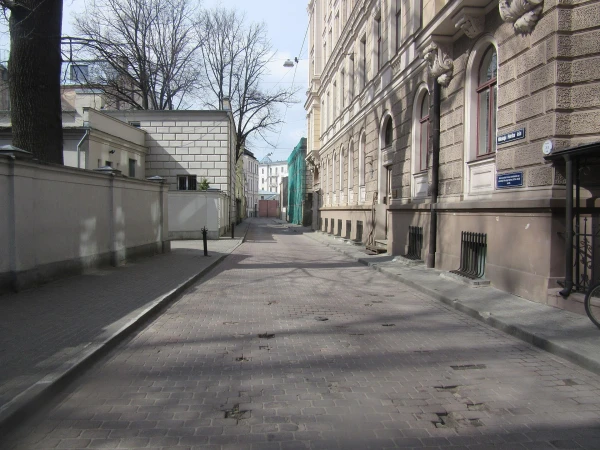
Imagine a taxi driver from a sunny Asian country who needs to take a client to Old Riga. He inputs the name — Katolu into the navigator, and as a result, instead of Old Riga, he arrives at the Latgale suburb. Because after the renaming, it will turn out that we will have two streets — only one "iela," and the other "gatve"...
Recently, your author spoke with historians from the Center for Public Memory regarding the names of Riga's streets. In fact, the mass replacement of capital city street names is still in its early stages. Everything indicates that the city authorities have now decided to slow down this process.
The Center for Public Memory consists of scholars, whose previous workplace was the Special Interdisciplinary Commission for the Study of Documents of the Committee for State Security in accordance with the Law on the Preservation and Use of Documents of the Former Committee for State Security and the Acknowledgment of the Fact of Cooperation of Individuals with the KGB (this is the full name).
Testimonies of the Era
Master of Sociology and Political Science Didzis Shenbergs noted that in the late 1980s, when historical street names began to be restored in the Latvian SSR, the then opinion leader, Academician Janis Stradins, led a working group that rejected the return of "religious" names. Except for Baznicas, Krustabaznicas, and Baltasbaznicas!
Therefore, D. Shenbergs believes that today it is necessary to restore the streets of Reformatu (currently Alksna), Katolu (Polu), Debesbraukshanas (Meness), and Svetcelnieku (Celnieku). The latter was "renamed" in the early 1960s, during the race to possess the Moon, in which the USSR was once a leader. From the "cosmic" names, it is proposed to free Riga from Andromedas gatve — renaming it in honor of Veronika Strelerte, a poetess who published in exile, and the wife of the famous historian of the "trimdya" Arveds Schwabe.
In connection with similar indicators — adherence to socialist realism, it has been proposed to change the names of the "writers'" streets — Anna Sakse (to become Herman Braun), Sudrabu Edjus (Kristofa Firekera), and Mirdza Kempe (Martina Braun). All these little streets are located in Mezaparks.
Another street associated with the USSR is Paula Leinya — in Zolitude. The famous Latvian agronomist was the Minister of Education in the puppet government of Augusts Kirhensteins in 1940. However, this can be viewed as activity in the role of a "wedding general." It is equivalent to how Mr. Leinysh was involved in the Land Committee of the Baltic Duchy in 1918 — a planned unification of parts of Latvia and Estonia by Berlin. By the way, two outstanding architects — Eizens Laube and Konstantins Pekshens — also shone there. What can I say, it was such a time!
From Old Believer to Legionnaire
Communication with various factions of the Riga City Council revealed discrepancies with the proposed list. "We do not think that we should support the street of General Bangertskis," D. Shenbergs assessed the counter-idea of the National Alliance.
The Occupation Museum sent a letter stating that it is also not worth renaming Rusas street — to Vila Januma. The brave colonel served in 4 armies, the last of which, unfortunately, was the Waffen-SS legion. Your author pointed out to the historians that respect should be shown to the Bulgarians — after all, they are in the EU and NATO. To which the response was that the city of Ruse was specifically "Russified," and was originally named in Turkish — Ruschuk.
In general, historians from the Center for Public Memory themselves "made great efforts" to defend such names as the "Old Believer" streets of Teodora Samanskogo, Grebenshchikova, and Sadovnikova.
– There were representatives of the National Alliance and "New Unity" who suggested removing all Slavic street names in Riga, D. Shenbergs reminded.
It was also necessary to explain to politicians that Rusova street (known to many due to the location of the State Revenue Service on it) has no relation to the Slavs. It was named in 1902 in honor of the Baltic-German chronicler of the 16th-17th centuries, compiler of the Livonian Chronicle!
Doctor of History Karlis Kangeris, who has lived almost his entire life in emigration, refers to the preamble of the Satversme: "names associated with communism need to be changed."
– To introduce a system, order. We held three conferences with the Riga City Council, where these issues were explained in detail in long reports. We do not decide — we only advise. It was problematic to connect with cities and parishes outside Riga. We heard various arguments — for example, there is no money.
According to K. Kangeris's calculations, experts recommended changing 140 street names throughout the republic — so far, new/old names have been adopted for about 50.
From Working to Factory
Your author reminded the esteemed scholar — who personally knew the emigrant historian Uldis Hermanis, that he, back in 1967, came from Sweden to the Latvian SSR to obtain archival materials about the red Latvian riflemen, including Yukums Vacietis. Now the name of the first commander of the Red Army is to be removed from the street sign in Plavnieki. But after all, the commander of the II rank was illegally repressed during the years of the cult of personality, just like the constructivist artist Gustav Klucis, whose street is also to be removed!
– There is not a single building there, D. Shenbergs justified. It was named after Klucis because, in the early 2000s, there were plans to build a Museum of Contemporary Art in the Skantes area, but something went wrong...
The decommunization of names sometimes looks quite anecdotal, for example, changing Darbu (Working) to Fabrikantu (Factory)! But is the concept of labor in the current social formation no longer relevant?
But Didzis Shenbergs is also not thrilled with excessive zeal in the field:
– In Jelgava, they renamed Prokhorova street, although he was a railway engineer who sacrificed his life saving people during a train disaster.
We Reached Rerikh
Your author pointed out that in some cases, it concerns streets with truly thousands of residents — such as Andrei Sakharov (to be renamed in honor of poet Karlis Skalbe), who is not favored because he invented thermonuclear weapons for the benefit of the Soviet military-industrial complex. Just like Friedrich Tsander, the author of the patent for the winged missile (1924) and the liquid oxygen kerosene rocket engine (1933).
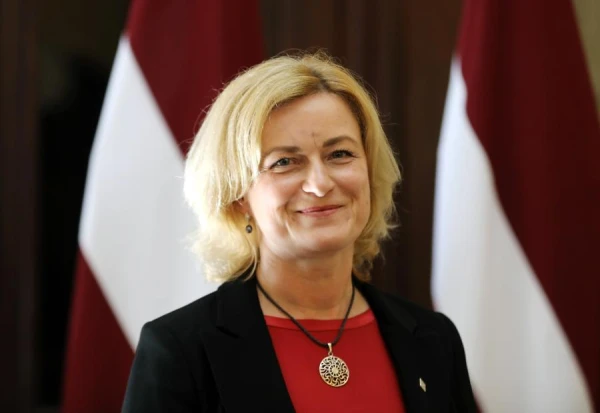
Kristine Yarinovska pointed out in this regard that in the case of changing street names, their residents will not have to spend money on obtaining new documents. In general, while this series of renaming is on the agenda of the Riga City Council — it is not worth it. Maybe after the Saeima elections!
But in general, there is no need to rush, they removed the street of Kijevas from the map in the early 1990s — and how relevant it would be now...
...Already after the meeting with representatives of the Center, your author discovered a new email from Mr. Kangeris. In it, he urged to name a street in honor of the former chairman of the Saeima of the First Republic, social democrat Pauls Kalnins. But instead of which? It is proposed to remove a small alley named in memory of the famous enlightener, philosopher, and artist — Nikolai Rerikh.
CEMETERY
_Lawyer Kristine Yarinovska also pointed out that many of our compatriots have misunderstandings regarding the familiar name of the Pokrovskoye Cemetery: "Who is Pokrov?"

Leave a comment