

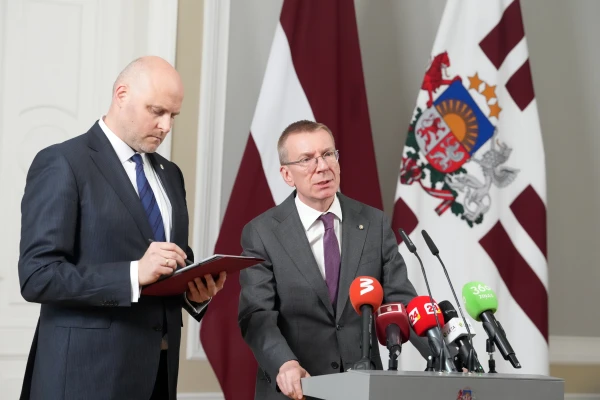
The current president of the country set records for legislative activity during the first half of his term as head of state — he sent a total of 17 legislative initiatives to the Saeima! In this regard, Edgars Rinkēvičs surpassed all his predecessors.
However, in the column "sending the law for reconsideration" there was... a dash! Yes, in almost 2.5 years in the presidential post, Rinkēvičs did not find a reason (grounds) to reject any of the laws adopted by the parliament.
I Return Your Law...
But everyone understood that at some point "the Rubicon would be crossed" and this happened in November of last year — it is symbolic that the first law returned by Rinkēvičs to the Saeima was the one that caused so much noise not only in Latvia but also beyond its borders, the law on withdrawal from the Istanbul Convention.
The current president reminded of hockey players who may not score goals for a long time, but once they finally do, they cannot be stopped. If for 2.5 years Rinkēvičs did not return laws, then now in two months the head of state has already managed to "wrap up" as many as 4 laws! Apparently, he has gotten into the groove.
Thus, in December, Rinkēvičs sent a law regarding the road toll for trucks weighing from 3 to 3.5 tons back to the Saeima for revision.
In the new year, the president decided to continue this practice and within a week returned as many as two laws:
-
first, the head of state refused to proclaim amendments to the law regulating the procedure for compensation for unjustly seized property;
-
and then the head of state rejected the amendments to the Education Law.
Thus, in terms of the number of laws returned to the Saeima, Rinkēvičs has already surpassed his predecessor Levits, who during his entire presidential term, that is, over four years, dared to return only 3 laws to the parliament.
Object Only Once
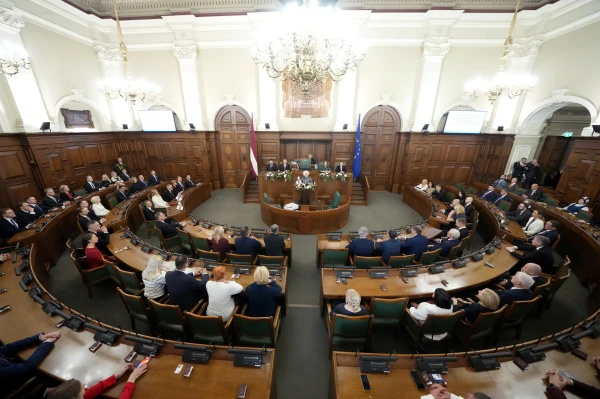
It should be noted that although the president in a parliamentary republic has rather limited powers, nevertheless, the head of state is endowed with the right not to proclaim laws adopted by the Saeima if there are valid grounds for doing so. This right is designated in Article 71 of the Constitution. However, this right is also limited by the same Satversme. Firstly, the president cannot reject a law if it has received urgent status, provided that at least two-thirds of the parliament voted for urgency. In other words, if at least 64 deputies supported the urgency of the law, then the president simply has to sign the law and that’s it.
In addition, the president can object to certain provisions of the law only once. If the deputies ignore this opinion of the president and vote again for the same articles of the law against which the president objected, then the head of state cannot return the law to the Saeima a second time.
Quickly Find Compromise
However, in the recent history of Latvia, there have been only a few cases when deputies actually ignored the will of the president. In the overwhelming majority of cases, parliamentarians either agree with the president's position and change the articles as proposed by the head of state, or an alternative (compromise) version of the law is developed.
If we take the current situation, the majority of deputies agreed to postpone the reconsideration of the controversial law on withdrawal from the Istanbul Convention... until the next Saeima session!
The deputies also agreed to temporarily not apply the toll for trucks with a total weight of 3 to 3.5 tons.
As for the third returned law, unofficial information suggests that the deputies are already ready to compromise — regarding the question of when exactly a person has the right to claim compensation for seized property.
At the next plenary session, the Saeima deputies will approve the reconsideration of amendments concerning remote learning — surely here too the matter will not come to "overcoming the presidential veto" and Rinkēvičs's remarks will be taken into account.
Elections Are Near...
What are the reasons for such "legislative rigidity" of the current head of state?
First reason – as the elections approach, deputies have begun to pay more attention to the election campaign than to the quality of legislative initiatives. Hence the result — the laws being adopted have become increasingly one-sided, that is, unbalanced and without taking into account the opinions of those affected by these laws. By returning laws for revision, Rinkēvičs shows parliamentarians that "this is not how to work" and the proximity of elections is not a reason to "cook up" low-quality laws.
Second reason – looking at which specific legislative initiatives the president has returned, there is a sense that the head of state is also thinking about a second presidential term and therefore is trying to maintain political balance regarding the returned laws.
Judge for yourself. The law on withdrawal from the Istanbul Convention was returned at the request of "New Unity" and the "Progressives" party. The second law — on road tolls — was clearly returned in the interests of the opposition and the Union of Greens and Farmers. It was a kind of slap in the face to the ministers of finance and communications (that is, representatives of "New Unity" and the "Progressives" party, respectively).
Under Pressure from Europe
If we recall the recent history of the presidency in Latvia, there were also situations when the return of a law was demanded not only by experts or the opposition but also by the international community!
The most vivid example is the Language Law, which was adopted a week before Vaira Vīķe-Freiberga took office as president — in early July 1999. At that time, the question was whether Latvia could claim EU and NATO membership in the foreseeable future. The representatives of the UN, OSCE, and the Council of Europe, as well as the leadership of the European Commission, which determined the prospects for our country's membership in the European Union, expressed extremely critical views on certain provisions of the law.
The July version of the law effectively prohibited any public information, including from private companies, in any language other than Latvian. There were bans on non-Latvian names for companies and enterprises. Any meetings, rallies, and other public events, whether by state or private companies, were required to be conducted in Latvian or provide translation.
It is clear that if this law were considered now, it would be adopted and proclaimed by the president in an even harsher reaction. But back then, 26 years ago, Latvia had to listen to Brussels and others, and the international situation was different...
In any case, Vaira Vīķe-Freiberga ultimately returned the law for revision, and in December of that year, a significantly more liberal version was adopted, which established language restrictions mainly for state and municipal structures.
Record Holder for Rigidity
Vaira Vīķe-Freiberga entered the history of Latvia as the toughest controller of Latvian legislation — during her first presidential term, she returned 18 laws to the Saeima! It is unlikely that Rinkēvičs will be able to "catch up" with the most popular head of the Latvian state in recent history in this regard.






Leave a comment