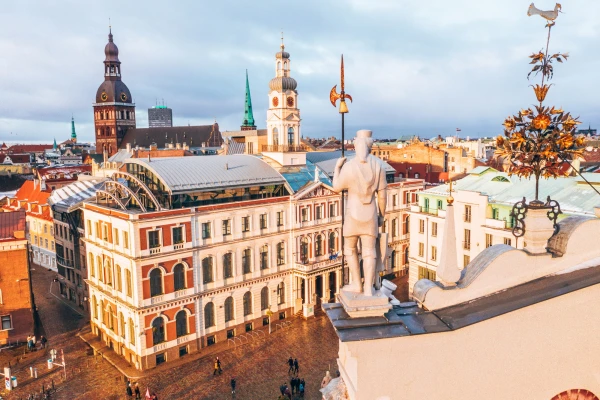
Next week, on January 21, the Riga City Council will begin reviewing the main financial document for 2026 – the city budget.
It is already possible to predict that the hearings will provoke a wave of criticism from the opposition. Although in the expenditure plan, the capital – the largest generator of Latvia's GDP – does not bear as significant non-productive burdens as the state as a whole. Social welfare and education, of course, play a significant role in the city treasury's spending – but there are no expenditures on defense (excluding civil defense).
What does the city leadership envision for its economic component in the near future? This is addressed in the updated Riga Long-Term Development Program until 2030.
When analyzing the ratio of money received and spent, it immediately stands out – in recent years, Riga's budget has ceased to be surplus. No matter how much Mayor Nils Ušakovs is currently criticized, in the year he completed his term (2019), the capital's revenues amounted to €1,011.7 million, while expenditures were €972.1 million. The first year in which the budget was fully formed under the leadership of Mārtiņš Staķis – 2021 – showed €984.8 million in revenues and €960.2 million in expenditures. Modest, but still decent.
However, 2024 under Vilnis Kirsis embodies living in debt: with significantly increased revenues, up to €1,399.9 million, expenditures amounted to €1,433 million.
Here, an explanation can be found at the micro level – money is lent to those who... earn it. If a bank clerk sees stable income on your statement, they assume that you will be able to repay a mortgage loan at a reasonable interest rate. On the other hand, they cannot be informed that you have already taken out a couple of loans from microfinance organizations for the latest iPhone and English language courses.
As priorities for the sharp increase in spending in our capital, the education sector stands out – from 2023 to 2024, the budget for it increased by 15%. The next non-productive area was social protection – 13%. Slightly less, but still increased, were the funds allocated for recreation, culture, and religion – 12%.
All these payments have a very high reputational potential and contributed to the popularity of the curators of these financial transfers. Is it any wonder that the mayor is the one responsible for social welfare, Viesturs Kleinbergs, and the vice-mayor is the organizer of public education, Edvards Ratnieks...
Yes, there is also a small item in absolute figures – security. €27.4 million was spent on it. But, firstly, this is four times more than on environmental protection. And secondly, it is 21% more than the previous year, highlighting the concerns of the city leadership about creating their own security forces. Do they not trust state law enforcement and their own residents?
Meanwhile, the funds directed by Riga to the real economy decreased by 2% over the same period. In principle, even the €313.4 million allocated to the capital's entrepreneurs could have been used to build a couple of tech parks based on industrial wastelands – take, for example, Bukultu or Tvaiku streets. Everything is there – solid buildings (even if with broken windows), a railway, and a port within walking distance. But we are not Valmiera and not even Daugavpils...
Income taxation is the main financial resource for municipalities. Here, Riga, with its €1,308 collected in 2024 from the average resident, looked modest compared to the municipalities surrounding the metropolis: Mārupe County – €1,777; Ādaži County – €1,519; Ropaži County – €1,443. For comparison – the city of Jūrmala only €1,215.