
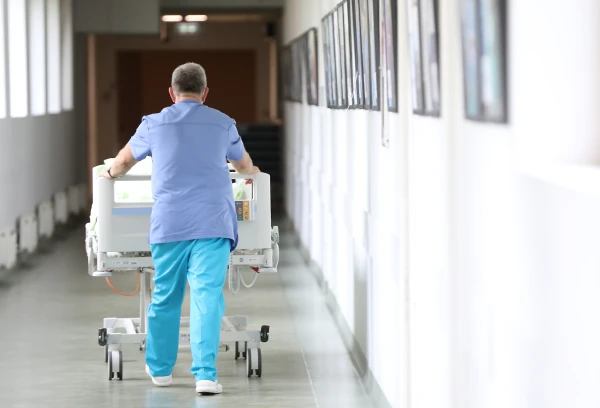
Recently, colleagues from the Latvian TV news service summarized information about the longest queues for receiving medical services by quota, that is, at the expense of the state. The result is disheartening!
And the Years Fly By...
In Latvia, there are healthcare services for which patients have to wait not days or months, but years in certain medical institutions, and there are 12 such institutions with record-long waiting times,” reported the Latvian TV news service. Data from the National Health Service shows that the longest queues are for knee and hip joint prosthetics.
For instance, to get into the Madona Hospital for dynamic monitoring after knee joint endoprosthesis, one must wait 396 weeks, or more than 7 years and 7 months. On average, this service has a waiting time of 4 years across the country.
Currently, there are 5,346 patients waiting for knee joint endoprosthesis, the highest number of those awaiting this procedure. On average, to receive this operation in one of the nine hospitals that perform it, one must wait two years and one month.
Latvian TV also summarized the institutions where one must wait the longest for state-funded examinations, but this does not mean that it would not be possible to receive it sooner elsewhere.
Leading the list is electromyography, which assesses the health of muscles and nerves. If one needs this service at the “Aura-R” Health Center in Riga, one should be prepared — while the average waiting time for this examination across the country is one and a half years, at this center it is over 12 years. However, for example, in Daugavpils, this examination has a waiting time of less than a year.
Similarly, several ultrasound and Doppler examinations of the vessels of the head and neck at Riga 1st Hospital. On average, for these state-funded examinations, one must wait about six months, while at Riga 1st Hospital — 3 years and 8 months.
And How Long Does One Have to Wait to See a Specialist Doctor by Quota?
The longest waiting times are for rheumatologists and gastroenterologists — on average, for a state-funded visit, it takes 8-9 months, while in Riga 1st Hospital and the “Aura-R” Health Center in Riga, it is over 4 years.
In many regions, patients also have to wait quite a long time to see cardiologists, allergists, and endocrinologists.
There Will Be No Miracle
Miracles do not happen, especially considering that in the 2026 budget, the healthcare sector did not receive even a third of the required funds, and queues will only continue to grow. However, representatives of the Ministry of Health have certain hopes for the electronic health system, that is, for the digitization of data in the healthcare system. Yesterday, the members of the Saeima Social Affairs Committee were introduced to the proposed electronic solutions.
From now on, all referrals to specialist doctors will be issued by family doctors only in electronic form — this will make the referral system to doctors more convenient (patients will not need to specifically travel to the clinic for a paper referral), and most importantly — it will eliminate the duplication of appointments with doctors. After all, today, patients often make multiple appointments with the same specialists, all within the quotas. As a result, other patients cannot quickly see a doctor, while the quotas, in the meantime, run out.
To improve the quality of medical services and ease the workload on medical staff, the e-health system is accumulating more and more data. Currently, the system has already collected 1 million electronic sick leaves, 15 million electronic prescriptions, 1.7 million visual diagnostic data (ultrasound, X-ray, fluorography, etc.), and 4.7 million laboratory test results.
This is all, of course, wonderful, but again, without additional appropriations, it will not be possible to increase quotas, that is, the availability of medical services at the expense of the state, and it is also hardly possible to significantly reduce queues solely through electronic solutions.











Leave a comment