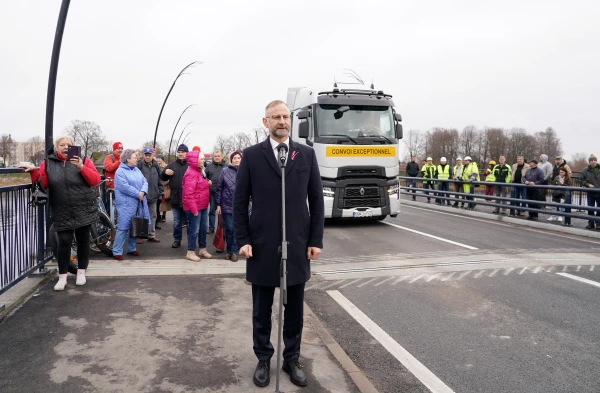
Last week, Minister of Transport A. Švinka ("Progressives") achieved a Pyrrhic victory — he barely managed to stay in his seat, as 45 votes were cast for his resignation in the Saeima, 47 against, and 1 parliamentarian abstained.
At the same time, both lawmakers and the head of the ministry voiced a number of theses that had not previously appeared in the public space...
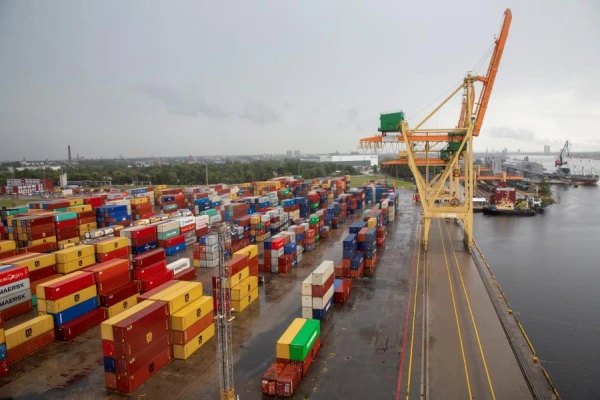
"The 15-Million Barter of the Ventspils Port"
Deputy Linda Liepiņa accused the Ministry of Transport of bribing coalition partners. "Instead of taking responsibility for your inaction, you are blackmailing specific carriers and ports," she reproached the minister.
Independent deputy Viktoria Pleškane took bus transport as a topic, for which a request was made to the A. Švinka ministry:
– The ministry hides its response behind beautiful terms — mobility, optimization, first and last mile solutions. In reality, people in Latgale will have to cover kilometers to reach a stop. Some routes will simply disappear. And transport on demand is not a real solution in places where there is not even a proper road network or internet. This is not a modernization plan. This is a plan for dismantling public transport… This is a fictitious solution.
Does Latvia Need Electric Buses for 36 Million Euros?
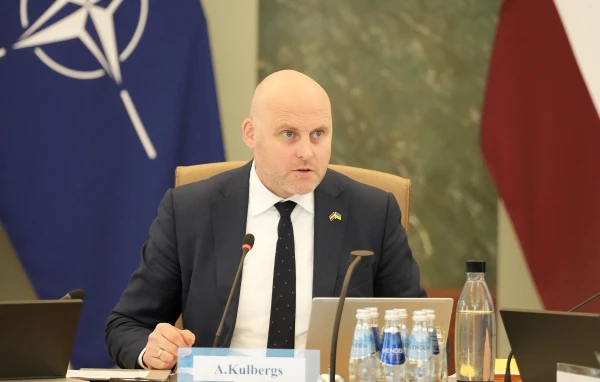
Andris Kulbergs ("United List"), who continues to lead the Latvian Automobile Association while working in parliament, supported the opposition's demands:
– People are leaving. The solution here must be state-driven. This cannot just be a question of money... and thus return these regional routes. This regional coverage and these routes threaten that we will lose even those carriers who are still conducting this activity. A similar situation can arise with builders. Yes, the builders' cartel was caught, but we are losing developers in this way — there is no one and nothing to build. And the same can happen with regional routes. We need to impose fines and demand severe penalties for those who deceive. If there are signs of a cartel, they should be punished. But we cannot destroy these enterprises because we need those who transport.
"The Ministry of Transport wants to provide this passenger transport service through the Road Transport Administration by purchasing electric buses for 36 million euros, which the state would acquire, while competing with commercial enterprises. And not only would it buy these electric buses, but it would also hire drivers... Increasing state participation in the economy again is madness."
"It is clear that a system is needed for this — a dispatch center, how to deliver these vehicles to the person who needs transport. It is clear that there will be downtime. Obviously, this will not be a busy service. And if we buy electric transport, it is about 7,000 to 15,000 euros more expensive than diesel transport..."
According to A. Kulbergs' calculations, for the electric platform to pay off, it needs to travel 25,000 km per year, which "it will not achieve in any version."
"This Year, a Record of 20 Million Passengers Has Already Fallen"
This was stated in defense of his colleague, the minister, by his predecessor, Kaspars Briškens ("Progressives"):
– New, modern railway stations with high platforms and park-and-ride facilities are being created... with different safety and accessibility equipment. And this is our strategy, which the minister mentioned (we call it station 2.0), this is the new standard for multimodal stations with over 80 million investments from the European Union. At the same time, the project is aimed at municipalities, where more hardworking, initiative-driven individuals can indeed receive funds to bring the infrastructure of these approaches to railway stations in order and create railway stations as a broader center for both mobility and service provision in a specific district, not only in Riga but everywhere in Latvia, including Latgale.
The Riga unified ticket was also credited to the Ministry of Transport: "For years, no political force has been able to achieve this agreement between Pasažieru vilciens and Rīgas satiksme. At this moment, it has been done." According to K. Briškens, reducing routes and introducing a transport-on-demand system is correct, as "there is no need to send a 40-seat bus for two passengers."
Juris Vilyums ("United List") countered that residents of Krāslava have only one train a day that can take them to Riga. Otherwise, it is only through Daugavpils, and "we need to call on artificial intelligence for help to find compatibility — what time to arrive in one city and when there is an opportunity to catch the next public transport." The yellow-black Vivi trains do not help in a situation where all public transport is cut by 16%.
"What is airBaltic in the Context of the Baltics?"
The issue of the aviation industry was raised by deputy Amil Salimov, who pointed out that there are "still no solutions or directions visible here." Air transport is not integrated into the overall transport system, just as the idea that Rail Baltica will become the backbone of national transport remains a declaration.
Regarding funding, the Ministry of Transport hopes to receive tens of millions of euros from the Social Climate Fund to ensure the infamous "transport on demand." The deputy is quite skeptical that most of the pensioners for whom this service is intended have the appropriate devices and will be able to call for transport in the same border area where there are also communication problems. By the way, mobile network coverage is also the competence of A. Švinka's ministry.
Former Minister of Economics, now deputy from the National Alliance Ilze Indrikson, provided shocking examples — according to the reform from the Ministry of Transport, in the southern part of Kurzeme (former Liepaja district), 65 bus routes have been cut; in the Cēsis region — 43, in Madona — 40.
And A. Švinka gave an extensive speech listing achievements, which summed up his business philosophy: – Colleagues, to be honest, I trust the applications that have already been invented. And should I really question what already works in Germany, France, Ireland, Switzerland? It seems to me that we should trust and move forward faster, and not waste extra money.