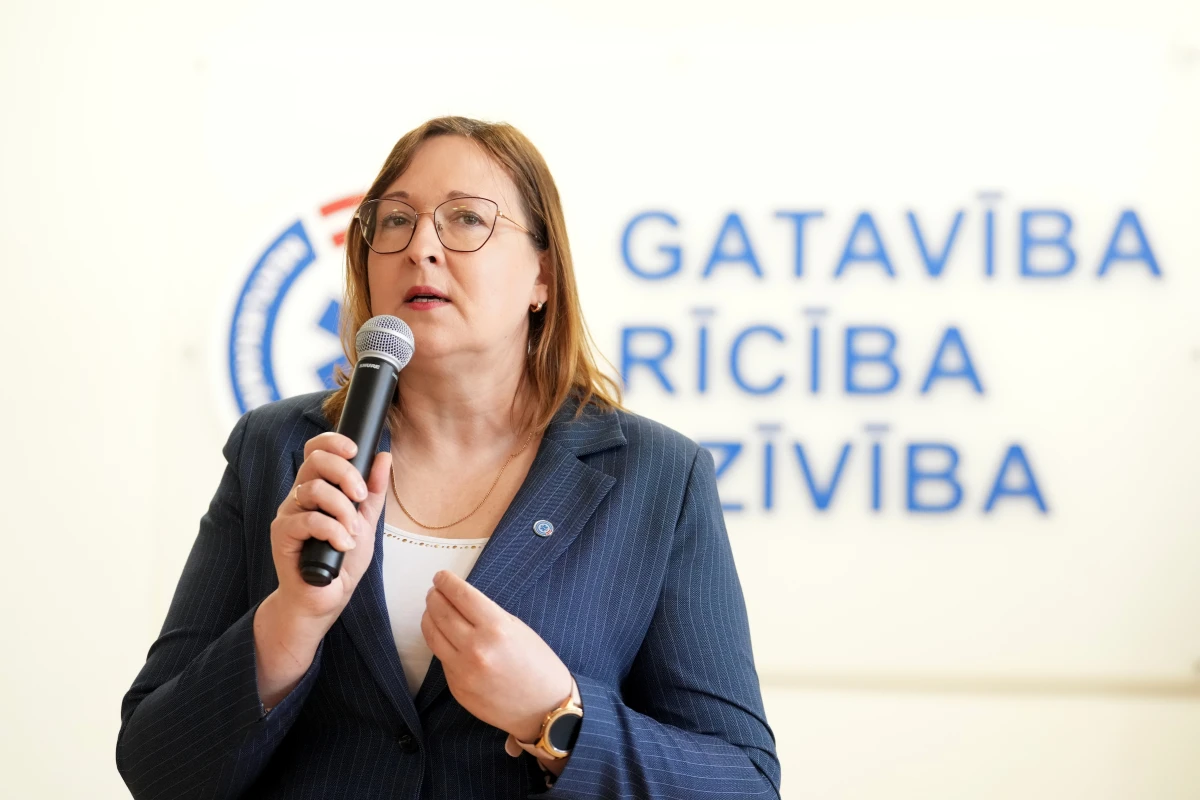
Head of the Emergency Medical Service Liene Cipule is skeptical about the prospects for a quick resolution to the problem of ambulance car queues at the emergency department of Stradins Hospital. According to her, the situation has existed for many years and continues to seriously affect the work of emergency medicine.
The issue of ambulance car queues at the emergency department of Pauls Stradins Clinical University Hospital remains one of the most pressing in Latvia's healthcare system.
Head of the Emergency Medical Service (EMS) Liene Cipule admits that she does not feel very optimistic about a quick improvement in the situation.
"There is still no agreement on specific measurable indicators and deadlines for achieving them," she noted in an interview with the program "Morning Panorama."
According to Cipule, queues at Stradins Hospital have been a problem for several years. When crews are forced to wait a long time to transfer patients to doctors, it directly affects the service's ability to respond promptly to new calls.
In fact, each delayed ambulance temporarily falls out of the emergency care system.
One possible solution proposed by the EMS was to establish a standard: a patient should be accepted by the hospital from the ambulance crew within 15 minutes. However, this initiative has not yet received support.
"This makes me think that solving the problem will take a long time," Cipule acknowledged.
The problem is not only organizational but also systemic. According to the head of the EMS, some patients visiting the emergency department of the university hospital do not require such a high level of medical care. At the same time, there are effectively only two university hospitals in Riga that accept the most severely ill patients, so the burden on them remains very high.
After the recent outcry regarding ambulance queues, the Ministry of Health, representatives of hospitals, and the emergency service held a joint meeting and agreed to seek solutions.
During the discussion, several reasons for the overload of emergency departments were identified. Among them are insufficient accessibility of medical care at other levels of the healthcare system, an increase in the number of chronic patients, issues in the field of social care, and inadequate participation of regional hospitals in patient admissions.
Statistics show the scale of the problem. According to the National Health Service, in 2025, more than 665,000 patients passed through emergency departments and waiting rooms — 2.2% more than the previous year.
The greatest burden fell on university hospitals. However, hospitalization is required for only about one in three patients.
What is important to know: if two-thirds of visitors to emergency departments do not require hospitalization, this indicates that many residents are using emergency care as a substitute for more accessible medical services that are lacking in other parts of the system.
As solutions, authorities are considering increasing the number of therapeutic beds, more actively directing patients to hospitals of the appropriate level, expanding the network of on-call doctors, and developing remote consultations. Stradins Hospital also intends to analyze the internal processes of the Emergency Medical Center and, if necessary, involve independent experts.
However, even the participants in the negotiations acknowledge that this is not about targeted measures, but about the need to change the operation of the entire healthcare system.