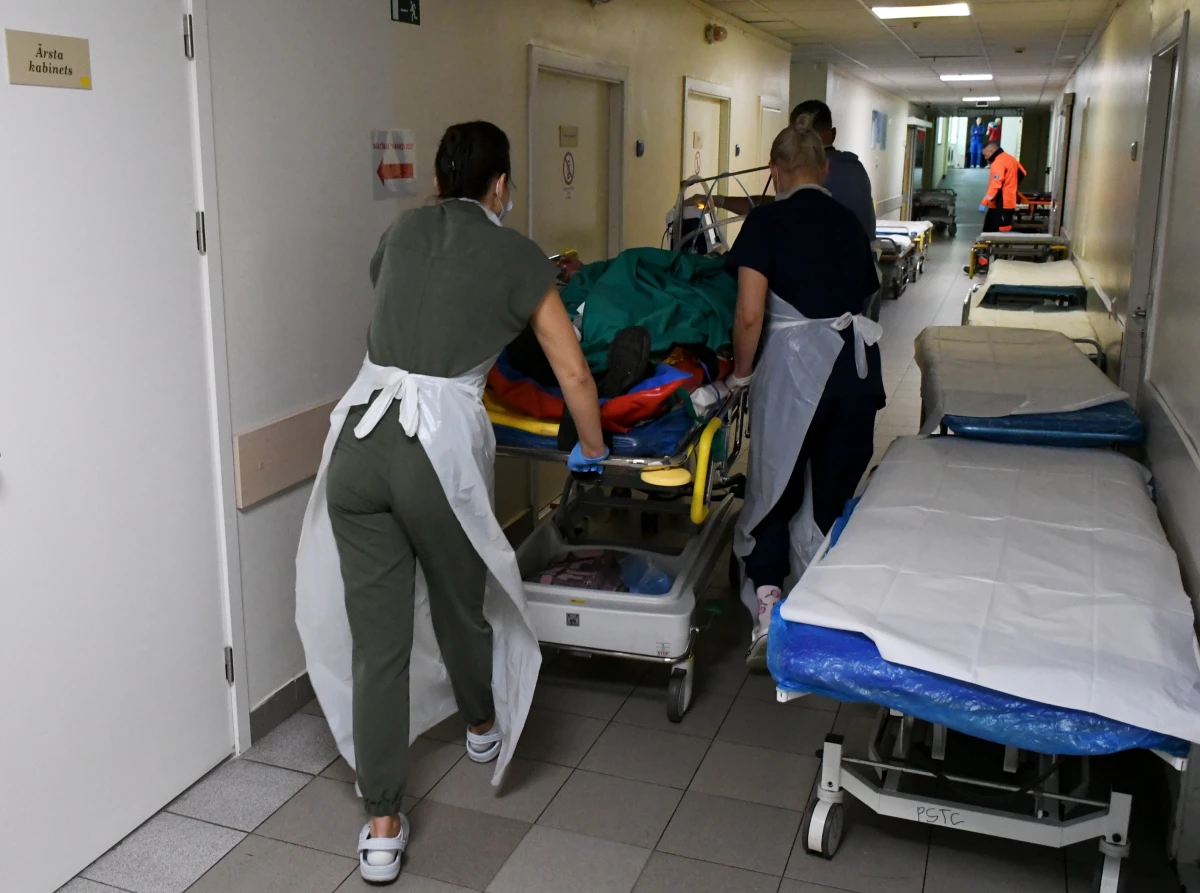
My wife's friend, a rather mature lady, took a decisive step in her professional life. She had always worked as a decorator – advertising, window displays, and so on. But now she gathered herself and completed a year-long nursing course!
And now she works in the operating room of one of the largest hospitals in the country. Besides the predictable heaviness of the work, to which she was morally prepared, there are also observations – a huge turnover of staff, primarily among junior personnel. It is quite realistic to find that several nurses and orderlies are missing after the weekend. The girls may just go out for a stroll, and they are completely unconcerned about the patients...
Those Who Have Will Be Stripped Away
As a result of all the governmental upheavals, our health minister remains the same Hosam Abu Meri from "New Unity." What should hospitals in the country, especially in a region with an aging population like Latgale, expect?
At a joint meeting of several Saeima committees, alarming trends were voiced: despite several years of "reforms," the availability and quality of healthcare services are decreasing in Eastern Latvia, emergency medical doctors are migrating to Riga and abroad, and the same trend applies to outpatient staff.
Meanwhile, all hospitals in Latgale are facing a significant "minus" this year – funding is being cut:
- by €1,545,356 for Daugavpils,
- by €1,215,820 for Preili,
- by €647,044 for Aluksne,
- by €638,344 for the combined Balvi-Gulbene,
- by €431,394 for Rezekne,
- by €160,158 for Kraslava,
- by €47,802 for the Ludza Medical Center.
In total, €4,658,918 is being taken away from the very region that has effectively turned into a frontline zone! And, most astonishingly, the budgets being cut are specifically for emergency departments. Where will wounded soldiers and civilians be taken in case of an emergency?
– There has been justified concern in many corners of Latvia, – acknowledged the chairman of the Saeima Committee on Long-Term Development, Uģis Mitrevics (National Alliance).
This year, this working body has already convened for the third time with colleagues from other committees to address medical assistance in the regions. "Questions remain," the politician admitted. Parliament must make a political decision – what to leave in the budget for 2027.
By the way, the reform under Abu Meri is aimed at 2029 – apparently, the minister intends to remain in his position for that long.
"Not All Hospitals Can Provide..."
The Ministry of Health, for its part, refers to objective factors. Yes, "the availability of services is uneven," "in practice, hospitals at the same level can provide different volumes..." The primary cause is, of course, the age structure of Latvia's population – over 22% of people are already over 65 years old. "There is an increasing need for treatment, rehabilitation, and care for chronic patients." "A team and equipment are needed for complex treatment."
Thus, it turns out that "there is a shortage of medical personnel," "not all hospitals can ensure the presence of the necessary specialists around the clock."
Therefore, in Latvia, a three-level hospital system is being built instead of the current five-level one (which has existed for about 10 years). The highest level will be a multidisciplinary medical institution where teams of specialists will work 24/7, providing treatment across all major profiles: surgery, gynecology, pediatrics, etc., including complex cases. This includes 8 hospitals – from Stradins to Ziemelkurzeme (Ventspils) and Vidzeme (Valmiera).
Next will be regional hospitals specializing in surgery and traumatology, as well as acute outpatient cases. There are 7 medical institutions here, also with a wide geographical spread – from Madona to Kuldiga.
Finally, at the grassroots level, local hospitals will remain, providing round-the-clock emergency care, as well as patient admission, diagnostic studies, therapy, and treatment for chronic patients. They must have an on-duty doctor! One for all.
This category includes 12 hospitals, of which 6 are located in the East.
Medical Professionals Talk About Relocation
"Readiness for hour X," which Mr. Mitrevics has repeatedly mentioned, will thus be, so to speak, basic. However, Margers Zeitmanis, chairman of the board of the combined Balvi-Gulbene hospital, said he "does not know what the agreement was."
– I urge not to rush. We have many unknowns to make such a turn. Doctors, nurses, and patients are worried. Doctors are not sowing panic, but people are talking among themselves that they need to go to Riga, to Kurzeme, somewhere else. News about the reduction of cross-border funding is ill-considered!
"The Eastern bloc needs good news, – the doctor stated. – Not that we are taking something away, but that we are adding. This is extremely important."
So far, in Latgale and Northern Vidzeme, which belong to the Eastern border area, there is still no objective data on either demographics or electronic referrals to hospitals – i.e., factors that could explain why medical professionals are being deprived of funds.
Algorithm for the Patient
Deputies were informed about the procedure for local hospitals. According to the Ministry of Health, a patient must arrive themselves (brought by relatives) or be delivered by the Emergency Medical Service.
In the emergency department, a team (specialist doctor, nurse/doctor's assistant, radiography, laboratory) works with them, and primary stabilization is carried out. In milder cases, assistance is provided on-site – they treat, monitor, and provide care closer to home.
If specialized assistance is necessary, the patient is transported by medical transport to a regional or multidisciplinary hospital.
"Important: emergency departments will not be liquidated," the Ministry of Health reassures (yes, but they will only be left on a starvation diet!). Thus, in case of injury, suspicion of a fracture, the local hospital will only take an X-ray and stabilize the limb – but if surgery is required, the patient will be transported at least to a regional hospital. It is possible that they will go to a multidisciplinary one, "if there is a severe injury, multiple injuries, or a life-threatening condition."
In the case of signs of a heart attack or stroke – ONLY a multidisciplinary hospital, the local one can only stabilize and transport; the regional one – connect for planned treatment (if there is a corresponding cardiology profile).
Consequently, only 8 hospitals will remain throughout the republic that can actually provide all treatment profiles, and that around the clock. Interestingly, in the same Latgale, where local medical institutions are losing funds for emergency assistance, there are still 2 multidisciplinary hospitals – in Daugavpils and Rezekne; while in all of Zemgale, there is not a single one. Although the distance, for example, from the Vadakste municipality on the border with Lithuania to the capital is 120 km.