The commander of the National Armed Forces of Latvia, Kaspars Pudāns, acknowledged that serious investments in the country's air defense have only begun in recent years — after Russia's full-scale invasion of Ukraine.
After the incident with the drone in Latgale, the commander of the National Armed Forces, Kaspars Pudāns, stated that Latvia's air defense system is still in the process of strengthening. According to him, serious investments in air defense have only been made in the last three to five years — effectively coinciding with the start of Russia's war against Ukraine.
Pudāns acknowledged that the capabilities for detecting aerial threats in the country are currently unevenly distributed.
"Air defense units are primarily deployed with the aim of protecting the largest cities," the commander explained.
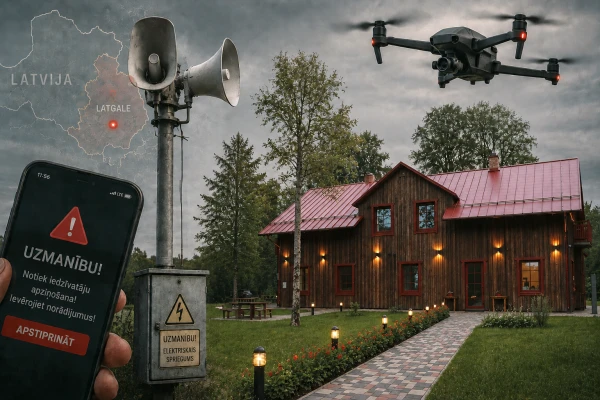
This is why situations like the one that occurred over the weekend are possible, when an unnoticed drone fell and exploded in Lake Drižģis in the Kraslava region.
This incident has once again intensified the discussion about Latvia's readiness to respond to aerial threats, especially in light of the war in Ukraine and the increasingly frequent sightings of drones near the borders of the Baltic states.
Pudāns noted that additional radars, more modern acoustic detection systems, and other technological solutions are necessary to strengthen Latvia's air defense system. According to him, the army will soon receive several new radars selected based on recommendations from the Ukrainian side.
The commander also reported that some of the means used by Latvia to combat drones are similar to those currently employed by the Ukrainian military. At the same time, Pudāns emphasized that Ukraine has only recently begun to share its developments and technologies more actively with other countries.
In light of recent incidents, the authorities in Latvia are also changing their approach to notifying the public. The National Armed Forces have begun to implement a system of warning levels, as mass alerts significantly affect not only the daily lives of residents but also the functioning of the economy.
Now, a so-called yellow warning level will be used — it will not require immediate action from the public but will serve as a signal of potential risk.
After several incidents involving drones in Latgale, the topic of air security is gradually becoming one of the key issues in public discussions about Latvia's national defense.