
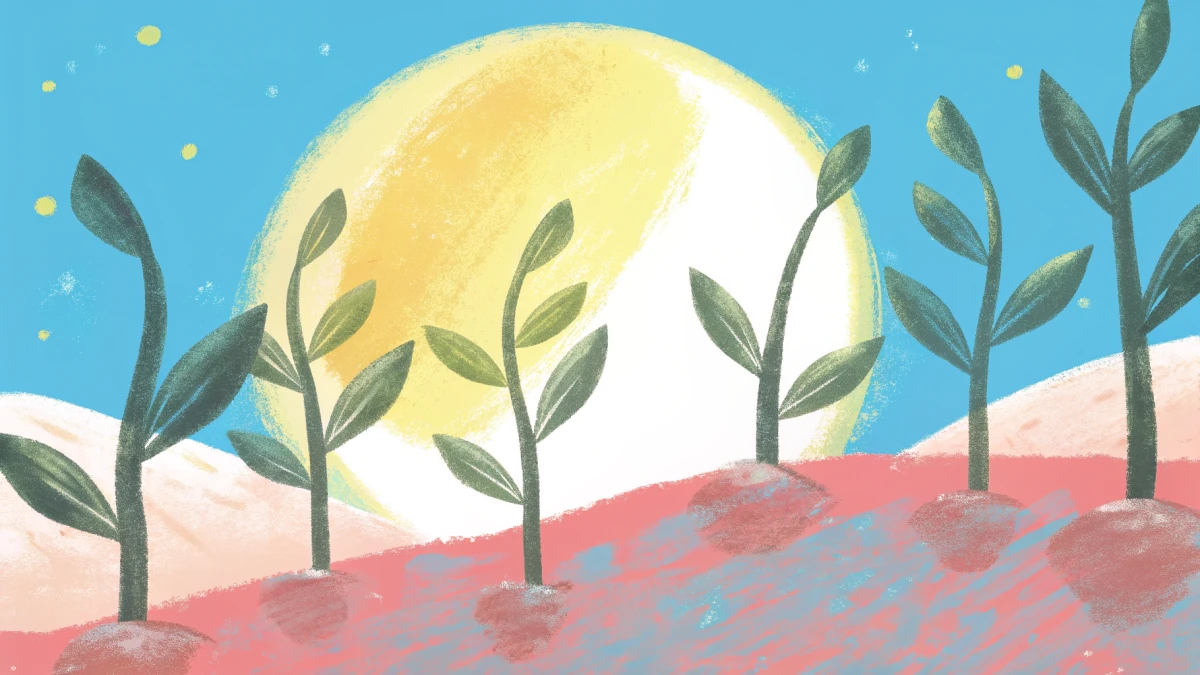
Where the idea that the Earth's satellite affects plants came from, and whether it is true.
Many gardeners and horticulturists in Latvia first consult the lunar calendar before planting crops. Entire tables of favorable and unfavorable days for various tasks are published online. People believe that the phases of the Moon will help grow a rich harvest, but scientists are skeptical about such calendars. What is the reason for their distrust, and is there any benefit to the lunar calendar? Let's find out.
How the Lunar Calendar Came About
The idea of coordinating agricultural work with celestial bodies is not new. Ancient people noticed that nature operates in cycles. Some researchers believe that prototypes of lunar calendars existed in the Paleolithic era — hunters marked seasonal migrations of animals in them.
The Roman scholar Pliny the Elder, in his "Natural History," advised digging up certain plants when the Moon was crescent-shaped. The Celts collected mistletoe on the fifth day of the new moon. Similar practices existed in Ancient Egypt, China, and among the indigenous peoples of America.
It is believed that the modern lunar calendar for gardeners traces its origins to Austrian philosopher and mystic Rudolf Steiner. In 1924, he delivered a series of lectures on agriculture, stating: "All living things on Earth are subject to the rhythms of the cosmos." Although Steiner did not directly mention the Moon, his ideas formed the basis of biodynamic farming — a system that takes into account not only the phases of the satellite but also the positions of constellations.
The first modern "lunar" calendar titled "Sowing Days" was published in Germany in 1963. It was created by Maria Thun — a practicing farmer from a peasant family. She noticed that radishes sown a few days apart grew differently. Thun linked this to the influence of the Moon and began conducting experiments: she sowed radishes every 15 minutes and then switched to other crops. Scientists criticized her methods as they did not meet strict scientific standards. However, farmers liked the calendar. "Sowing Days" began to be published annually in 35 countries around the world. It was first printed in Russian in 1994, and since then, lunar calendars have firmly established themselves in newspapers and magazines for gardeners.
Where the Idea That the Moon Affects Plants Came From
The strongest argument of lunar calendar supporters is the Moon's influence on water. Proponents say: the Moon causes tides in the oceans, which means it also raises the water level in the soil. During a full moon, when gravitational pull is stronger, water becomes more accessible to seeds. Additionally, moonlight (or its absence) also affects plants. Some gardeners believe that during a full moon, plants absorb nutrients better.
It is also believed that different phases of the Moon affect plant growth. The Earth's satellite sequentially goes through eight phases: from new moon to full moon and back. It is thought that during the waxing moon, the sap in plants rises, making it a good time to sow leafy crops and fruiting plants. Conversely, during the waning moon, energy goes into the roots — a time to plant carrots, beets, and potatoes.
What Scientific Experiments Have Shown
Spanish scientists from the University of Valencia decided to check whether lunar calendars have a scientific basis. They analyzed over a hundred works: scientific articles, university textbooks, and monographs. The results were published in the journal Agronomy.
The conclusion was unequivocal: there is no connection between the phases of the Moon and plant growth established by these sources. Arguments in favor of lunar influence lack clear scientific evidence.
Russian scientists also conducted experiments. At the Ural State Agricultural University, cucumbers were sown for several years on favorable, unfavorable, and neutral days according to the lunar calendar. For the purity of the experiment, seeds from the same batch were used, planted in the same soil, and cared for in the same way. The harvest turned out to be absolutely identical in all cases. The main role was played not by the phases of the Moon, but by scientifically justified sowing dates.
A similar experiment was conducted by authoritative agronomist Oleg Metlitsky along with his wife. They planted garden strawberries on days when the Moon was in the signs of Cancer, Pisces, and Scorpio. According to the lunar calendar, this promised a record harvest and excellent taste. However, the result depended solely on the weather. In a warm year, the bushes produced many large berries, while in a cold year, with a rainy May and June, the harvest was five times smaller, and half of the berries rotted — despite the "favorable" days.
Why Lunar Tides Don't Work in the Garden
Indeed, the Earth's satellite causes tides in the oceans. But let's look at the numbers. For the ocean, the effect is enormous because water is concentrated in a vast volume.
Take Lake Baikal, for example — lunar tides raise its level by only 2–3 cm. Water in the soil is even more dispersed: it is located between particles of sand, clay, and organic matter. The Moon is simply unable to noticeably shift it from there.
As for the water inside the plants themselves, it does not rise and fall within the stems and leaves. If this were happening, the sap would rise and fall every day, which would harm the plants. We would see them wilting and then re-filling in rhythm with the lunar cycle. Nothing of the sort is observed. For the same reason, we do not feel the Moon's influence on the fluids in our own bodies — the body simply does not notice such a weak influence against the backdrop of many other factors.
What Really Matters for the Harvest
Experienced agronomists know: the success of a garden depends on the weather and the right choice of varieties. No lunar calendar can replace these simple things.
But this does not mean that the lunar calendar is useless. It effectively disciplines gardeners and horticulturists. The main thing is not to expect miracles and especially not to abandon proven agronomic rules. Keep an eye on the weather, choose suitable local varieties, and water and feed the plants on time. That is what will truly help gather the harvest in the fall.








Leave a comment