

"The initiative to hold a referendum regarding the possibility of withdrawing pension savings is unlikely to gather the necessary number of signatures," said political scientist Lelde Metla-Rozentāle recently. Other experts unanimously state that the referendum on the right of residents to choose their savings will not come to fruition!
14 years without nationwide voting
It must be acknowledged that these pessimists have valid reasons to think so. Just consider this. First, the last referendum in Latvia took place... in February 2012, which is more than 14 years ago! It addressed the question of granting the Russian language the status of a second state language. Although the outcome of the referendum was predetermined (it was clear that among the citizens of Latvia, supporters of bilingualism are in a significant minority), the ruling authorities were very angered by such a democratic freedom and tightened the legislation, effectively depriving the people of the opportunity to initiate referendums. After all, gathering at least 152,000 signatures from voters is almost impossible!
Interestingly, over these 14 years, there have been 31 attempts to collect such a number of signatures for referendums on various initiatives! Different groups of activists collected signatures for a referendum on the dissolution of the Saeima and for amendments to the Constitution – in particular, to state that the Latvian state recognizes only two genders: male and female, and does not support artificial gender constructs.
Ironically, during these years, there were 4 attempts to collect signatures... for amendments to the Law on Nationwide Voting itself! The goal was to lower the minimum threshold of signatures required to initiate a referendum.
The law could not be softened
Interestingly, the undemocratic nature of the legislation regarding referendums was pointed out by former president and doctor of law Egils Levits. The current president, Edgars Rinkēvičs, even submitted a legislative initiative to the Saeima that would allow gathering not 152,000 signatures at the first stage, but 60,000 signatures.
However, the presidential proposal is currently stuck in the Saeima committees and, we dare to assume, will not be considered until the end of this term, that is, until the end of October.
Stay quiet
The second reason that has led experts to doubt the success of this "hopeless endeavor" is the overall political background and facts from recent history. As soon as the authorities feel that there is even the slightest chance of gathering the required number of signatures, a massive information and propaganda campaign is launched, which intimidates the people and discourages them from "getting involved in politics with their signatures."
What grounds are there to believe that this time will be different? Surely, this question has been asked by the organizers of the current signature collection themselves! Let's figure it out.
Reaching for the money
For the first time in the last two decades, signatures are being collected not in support of some political idea, political stance, or ideology (for example, for traditional families, the dissolution of parliament...), but to receive "real money" – from their savings in the second pension level.
Agree – this is a very powerful incentive to spend a little time and sign for the referendum.
Let’s recall: it is proposed to amend the Law on Funded Pensions, granting participants in the second pension level the right, if they wish, to partially or fully withdraw their savings from the second pension level even before reaching retirement age.
Protest referendum
Moreover, the collection of signatures for the referendum on pension money is perceived by many as a kind of protest against the policies of the current Latvian authorities – against an extremely unpopular government amid general dissatisfaction.
And there are more than enough grounds for discontent – high inflation, fuel prices, and all the recent scandals, including the Rail Baltic project that slipped past Riga, airBaltic consuming state millions, and drones flying unpunished in the skies of Latvia...
Is the people stupid and foolish?
The desire to sign is also heightened by various experts' statements that this is "not quite" the money of future pensioners, and that the people are foolish and stupid – just give them the opportunity, they will choose these pension savings, drink them away, eat them up, and then, upon retiring, will rush for social assistance.
Such a "dialogue" will definitely spur voters to support the referendum. In any case, the first days of the signature collection show that if this pace continues, gathering this number of signatures is quite feasible.
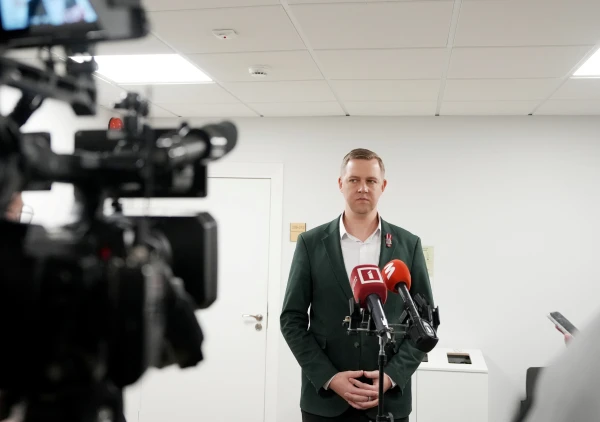
Another important factor is who is conducting the referendum: this time it is not just some initiative group or an extra-parliamentary party, but, according to ratings, the currently most popular political force "Latvia First."
And then the main thing will begin
Let’s assume that the required number of signatures is collected. What happens next?
In this case, the bill that has gathered the necessary number of signatures is submitted to the president, who sends it to the Saeima. If the Saeima rejects the bill or adopts it with amendments, a nationwide vote is scheduled – no earlier than one month, but no later than two months after the vote in the Saeima.
The nationwide vote takes place almost like elections – it is a closed vote by voters, who must mark either a "plus" in the "for" column if they support the bill, or a "plus" in the "against" column if they do not support the bill.
The Constitution states: "A bill submitted for a nationwide vote is considered adopted if the number of voters is at least half of the number of voters who participated in the last elections to the Saeima, and if the majority voted for the adoption of the bill."
In the last parliamentary elections, 916,594 voters participated. Thus, the bill will be adopted if at least 458,297 voters participate in the referendum and the majority of them vote "for."
As you can see, the road to adopting the bill in this way is long. But, as they say, the road will be mastered by the walking...
Neighbors
In Estonia and Lithuania, authorities have significantly softened the rules for residents' access to second pension level savings in recent years.
-
In Estonia, the reform came into effect earlier – from 2021. Residents were allowed to voluntarily exit the second pension tier and withdraw their accumulated money early. According to Estonian authorities and banks, a significant number of people took advantage of this opportunity: more than 1 billion euros were withdrawn.
-
In Lithuania, a similar reform was approved by the Saeima in 2025 and began to take effect in 2026. Now Lithuanians are allowed to withdraw 25% of their savings at once, and in case of serious illness, they can withdraw the entire amount. A special "exit window" is also in place for 2026–2027.
In the first three months of 2026, 500,000 to 580,000 people (almost 40% of system participants) decided to withdraw their money.









Leave a comment