The head of the capital's Urban Development Committee criticized plans to introduce a charge for entering the center to create a low-emission zone.
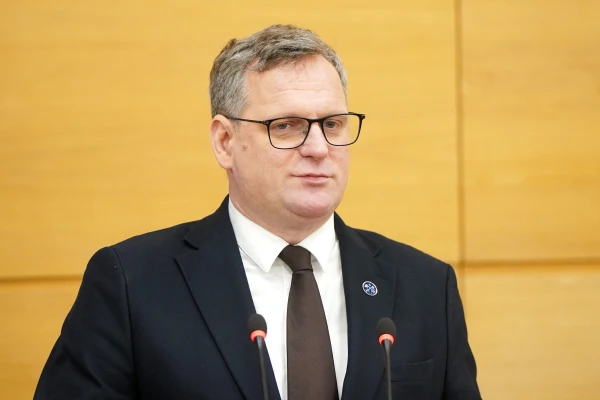
Initial developments regarding the introduction of a low-emission zone in Riga mainly involve the implementation of a charge for entering the central part of the city and are not applicable for further advancement of the project, believes the chairman of the Riga City Council's Urban Development Committee, Edgars Bergholcs.
As reported to the LETA agency by the Riga City Council's external communication department, the committee head promises to conduct an additional assessment of the project for introducing a low-emission zone, as he believes that the proposed scenarios are primarily aimed at increasing the city budget rather than reducing the number of cars in the city and improving air quality.
The alternative scenarios for establishing a low-emission zone in the case of Riga, developed by the Riga City Council's Urban Development Department and Ernst & Young Baltic, would effectively mean the introduction of a charge for entering the city rather than targeted solutions for improving air quality, explains Bergholcs.
"It is obvious that sufficiently accurate calculations have not been made. I believe this is yet another municipal project where funds may have been wasted during its implementation," stated the deputy.
So far, €253,616 has been spent on the research for the project, and more than €155,000 has been reserved for the development of an action plan; however, no assessment of the financial impact of the planned traffic restrictions on all involved parties has been conducted, funding sources have not been identified, a plan for using the revenues has not been developed, and the impact of other municipal projects on traffic intensity in the city has not been analyzed, emphasizes Bergholcs.
"The project is presented to the public as a successful solution for improving air quality; however, its benefits are exaggerated, as in many places around the world, such zones have not yielded the expected results," noted the committee chairman.
International experience shows that charges primarily reduce traffic intensity, while improving air quality is a secondary effect.
"In other cities, revenues are directed towards specific urban development goals, such as public transport or road infrastructure construction as an alternative to private cars; however, Riga does not have such a plan," added Bergholcs.
Speaking about alternatives, he emphasized that reducing traffic jams in Riga is a matter not only at the municipal level but also at the state level, and it should be addressed by both parties. For example, if the Riga bypass project were implemented, transit traffic and congestion in the center would significantly decrease, which is the main goal.
Bergholcs stressed that alternative solutions are needed to reduce transit flow, which could be provided by projects such as the construction of a bypass road and the Northern Intersection, rather than new charges and additional burdens on drivers and Riga residents.