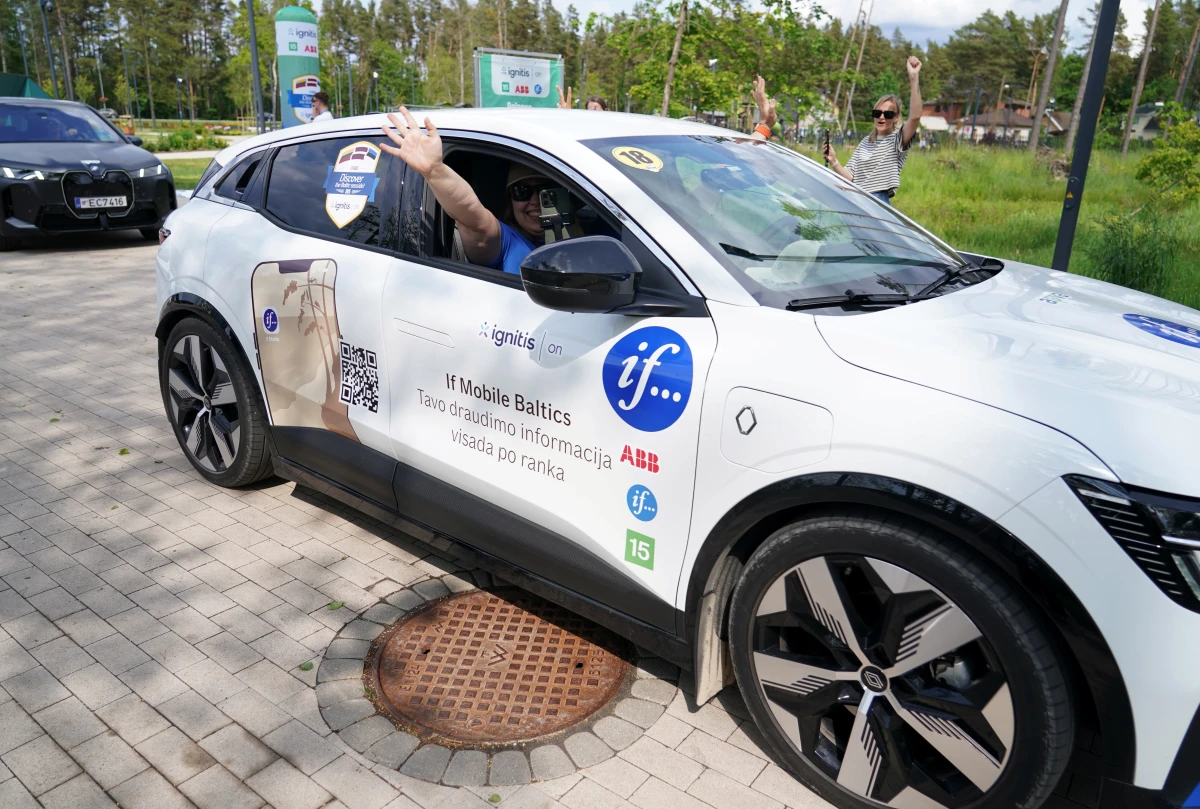
If you think about it, almost every one of us has driven an electric vehicle at least once in our lives. "Those who are older..." surely remember that in old amusement parks, there were cars connected to the power grid, which were so much fun to bump into. It turns out that now we are at about the same level, only the current collectors are now connected to the state budget and EU subsidies.
Increase the share of "green" transport to 29%
Recently, another Iranian-American ceasefire coincided with my weekly refueling ritual – and for the first time in a month, diesel cost less than 2 euros per liter. But this, of course, won’t last long...
In any case, the war in the Persian Gulf is one thing, and the EU's plans are another! There are only 4 years left until the cherished goal, as Brussels has ordered a reduction in greenhouse gas emissions by as much as 55%. Two years ago, a special National Climate and Energy Plan was adopted for Latvia. In particular, by 2030, it is planned to raise the share of non-emission transport in the republic to 29% (not only electric but also hydrogen vehicles, which emit pure water vapor!).
Currently, transport in Latvia produces 31.4% of all emissions; 97% of these come from cars (the rest are airplanes, trains, ships). The average age of a local car is 13 years. It seems that a car is definitely not a luxury, but "transport poverty," i.e., difficulties with mobility, affects 243,000 households in the country.
To achieve the desired decarbonization – i.e., a transition to transport that does not emit into the atmosphere, Latvia needs to invest, initially, 2.9 billion euros. This is slightly more than military spending for 2026. Funds from the aforementioned amount have already been utilized by 41%, although, as noted in a recent report by the State Audit Office of Latvia, "limited funding has been redirected to other activities without affecting the goals for 2030." In particular, over 100 million "climate" euros have already been spent on Rail Baltica.
The main conclusion drawn by the auditors: "Achieving climate goals in the transport sector is at risk!"
The complexity also lies in the fact that all civil agencies related to the economy of Latvia – a total of 7 ministries – are trying to carve out their share from the EU's "green course."
From 2028, it’s better not to visit traditional gas stations
For anyone considering a change in means of transportation to electric transport, it should be noted that in 2 years, the EU ETS 2 (Emissions Trading System 2) will come into effect in Latvia – a new EU directive establishing a charge on CO2 emissions from fuel used in road transport and – most importantly! – for heating buildings. So, even if you purchase a small electric vehicle, the state will somehow extract that same money through utility bills...
For the years 2026-2032, a whole range of activities has been announced under the so-called Latvian Social Climate Fund. In particular:
-
Transport on demand to remote rural areas – 36.6 million euros;
-
Support for the purchase of non-emission and low-emission vehicles for social and medical services – 28.1 million euros;
-
Support for the purchase of electric vehicles for vulnerable households – 70 million euros;
-
Development of micromobility – 26 million euros;
-
Support for the acquisition of technical aids for vulnerable groups – 15 million euros;
-
Improving accessibility to railway stations – 1.5 million euros;
-
Support for battery electric trains – 39.6 million euros.
Thus, a total of 216,777,903 euros will enrich the population through EU funds along the lines of the "green agenda." Let’s see if this can eradicate the so-called "transport poverty," when a car is available, but there are no funds for fuel, it hasn’t passed technical inspection, it stands and rusts in the countryside, and disposing of it also costs quite a bit...
Growth – 21 times
Such a crazy boom has been shown by electric vehicles from 2020 to 2025. At the beginning of the decade, there were 658, now about 14,000, and by 2030, they promise 20,000.
This will require investments of 600 million euros, including private ones. By the way, owners of hybrid cars, which, although partially, still use internal combustion engines, will have to come to terms with the cancellation of support – because in Germany, Estonia, Lithuania, hybrids are not subsidized.
In total, over the past 5 years, about 31 million euros have been allocated to support electric vehicle buyers. But perhaps the main motivation – at least for users in Riga – was the ability to use public transport lanes and park for free in municipal parking lots.
Unfortunately, the authorities of our capital, although "progressive," have decided to gradually abandon the latter option (starting with hourly use, after which there will be a paid tariff). Because electric car owners are effectively using parking lots for the permanent storage of their vehicles! It has also been calculated that due to this benefit, the Riga budget lost 1,456,764 euros last year.
What is social leasing
This term is used to denote support for the purchase of electric vehicles for the same groups affected by "transport poverty." The state intends to take on the obligations for the initial use of the car, and the monthly payments for the driver will be 75-150 euros. It is assumed that even those who have "on hand" about 1,000 euros a month will be able to afford this opportunity. Well, these are, of course, extremely optimistic forecasts – as no one knows what food and utility expenses will be like in a year or two.
In any case, the state is preparing for the universal electrification of transport. A basic network of charging stations has been created throughout Latvia – 139 of them. However, not all users find the location of the points optimal, and the loading of stations sometimes differs by orders of magnitude – therefore, on average, the state system incurs losses of 380,000 euros per year, and over the past five years, the charging business has caused a loss of 2.37 million to the treasury.
And finally, it is worth discussing the price of the issue. In Latvia, electric vehicles range from 15,000 euros for used models to 40-50,000 euros for new ones. Budget new models start at 38,000 euros, while popular options on the secondary market can be found for 13-25,000 euros.
However, the cost of servicing electric vehicles is a completely different story!