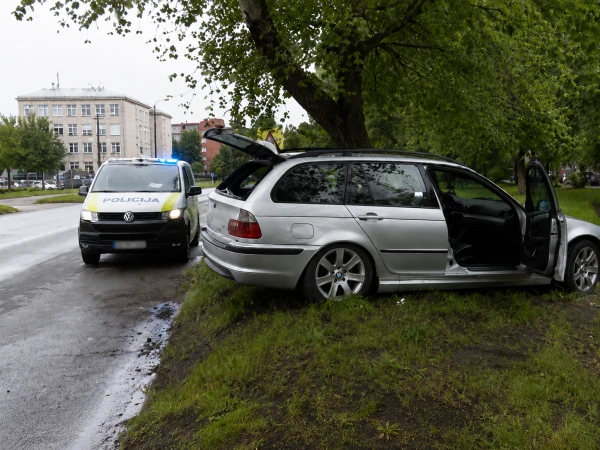
The spring exacerbation, it is like this... It takes just a few rides on public transport a day to encounter at least once with inadequately behaving characters.
In various ranges: from those who constantly curse or drink alcohol in public right in the salon, to those who continuously chatter next to the driver, whom, as is known, should not be distracted. Moreover, if one tries to have a professional conversation with these individuals, they will be outraged that their normality is being questioned. However, as is known, there are no healthy individuals – only those who have not been thoroughly examined!
Numbers That Are Hard to Face
"Signs of depression and anxiety are widespread in society," it is stated in the materials from the Ministry of Health presented recently in the Saeima. About 20% of the residents of the republic experience depression to some degree within a year, and 62% face stress and fatigue in the last month. Latvians most often seek salvation at the bottom of a glass. For a long time, the country has ranked among the top in Europe for alcohol consumption: 11.7 liters of pure alcohol per capita, including the elderly and children. The situation has not significantly changed with the amendments to the Law on the Circulation of Alcoholic Beverages that came into effect on August 1, 2025:
- trading hours have been reduced;
- advertising of prices and promotions has been banned;
- events to promote sales have been discontinued.
Latvian youth are decisively reaching for the bottle: more than three-quarters of those aged 15-16 have tried alcohol at least once, and one in six has experimented with drugs.
It is not surprising that such a method of "solving" problems only deepens the disintegration of personality and leads to suicides – out of 250 cases a year, 43% are related to substance abuse.
Unfortunately, even the happiest period in the lives of young women – motherhood – leads to depression in the current environment. According to screening data presented at the parliamentary health subcommittee, 18% of mothers experience postpartum depression; nearly half of them reach a clinical level.
Moreover, despite the external similarity between our and Western European mothers, the latter experience such trends 50% less frequently. But, alas, it is again not in our tradition to seek help – 30% of women refuse medical measures. Although in such a state, they can cause irreparable harm to both themselves and their child...
Where to Seek Support?
Unfortunately, obtaining qualified help in our country is quite difficult. The shortest waiting time for an appointment with a state-paid psychiatrist is about 20 days, this is in Latgale. Whether the people there are that resilient or prefer "folk" remedies – in any case, with almost 100 days of waiting in Riga, it’s a different world.
The most critical situation has developed with child psychiatrists in the capital – families need to wait an average of 155 days to consult a specialist, having paid only the patient fee. For money, however – it can be done as soon as tomorrow.
There are only 258 psychiatrists, 90 psychotherapists, and 55 child psychiatrists working in Latvia. The main difference between a psychiatrist and a psychotherapist lies in the methods of treatment and the severity of disorders. A psychiatrist is a doctor who treats severe mental illnesses (schizophrenia, bipolar affective disorder) with medications. A psychotherapist, on the other hand, works with borderline conditions (neuroses, anxiety, depression) primarily through communication, although they may also use medications.
Kids in a Cage
At the official level, child psychiatry has been prioritized, and there are announcements about fighting queue reductions. Here’s what has been adopted at the legislative level: according to the new edition of Article 64 of the Medical Law, a minor can be called for mandatory drug treatment – "if there is a significant threat to life or health," or "if other treatment methods are impossible or ineffective."
Of course, there is also an emphasis on prevention. For example, in schools, the program for preventing addictions to alcohol, tobacco, and other substances will start as early as... 12 years old.
Currently, psychiatric assistance for children is concentrated in a specialized hospital in Ainazi. Soon it and four other state-owned enterprises (in Daugavpils, Liepaja, Gintermuiža in the Jelgava region, and Strenči in the Valka region) will be merged. The Ministry of Health believes that this will achieve "more uniform quality of services and accessibility in the regions." It will be possible to "centralize support functions" – that is, to lay off part of the administrative staff, accountants, and IT specialists. But will these individuals not become future patients?
Marika Petroviča, head of the Department of Mental Health, Addiction Prevention, and Integrated Services at the Ministry of Health, promised that a new three-year psychiatric assistance plan would be presented to the government by autumn. Funding from Norway is being attracted...
No Free Spots
Elmārs Terauuds, the chief psychiatrist, added that all children brought to hospitals with alcohol and drug intoxication are currently being assessed. In the capital, there are 24 hospital beds for such patients – and there are no free spots. In general, according to the doctor, "treatment for addictions is an outpatient service..."
– This is absolutely a political issue, – Dr. Terauuds commented on involuntary inpatient treatment (which is very expensive, by the way).
For her part, MP Ingūna Cīrceņa ("New Unity," former Minister of Health) stated that parents of children who experience dangerous addictions are obviously unable to supervise them. And if a child needs to wait three months for a doctor – during that time, they will repeatedly be brought to the emergency room by ambulance.
– They are brought from Ventspils or Kraslava, they are drunk or high, and what should be done then? – the public health doctor posed a rhetorical question. In I. Cīrceņa's vision, it is necessary to disperse points of narcological assistance for minors across the regions.
Who Will Take Care of the Doctors
Liga Aboliņa, parliamentary secretary of the Ministry of Health, spoke about the "burnout" of the doctors themselves. She mentioned that 11 outpatient psychiatrists provided 9,372 consultations over the year. – We regularly have all beds occupied, – noted the official. Therefore, an alternative could be "mobile" service, where the patient is treated at home, and a doctor regularly visits them.
An important factor is also the "ten-year gap" in the training of specialists. Thus, in 2025, only 2 professional psychiatrists graduated in Latvia – one from the University of Stradiņš and one from the University of Latvia. In 2026, 11 young doctors are expected. However, as Ms. Aboliņa noted, "four are improving demographics, one changed residence." So, likely, the services of the latter will be used by patients from another EU country...
Well, if you do come across an offer for free psychiatric help – say, as part of a promotion – don’t pass it by. "It’s interesting to talk to a psychiatrist," – L. Aboliņa said almost in a promotional manner. However, there remains the question – in what language? After all, the law is certainly not on the patient’s side in this regard.