

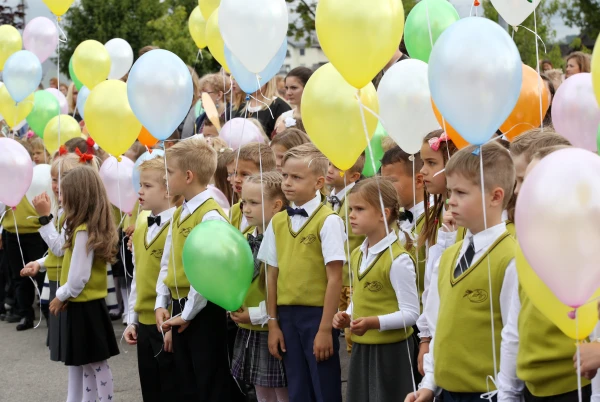
Almost every second parent does not feel a sense of belonging to their child's school, although nearly all consider cooperation with it important or very important, according to the latest survey data.
A study shows that half of parents do not feel adequately informed about their child's well-being at school, and the main obstacles to cooperation are insufficient communication, lack of time, and differences in views on education, reports TV3 News. On Wednesday, the conference "Pamats" discussed what should be improved for the relationship between parents and schools to become more successful.
Everyday communication between schools and parents is becoming increasingly structured, notes Arina, whose eldest son is in the first grade. She considers the transition from general parent meetings to individual meetings with the class supervisor a significant improvement.
"I think this is a big step forward! That 15–20 minutes were dedicated only to me, and we talked only about my student, not about the whole class, not about how the class is doing, but only about my boy," says Arina, a mother of three.
However, alongside positive aspects, problems such as violence and bullying are emerging. In such cases, Arina expects greater involvement from the school:
"I had a situation yesterday… My son came home crying and said that his mitten fell, older kids filled it with stones and started tossing it to each other. He couldn’t catch it because the boys were taller. And he was very upset about it. In such situations, I would like to learn about this not only from my child but also for the school to address such issues!"
When asked, "Do you feel adequately informed about how your child is doing in school?" 46% of respondents answered negatively. When asked, "Do you feel a sense of belonging to your child's school?" 44% answered negatively.
And this is not an isolated case. The survey shows that half of parents feel in an information vacuum regarding their child's well-being at school. Experts emphasize that this hinders the formation of a sense of belonging to the school, and it is important for the child to see that parents and teachers are collaborating rather than conflicting.
"In the middle is the child, who sees that the two most important parties for him are unable to cooperate. Then we can imagine what attitude towards education he may develop," says the head of the Latvian Parents' Organization, Inga Akmentinā-Smildzina.
Teachers themselves are increasingly feeling the tension — communication with parents is becoming one of the biggest challenges.
"It is becoming increasingly difficult… Teachers are already being persuaded to become class supervisors. And the main reason is not the unwillingness to teach students or to form a collective and classroom culture, but rather communication with parents. Most often, clear boundaries are not established," notes the director of Liepaja Secondary School named after Rainis, Karlis Strautins.
The head of the teachers' union points out that overall, the cooperation between parents and teachers can be assessed as very good; however, a small portion of parents is a fly in the ointment.
"A portion of parents poisons the everyday life of the school community — for students, teachers, and also many parents. Here we need to find solutions on how to deal with parents who interfere excessively, behave aggressively, and do not care for their children, and we see the consequences," notes the chairwoman of the Latvian Trade Union of Education and Science Workers, Inga Vanaga.










Leave a comment