
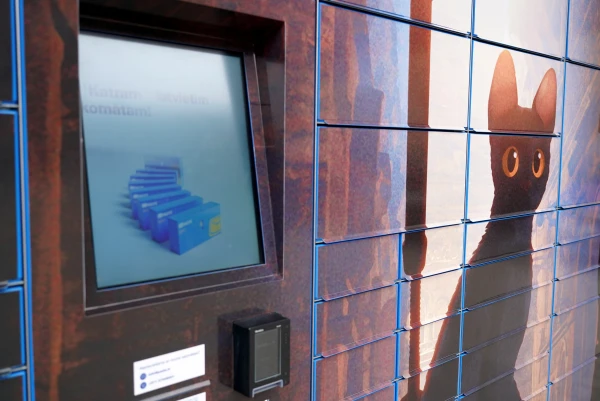
I haven't received any mail for a long time – everything the state wants from me is reported in the protocol on Latvija.lv; and goods arrive at parcel lockers or pickup points. But I regularly walk past the glass windows in the Jugendstil building on Elizabeth Street – life is bustling there, people are waiting for their turn.
A Little Bird Will Fly Out
By the way, dear readers, you have probably noticed that the appearance of post offices has undergone certain changes recently. The signs have turned blue, a little bird has appeared on them, and the state affiliation is no longer attached to Pasts – just Pasts, and not Latvijas Pasts as before. This is likely done in favor of upcoming works in the international market – and the name of our country has become shy. Or perhaps they are thinking about privatization...
Along with the new logo, a new slogan has been devised: "We are nearby, sending far away." Interpret it as you wish...
Meanwhile, it is precisely on the shoulders of the domestic postal service, whatever it may be called, that the execution of the universal postal service lies – the delivery of letters, parcels, money transfers, and periodicals, for which the Ministry of Communications pays nearly 7 million euros a year. The meticulous postal workers have calculated that they need over two million more – 9,226,315 euros. Give us the money!
The European Commission, by the way, stands up for the industry: by the end of 2027, a new EU Delivery Act will be adopted "to ensure equal competitive conditions for market participants, increase price predictability, and support consumer rights."
Our state budget, which spends over 2 billion euros on military needs in 2026, cannot come to terms with such a burden as compensating 70% of the costs for delivering printed press to readers (30% is covered by publishers). They are looking for ways to cut costs from wherever possible – even from the profits of the not-so-rich postal workers.
On June 25, 2025, the Cabinet of Ministers issued a special decree No. 371, according to which 64% of the profit amounting to 344,733 euros was sent to pay the state share.
In the near future, they intend to squeeze even more from the post office to reduce the "negative impact" on state expenses by 1.5 million euros in 2027. That is, when approximately 1,500 times more is spent on concrete barriers, barbed wire, and anti-personnel mines – that’s not "negative" for us.
Do We Have a Newspaper in Livonian Lying Around?
Of course, the sacred cow – the language map – can also come into play. Here’s what is stated in the document that Agnes Zarina, the director of the Communications Department of the Ministry of Communications, submitted for interdepartmental coordination by April 15:
"Considering the geopolitical situation, as well as the statistics of delivered subscription publications in languages other than Latvian, as a possible solution to reduce the burden on the state budget, it will be necessary to consider changing the existing regulations on the payment conditions for the delivery of subscription publications, extending state budget support only to the delivery of subscription publications published in the state language, as well as in the historical variant of the Latvian language – the Latgalian written language and in Livonian – the language of the indigenous people of Latvia, or in the official languages of the states participating in the European Economic Area, the Swiss Confederation, candidate countries for the European Union, or in the official languages of the Organisation for Economic Co-operation and Development."
Similar language criteria, the department notes, led by the "progressive" Aitis Švinka, are already being applied: amendments to the Value Added Tax Law (adopted on December 3, 2025) established a reduced VAT rate of 5%.
How Much Is the Russian Press Worth
So how much does the state intend to receive from this? According to information provided in the report by the Ministry of Communications, the costs of delivering the press in Russian in 2024 accounted for 9.6% of the total volumes, and in the first half of 2025 – 9.3% of the total volumes.
The amount payable from the state budget for the delivery of subscribed printed publications in Russian in 2024 amounted to 671,229 euros (including VAT), and in the first half of 2025 – 403,354 euros (including VAT).
Well, I don’t know what such savings will go towards. Although the essence does not change: no matter how insignificant the money itself is, the principle of language is the most important. Let’s recall the infamous LR4 radio – it was an extremely low-budget institution, yet it was closed down.
A Letter in an Envelope – Wait, Don’t Tear It!
At the same time, shifting the blame from the sick head to the healthy one is not a correct administrative practice. The root of the problems of Latvia's post lies elsewhere.
As rightly noted in the document from the Ministry of Communications: "There are trends in the postal market – the number of letter shipments... continues to decline. Letters are being replaced by email.
At the same time, the number of parcels continues to grow, which is explained by the rapid development of e-commerce and the presence of parcel lockers. Data presented by postal merchants for 2024 indicate that postal parcel shipments (30.9 million pieces) accounted for 51% of activities, letter shipments accounted for 28%, and delivery of subscription press accounted for 21%.
The total number of postal parcel shipments compared to 2023 increased by 13%. Meanwhile, the number of letter shipments continues to decrease, amounting to 7.5 million shipments, which is 13% less compared to the first half of last year."
It turns out that on average, a Latvian has to handle paper letters about 4-5 times a year. Unfortunately, for the most part, these are no longer love letters or holiday greetings – but strictly business documents. Sometimes even quite valuable ones – for example, a systemically important bank casually sends a new plastic card.
Wrote in the Morning, Read in the Evening
Quality standards for universal postal service are another important criterion. It is now established that 90% of shipments must be delivered in Latvia – the very next day! Latvijas Pasts reports exceeding this – 93%.
In every state city or regional center, there must be "live" post offices. With a population threshold of 25,000 residents for state cities and 15,000 residents for regional cities, new offices should also be opened. Importantly, the regulatory framework for the post even includes such a vanished unit as – a parish. But it is no longer a post office with postmen – but a "pickup point."
So, an elderly woman will have to somehow get from her homestead to the former center of the village council, to the parcel locker. And who said that the path to a digital state would be easy?








Leave a comment