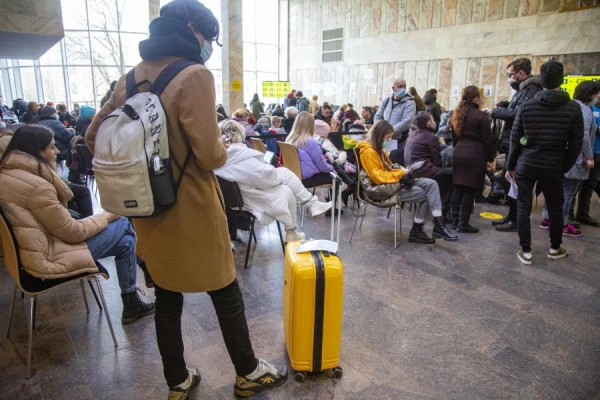
Since the full-scale invasion of Russia into Ukraine in 2022, Latvia has opened its doors and hearts to tens of thousands of residents of Ukraine. As of 2025, more than 31,000 people have found a sense of safety here, and many of them are very grateful for what the people of Latvia are doing for them. They have successfully integrated into our society, working and studying.
However, there are also stories that raise uncomfortable questions about mutual respect, integration, and attitudes towards the state language of our country.
Sometimes, it only takes one everyday situation in the stairwell for the goodwill of Latvians to encounter misunderstanding and even outright disrespect. A reader of the LA.LV portal, Ieva (editor's note - name changed), decided to share her experience because, as she says, her heart is overflowing.
"Our home is located in one of the neighborhoods of Riga. It has become a refuge for those residents of Ukraine who fled from the war and aggression unleashed by Russia. Since the fall of 2024, a family from Ukraine has been living on the second floor - a husband who has been working in Latvia since 2014 and a wife with two daughters, who arrived after Russia's full-scale invasion of Ukraine in 2022," Ieva recounts.
The woman emphasizes that from the very first days, she and her family have shown kindness and warmth towards the residents of Ukraine, who are experiencing unimaginable tragedy due to Russia.
"Latvia has given them shelter, warmth, and safety - what Russia took away from them. Every time, my husband and I greet our neighbors with the words 'Labdien'. This is our ritual, a sign of respect for the language that unites us all. But they never respond with 'Labdien'. Always - I emphasize, pointedly in Russian - 'Zdraste'.
In communication, only Russian is used, persistently and uncompromisingly," notes Ieva, who finds this incomprehensible.
"My work responsibilities have taken me to various near and far foreign countries. I know that the first thing to do is to learn to greet in the local language. This is the minimum that a guest should do. But today's incident in the stairwell of our house caused even greater bitterness, which is why I decided to write.
Today, my husband and I, as usual, greeted our neighbor with the words 'Labdien', she responded with 'Zdraste' and additionally showed us the middle finger.
This was seen by her young school-aged daughter, who studies remotely in a Ukrainian school and does not learn the Latvian language or integrate into Latvian society. This raised the question - what attitude towards the Latvian language and hospitality is the child absorbing from such an example? As a family, we actively support Ukraine - we donate to aid and follow its struggle against Russian aggression. We know and understand that not all residents of Ukraine are the same. However, such moments leave a bitter aftertaste, dulling the joy of the provided refuge."
It is worth mentioning that government and non-governmental organizations have invested significant resources to help residents of Ukraine integrate into Latvian society.
According to the Society Integration Foundation (SIF), since the beginning of the war, with the support of SIF, 20,546 Ukrainian military refugees have studied the Latvian language, including 1,532 children. More than 15,000 participants have successfully completed the courses.
The director of the SIF secretariat, Inese Kalvāne, emphasizes that over four years, extensive support has been provided - both in language learning and in addressing practical everyday issues.
This story highlights a complex reality - alongside successful examples of integration, there are also situations where mutual respect and the desire to integrate into society are not a given.
At the same time, it is important to emphasize that this story is not about everyone. Latvia has provided shelter, assistance, and opportunities. And in most cases, this is appreciated. However, such cases make one ponder - integration undoubtedly starts with very simple things: with 'Labdien', with respectful attitudes, with the desire to be here not just physically, but also humanly.
Interestingly, what would Ieva's new neighbors say if she asked them, 'Whose Crimea?'