
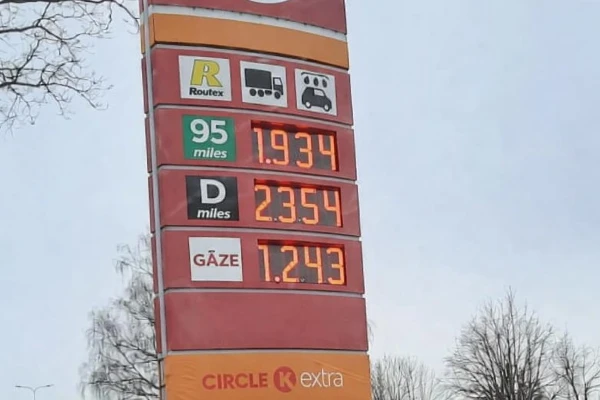
The fuel budget of state structures in Latvia will run out by summer.
The Ministry of Economics is urgently promoting a Law to limit the increase in fuel prices. The development by Viktor Valainis' department (Union of Greens and Farmers) has much better chances than the separate efforts of individual factions in the Saeima.
In Latvia, the retail price of diesel fuel has risen from €1.504/L (average for January-February) to approximately €1.95/L (March 20, 2026) — an increase of about 30%, or €0.45/L. This is the highest price level for diesel fuel since June 2022, when the price reached approximately €2.04/L — as stated in the law's annotation, "as a result of the impact of the full-scale Russian invasion of Ukraine."
"According to a market study by the Competition Council, 93% of the retail price of fuel consists of components that the trader cannot or can minimally influence — the purchase price, which directly depends on international stock prices (about 46% of the final price), taxes, and the fee for the service of guaranteed reserves (a total of 47%). In Latvia, all fuel is imported (mainly from Lithuania and Finland), so domestic prices closely follow international stock prices.
The physical availability of fuel in Latvia is currently not under threat."
The manager of public assets SIA Posessors confirms: "There are sufficient stocks at the traders' excise warehouses." The main challenge in the current situation, emphasizes the Ministry of Economics, is the rise in prices, not a lack of supplies.
The rise in fuel prices has a significant negative impact on the national economy — both in the private and public sectors, states the Ministry of Economics. "The cascading effect in the economy — transportation costs rise, which affects the prices of all goods and services. With a retail price of diesel fuel at €1.90/L, the overall impact of additional fuel costs on the Latvian economy amounts to about €50 million per month compared to the baseline price levels of January-February."
According to turnover figures published by the State Revenue Service, in 2025, 1,041,277 tons of diesel fuel were consumed (excluding marked diesel), which amounts to 1.24 billion liters per year, or about 104 million liters per month. The most affected sectors are: freight transport and logistics, where fuel accounts for 25-35% of operating costs; logging (fuel accounts for 25-45% of production costs) and agriculture, as spring is the most intensive period for work. During this season, construction also revives, increasing operating costs for transport and machinery. Plus, 700,000 personal cars of Latvians...
Moreover, the rise in fuel prices directly affects the provision of "critical state functions" — border protection, public order, firefighting and rescue, emergency medical assistance, and national defense. The fuel budgets of these institutions for 2026 are approved based on last year's prices — and do not include coverage for the extraordinary increase.
But all the Ministry of Economics can offer is to reduce the excise duty on diesel fuel from €467 to €396 per 1,000 liters. Interestingly, in the calculations of tax revenues, the annotation includes a probable price of €2.40 per liter...
With a retail price of diesel fuel at €2.00/L, the overall budget deficit for fuel in security and public sector institutions exceeds €4 million. For several institutions, the fuel budget runs out by the end of summer or the beginning of autumn 2026. The National Armed Forces estimate additional costs at about €7.5 million per year. The fuel budget deficit in these institutions cannot be resolved through internal redistribution, which directly reduces operational capability and "may threaten the lives of people and the security of the state."














Leave a comment