
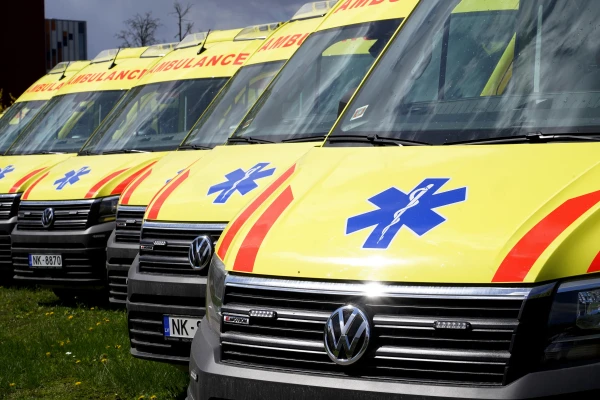
Marcis Kulis tried to call an ambulance, but the dispatcher threatened him with a 91-euro fine if the medics deemed the call unjustified. Frightened, he went to the hospital on his own. It turned out to be pneumonia, reports the portal Grani.lv.
Kulis is a well-known figure in Riga, as he is remarkably socially active. By education a musician, by calling a militant de-Russifier, he constantly makes provocative proposals. Sometimes he suggests fining those who speak to Latvians in Russian, claiming it is "an expression of hatred and aggression." Other times, he proposes to expel "300,000 colonists" from Latvia to "restore the ethnic proportions of 1939, where Latvians will make up at least 79%, and Russians 8%."
At the end of January, he was hanging around in a leopard-print jacket (in the freezing cold!) in front of the German embassy — it was an action demanding that the Germans transfer their "Leopard" tanks to Ukraine. Surprisingly, Kulis did not fall ill immediately; he only got sick recently — but severely. For five days, he had a temperature of 39 degrees. What happened next, he recounted on his Facebook page:
"For five days, I could not bring down my temperature of 39 degrees and became very weak. I asked my wife to call 113 so that the ambulance would take me to the hospital (1 kilometer to Stradins). But, to our surprise, the dispatcher, after listening to my condition, said that if the call turned out to be unjustified (whatever that means, the criteria for justification are known only to some 'secret lodge'), it would be considered false, I would be fined 91 euros, and I still wouldn't be taken to the hospital."
The conclusion of the story was this: in fear of having to pay, Kulis preferred to cancel the call. His wife drove him to the hospital, where he was diagnosed with pneumonia and admitted for treatment — with an IV and antibiotics. According to Kulis, if they hadn’t made it there, he could very well have died that night, as he had "never felt so bad."
From this, questions arose in his soul, which he personally asked the head of the Emergency Medical Service (EMS), Liene Cipule, through social media.
"1) Why, being sick, must I, without medical education, be able to assess my condition during a fever by unknown criteria to me, which even a family doctor could not determine, because the day before he not only made a diagnosis but also added that if it gets worse, I should call 113?
-
Is this a discriminatory attitude towards me?
-
Does the current 'Russian roulette,' guessing whether the call will be justified, undermine the very idea of creating an ambulance service — when a doctor arrives and assesses the patient's condition, which seems critical to those around or to themselves, and accordingly decides on hospitalization or not?"
The publication received 2,700 views, 2,200 shares, and 716 comments under this 'open letter' showed that the topic raised by Kulis is relevant, pressing, and that a whole crowd has long wanted to ask the head of the ambulance the questions he posed.
People began sharing their stories. Here’s what Liva Jansone wrote: "A year ago, when my one-year-old daughter had a temperature of 40 degrees, began having seizures, vomiting, and complete apathy at night, the ambulance refused to come. I was in complete shock. I was afraid for my child… but, you see, if the child is conscious, you go yourself… At the same time, I regularly see ambulances for drunk people lying at public transport stops. I was so disappointed and even offended because I was made to feel like the last piece of garbage…
Of course, we drove to the hospital ourselves, and my daughter was hospitalized."
And here’s the story from Anastasia Abaeva: "A few years ago, I still lived with my parents but was already an adult. My father felt unwell. My mother called the ambulance; they said they wouldn’t come, claiming the call was unjustified. She called several times, but they did not arrive. Then I called, and they threatened me with a fine. I said: come, if anything, I will pay. They came. Heart attack. They said that if I had waited a little longer, he would have died."
"My mother was in a similar situation," Inga Wolf picked up the topic. "Blood pressure 190/100, medication doesn’t help, pressure is rising. She texts me and asks what to do because she is afraid of being punished for an unjustified call. I took responsibility and called the ambulance. For an hour and a half, the team fought, but the pressure didn’t drop, and she was taken to the hospital, put under a system. Fortunately, everything ended well."
And here’s another situation with a mother, brought up by Iolanta Kovriga: "The family doctor said on Tuesday: if it gets worse, call the ambulance. I called — they threatened a 91-euro fine, and the arriving doctors didn’t immediately understand the situation. Sarcasm, poisonous phrases, and questions in the same spirit. However, they took her to the hospital, where my mother was examined very thoroughly, and the cause was found. She spent a week in intensive care… Thanks to the hospital doctors. But the conversation with the dispatcher and the arriving ambulance left a bitter, unpleasant experience."
Finally, tagged in the comments, the addressee of the appeal — head of the Emergency Medical Service Liene Cipule — complained. She vigorously defended her team and stated that a high temperature is not a reason to call an ambulance. The reason is only if it is absolutely clear that a person is about to die: either within a few minutes (highest priority) or within one or two hours (high priority).
After this rebuke, commentators were even more outraged. How can an ordinary person, without being a medical professional, understand how threatening their condition is to their life? Suppose the same Kulis — how was he supposed to figure out whether he would survive until morning to get to an X-ray or not? And if, for example, a lonely person were in his place, who would take them to the hospital?
Here are the comments that angry users stuffed into Cipule's hat:
"Very progressive. Medicine as a quiz: guess the diagnosis yourself or pay a fine."
"You scare people, and people simply do not call the EMS and get into trouble. And don’t be rude to those without medical education; we can’t know everything; we need to be humane to each other, not to kick away those seeking help."
"What is happening with ambulance calls and the attitude towards people in Latvia is a crime. Only when you, Liene Cipule, or your loved ones, relatives find themselves in situations that people face every day with the EMS, only then, perhaps, will you understand what it means."
"It’s interesting how a person with a serious health situation can assess whether they will die soon or not? It’s clear only when a person is already dead, but then the ambulance is not needed. And the dispatcher with their remote recommendations is unlikely to assess how bad everything is."
"People without medical education cannot assess the degree of danger. And the dispatcher is not a psychic either. How many people are we willing to lose like this?"
"Your 'false' criteria are known to no one and can be applied quite subjectively. People are being mocked; they avoid calling the ambulance, putting their lives at risk. And don’t pretend you’re not aware: family doctors, to whom you refer for consultation, are unavailable at night and on weekends."
"Cipule, you are cynical!"
"So the conclusion is: you can only call the ambulance five minutes before death! And then strictly monitor that there is not the slightest improvement before arrival."
"The healthcare system itself is dangerously ill."
Commentators also supported Kulis's proposal — to impose a 91-euro fine only for repeated unjustified calls, while for the initial call, which doctors deemed not life-threatening, nothing should be charged.
But by the tone of Cipule, who made several more comments in the above battles, it is clear: the head of the ambulance only ever hears herself…







Leave a comment