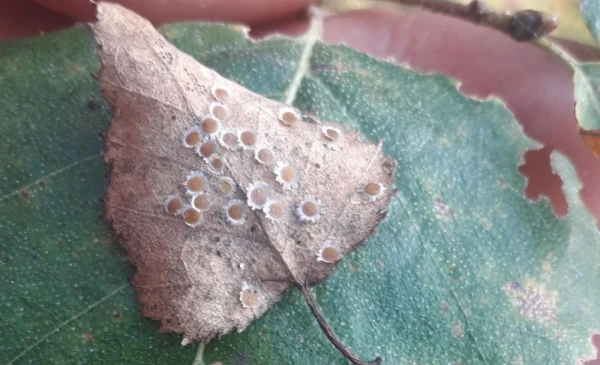
At the end of last week, the portal "Dabasdati.lv" reported that confirmation has been received — a completely new species has been recorded in Latvia for the first time. This concerns the aphid with the Latin name Hormaphis betulae (Cerataphis betulae), whose natural "homeland" is the countries of the Far East. In Russian, it is called "birch round aphid."
The portal “tv3.lv” contacted entomologist Voldemars Spuņģis to find out how it was possible for the aphid to travel such a long distance to Latvia and whether this "guest" poses a threat to our nature.
The entomologist reported that the aphid Hormaphis betulae currently does not have a Latvian name and is referred to by its Latin name. However, this species is now spreading in Europe, noted Spuņģis.
"I cannot name the exact countries, but they are in the same climatic zone as Latvia," he said.
Hormaphis betulae primarily inhabits birch trees.
"Many aphids are characterized by specializing on a specific host plant. In this case, it is birch," explained Spuņģis.
He also noted that in Japan, which is associated with the name of the aphid, the climate is similar to that of Latvia. However, it would be a mistake to think that Hormaphis betulae lives only in Japan. On the contrary, this species is widely distributed in the countries of the Far East.
There is currently no precise information about its distribution in Latvia, Spuņģis acknowledges. In his opinion, it is important to consider that the aphid is extremely small — its size is measured in millimeters. It may have been present in Latvia before it was officially observed.
"It is quite difficult to notice. You can only see it if you are specifically looking for it. A tiny creature, possibly only about a millimeter long," described the species Spuņģis.
It cannot be called an invasive alien species at this time, the specialist emphasized. Only those introduced species of plants and animals that threaten local species, harm nature, fauna, or humans are considered invasive. In this case, on the contrary, the species may have appeared either due to climate changes or as a result of natural spread. "If it does not threaten our existence, we cannot call it an invasive species," added Spuņģis.
Commenting on the lengthy process of species confirmation — from 2020 to 2026, almost six years — the expert was succinct:
"Obviously, for all these six years, no one was particularly interested in observing Hormaphis betulae, and now it has happened, and the species has been confirmed."
As previously reported, on Friday, March 6, "Dabasdati.lv" announced that the first observation of Hormaphis betulae has been confirmed in Latvia. "This is the first and so far the only observation of this species in Latvia!" reported "Dabasdati.lv."
The observation was posted by Mārtiņš Dakša on the portal back in 2020, and it should be noted that it was made in the Engure municipality of Tukums region.