
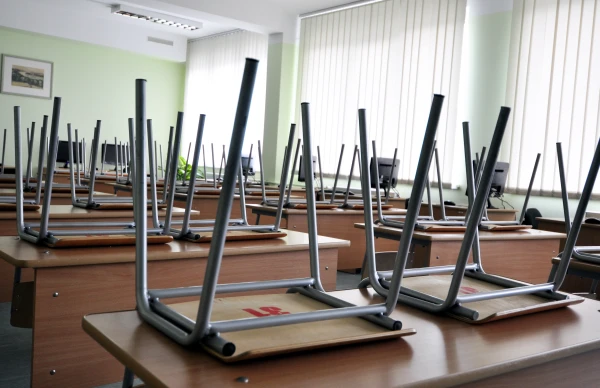
The "Program in School" model changes the way the state allocates funding for teachers' salaries, writes Diena.
In full, it will be provided to schools that meet the criteria developed by the Ministry of Education and Science (MoES). Funding for those schools that do not meet the criteria will have to be sought from the budgets of municipalities. Currently, only ten municipalities will not have to do this, while the others will have to decide what to do next with their network of schools.
The new order still raises many objections from both municipalities and state institutions and professional organizations. Previous experience shows that municipalities sometimes yield to public pressure and postpone school reorganizations for a year or two; however, they cannot stop the decline in the demographic curve, and in the end, they are still forced to change the status of a school or even close it altogether. This is especially true for secondary schools, for which the new norms do not allow deviations from the criteria for the number of students: in large cities and administrative centers, there must be 120 students in grades 10-12, just as in stages 1-3, 4-6, and 7-9, while in other regions, there must be at least 60 students at the secondary school stage and 30 at the others. Only 30 schools are subject to reduced requirements.
Some municipalities did not postpone painful decisions and gradually reorganized their network of schools, while others acted radically, such as the Alūksne municipality, which left two primary schools in rural areas and one secondary school (state gymnasium) in the city. Although residents protested loudly, the municipality did not change its decision. In turn, the Jēkabpils municipality delayed its decision for a long time, explaining that "it is not worth running ahead of the train." Nevertheless, this year the municipality was forced to carry out significant cuts that will affect both secondary and primary schools, as well as their branches and preschool institutions.
Residents are protesting and collecting signatures on the Manabalss.lv website; however, they will likely have to come to terms with this painful decision. The Latvian Association of Municipalities and the Latvian Trade Union of Education and Science Workers also failed to achieve quantitative concessions, for example, regarding secondary schools in administrative centers, to reduce the requirements for the number of students from 120 to 90. Such a quantitative indicator, considering demographic trends and the decline in the number of children in the regions, may prove to be unmanageable for Līvāni, Aizkraukle, Balvi, and a number of other regional centers.







Leave a comment