
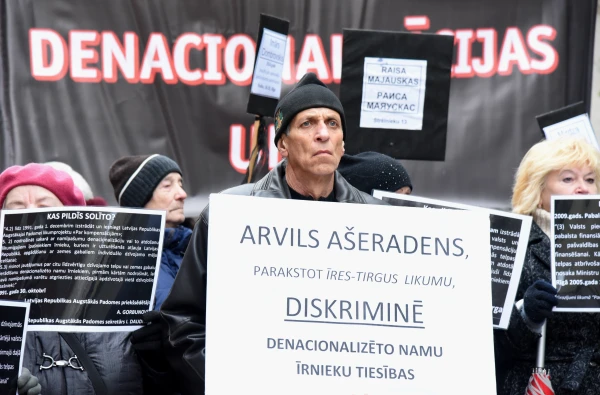
We have written extensively about the problems of residents of denationalized houses. Historical justice regarding people whose ancestors suffered as a result of nationalization has resulted in a glaring injustice towards others, who are innocent in this matter.
However, over time, the number of complaints decreased, special assistance programs were introduced, and there was hope that the issue of "housing repression" was no longer relevant.
But recently, a reader named Mark B. called our "Hotline" and shared the story of his more than 30-year "ordeal." Unfortunately, he is far from alone. The injustice towards residents of denationalized houses, which has stretched over decades, continues.
Two Registers and Endless Queues
I received my current apartment legally in the early 90s. In 1993, our house was denationalized. We signed a quite acceptable contract with the landlord. Then he sold the house, and the chaos began: the house was resold multiple times, and with each change of ownership, I had to confirm in civil courts several times that I occupied my apartment legally. I made payments regularly and on time, according to the contract; I had no claims from the landlords in this regard.
In 1997, under the Riga City Council's Rules "On State and Municipal Assistance in Solving Housing Issues," I was placed on the waiting list in the 12th register as a "pre-reform tenant"; the goal was "improvement of living conditions," since the wear and tear of the building I lived in was 75%. My queue number exceeded 4,000.
A little later, another opportunity arose: to receive a subsidy from the municipality for voluntarily vacating the housing. I was ready for this as well, for which I additionally registered on the general waiting list in the 4th Register. Again, months of waiting stretched on, regular confirmation of status, "disputes" with the next landlords, appeals to the Rental Administration about deteriorating living conditions, since no investments were made in the maintenance of the house, and it continued to decay...
When the Goal is Not to Help
In 2021, the state allocated funds to the municipality for subsidies that had been frozen since the crisis of 2009. The amount of the subsidy was not changed, although real estate prices had increased 2-3 times. The procedure for obtaining the subsidy was quite complicated and very time-consuming. The subsidy was paid only after a contract for the sale of real estate was formalized with the seller by a notary, but first, it was necessary to gather and submit all the required documents for consideration by the municipal commission, relevant at the time of submission.
In my case, all of this coincided with the COVID-19 pandemic; making appointments with the social service for in-person consultations and preparing all the required documents for obtaining social status became a true nightmare; people crowded in social services to obtain/extend status certificates, gathered necessary documents in paper format (and this in the age of the internet and digitalization of state and municipal services!), due to the rush, anxiety, and haste, mistakes were made... When I requested legal assistance, I was told "no lawyers," "COVID does not allow us to hold consultations," etc.
It was not easy to find a seller: someone wanted either a direct transaction (without the municipality as an intermediary), someone - often - partial payment in cash... All this created additional obstacles, especially since the amount of the subsidy was, to put it mildly, insignificant. Sometimes it seemed that such conditions were created to filter out a certain number of applicants for the housing release subsidy!
So Where to Go
My "odyssey" with obtaining certificates, submitting applications, and gathering documents ended with me reaching retirement age. Under the pretext that I no longer met the previous status, I was removed from the queue, although at that moment I had not even submitted an application to the VSAA and had not opened a bank account. I tried to challenge this decision, but the Administrative Court upheld the officials of the RD.
The result: I continue to live in a house that has been brought to a state close to emergency. Without gas, without water, without electricity (which was disconnected a month ago - despite the fact that I had been paying for it diligently and had no debts). From time to time, some individuals try to break into my apartment; they claim to have authority from the landlord (without presenting any confirming documents), threaten, and demand that I leave in all directions... But where am I supposed to go?!
Natalia Yelkina, Co-Chair of the Latvian Association of Residents of Denationalized and Municipal Houses and Apartment Owners:
A Not Isolated Case
- Unfortunately, the problem of residents of denationalized houses is still being addressed, if at all, only for a very limited circle of people. The main criterion in determining who is entitled to municipal assistance in solving housing issues is the income level of the specific applicant for assistance: only people with very low incomes are entitled to assistance. Importantly, the criteria themselves are fixed; if they changed, it was regardless of other changes occurring in society. And if a queue member's income level increased, for example, as a result of pension indexing, even slightly, sometimes by just a few euros, the person automatically lost the right to municipal assistance in solving housing issues. They were simply removed from the queue!
It is clear that a few added euros as a result of indexing cannot solve the housing problem of a resident of a landlord's house, but at the same time, it gives the capital's municipality a formal right to disengage from providing assistance to these people. We do not know how many such "suddenly enriched" individuals have suffered in this way; no one provides us with this data. But the fact that the reader's case is not isolated is a fact: other Riga residents have approached our Human Rights Committee with the same problem.
Capital Authorities - Against
Another aspect is striking. In 2021, amendments were made to the Law on Assistance in Solving Housing Issues, specifically concerning residents of denationalized houses (21.12.2021. Amendments to the Law "On Assistance in Solving Housing Issues"). According to Article (11), "Targeted subsidies to municipalities are provided in the amount of 100% of the actual expenses of the respective municipality to cover the costs of the subsidy for vacating residential premises, if the subsidy for vacating housing is paid to persons specified in paragraph 1 of Article 26.1 of this Law" (translation by the editor - M.B.).
These "persons" were individuals (quote) "who lived in denationalized or returned housing and rented an apartment until property rights were restored, and were evicted from these residential premises due to a prohibition on the operation of the residential building or evacuated from the residential building due to its danger, if these individuals were registered to receive assistance in solving housing-related issues at the time of the prohibition on the operation of the building or evacuation and did not receive this assistance."
But when the Riga City Council adopted its Mandatory Rules based on this Law, this provision was not included. Why - is unknown. But the fact remains: Riga residents - tenants of landlord's houses, who in emergency situations could at least expect some compensation from the state, as a result of this decision by the capital's deputies lost that opportunity. This raises at least bewilderment, as the payment of subsidies would not affect the Riga budget in any way. If the Riga City Council had included in its Rules a provision under which a resident of a denationalized emergency house could receive compensation (guaranteed by the state!), the problem of this specific person could have been resolved at least in some way. But between him and state assistance stood the capital authorities.








Leave a comment