
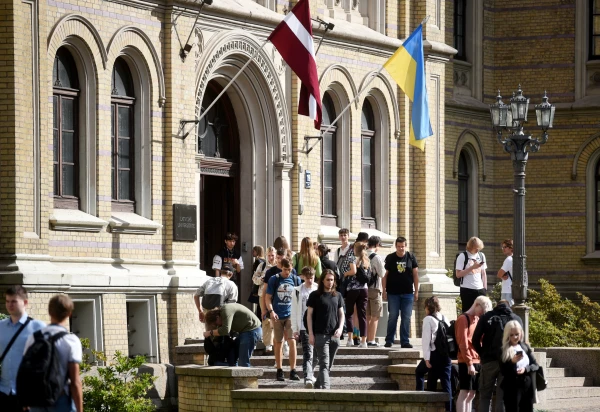
Our republic in the European Union and NATO continues to break records for the number of foreign academic guests. Last year, 12,343 representatives of foreign states studied at universities in Latvia, accounting for 16% of the total. Almost three-quarters — 73.5% of them — belong to the so-called "third countries" outside the EU.
Leaders of the Educational Process
The Saeima's Commission on Citizenship, Migration, and Social Cohesion was presented with data from 20 universities in Latvia — both public and private. The highest number of foreign students, both in absolute and relative terms, was at the University of Stradiņš in Riga, with over 3,000 students. This is already approaching a third of all its students!
The Ministry of Education and Science cites more than 2,500 foreign students for Riga Technical University. This does not match the data on the university's website rtu.lv — as of October 1, 2025, the number of "full-time" foreign students is stated to be 3,901. This also represents about a third of the total number of students, which is 14,266.
The honorable third place is held by the Riga Graduate School of Law (RZA), previously known as ISMA – which has now opened a branch in Fergana (Uzbekistan). It has about 2,000 foreign students, and their number has increased by a quarter over the year!
For the sake of fairness, it should be noted that the division by the number of "third-country nationals" is different. Those who came from outside the EU primarily study at RTU, followed by the Riga Graduate School of Law and the Turība School of Business.
Three Percent from Russia
42% of foreigners obtain a bachelor's degree in Latvia, 26.5% pursue a master's degree, and 2.4% are engaged in doctoral studies.
Interestingly, social sciences, business knowledge, and law occupy the first place in specialization — although in distant non-EU countries, all these fields differ significantly from ours.
Next come: healthcare and social welfare; natural sciences, mathematics, and information technology; engineering, manufacturing, and construction; services; humanities and arts; agriculture; education.
By country of origin, India currently leads with 28%, followed by Uzbekistan (11%), Sweden (8%), Ukraine (5%), Sri Lanka (5%), Germany (5%), Finland (5%), Turkey (4%), Azerbaijan (4%), and Russia (3%).
Yes, according to statistics, despite everything, the Russian Federation is among the top ten countries most interested in Latvian education! Although with a declining trend — but there are also fewer Ukrainians on our university benches than a couple of years ago.
However, Ukraine is part of the European Erasmus+ program, consistently ranking first in terms of student trainees in Latvia — with 325. France (247), Germany (196), Spain (116), and Italy (111) follow. And then there are the very distant, exotic countries — Botswana, Lesotho, Cape Verde!
Better Less, But Better
"Certificate of Good Practice" – under this name, known in English as Study in Latvia, 16 universities (9 public and 7 private) and interested agencies — the Ministry of Education, the Ministry of Foreign Affairs, and the Ministry of the Interior — have united. The goal is to create a "strategy for the internationalization of higher education" by the summer of 2026. Amendments to the Immigration Law have been made:
-
Deny visas to students excluded from the list of learners;
-
Do not issue temporary residence permits to those who "forgot" to return to their homeland;
-
If 30% or more foreign students at a specific university are denied a visa, it loses the right to invite them in the future.
Amendments to the Law on Higher Education Institutions have been developed and will be presented: it will be established that a person who has received a temporary residence permit for study and has not participated in the educational process for 10 days without a valid reason, or attended less than 70% of monthly lectures or classes, will be excluded from the list of students by the higher school no later than within 20 days.
When a foreigner enrolls in a university, grades in core subjects must now be no lower than 60%. Standards for knowledge of the English language (IELTS, TOEFL, Cambridge English) and Latvian language (A2) will also be established.
It will be established that first-year students from third countries must provide "financial security" covering expenses for return in case of visa or residence permit cancellation. Universities are obliged to create a "control mechanism" for foreigners.
Who Is Denied Visas
The Ministry of Foreign Affairs, for its part, reported to the Saeima on the filtering of applicants for entry into Latvia. The most lenient attitude appears to be towards those coming from Kazakhstan — only 6% are denied. Surprisingly, citizens of the Republic of Belarus, officially under various sanctions, receive only 10% denials at the consular offices of Latvia.
The anti-leader is Tajikistan — 39% were not allowed to enter. India also has a high percentage (23%). Next are Uzbekistan (17%) and Azerbaijan (12%).
In total, in 2025, 3,375 study visas were issued at Latvian representations abroad, while 532 candidates (14%) were denied.
FILTERING
In the 2024/2025 academic year, every fifth foreign student (21%) dropped out of their studies. A year earlier, this figure was over a third (37%).







Leave a comment