
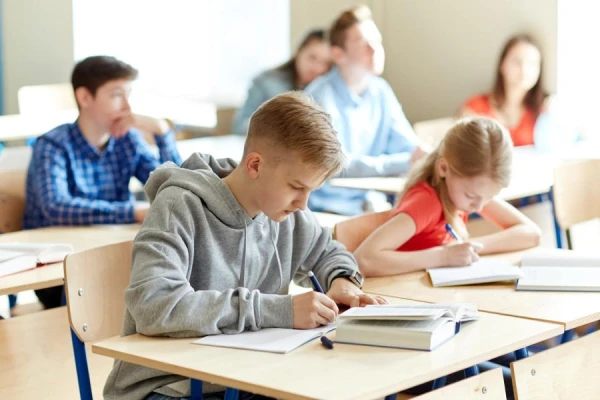
An increasing number of students from minority families use Latvian outside of school, but one-fifth still use it only at school, according to a survey conducted by the Ministry of Education and Science (MES).
88% of students whose native language is not Latvian believe that the knowledge of the Latvian language they acquire at school helps or mostly helps them in life outside of school. Students use Latvian on the internet, in communication with friends and family members, in clubs and sports activities, in public and other places. 70% of respondents believe that participation in extracurricular activities helps improve their Latvian language skills.
At the same time, 21% of surveyed students admitted that they use Latvian only at school. This is a lower figure than in the responses from parents, indicating a broader use of the language in the daily lives of students, the ministry noted.
During breaks, 47% of students talk mainly in Latvian with teachers and other school staff, 43% use both Latvian and Russian, while 8% primarily speak Russian. In paired and group work, only 16% of students prefer to speak in Latvian, 41% mainly use Russian, and 41% use both languages simultaneously.
A more pronounced trend of speaking Latvian at home is observed in younger grade groups, especially in families with first-grade students, where Latvian is increasingly used alongside one of the minority languages. At the same time, 54% of respondents noted that they rarely speak Latvian at home or do not speak it at all.
74% of students fully or mostly understand lessons in Latvian. As students age, their language skills improve. As the most important support factor in learning Latvian, students cite explanations from teachers; children are also increasingly using digital learning resources in Latvian, including educational platforms and artificial intelligence tools.
As the most important external support, students named their families - this response was given by 30%. Parents of students often help with translation, clarifying longer texts, and preparing for tests, while about a third of parents rely solely on the school for this. Parents of preschoolers more often help their children learn Latvian by talking, reading books aloud, and playing. Only 17% of surveyed parents rely solely on preschool institutions.
Compared to the survey results obtained a year earlier, the share of teachers who find it easy to prepare for lessons has increased by 13 percentage points: this year, 38% of respondents gave this answer. As significant support, teachers mentioned professional development, collaboration with colleagues, and methodological and emotional support. For 32% of teachers, Latvian is their native language, and 46% believe they are fluent in Latvian. None of the surveyed teachers rated their knowledge of the Latvian language as poor.
The survey was conducted in October-November 2025, with 10,329 respondents participating - students, parents, teachers, and school administration from 24 municipalities. For 84% of surveyed students in the 7th and 9th grades, Russian is the only native language, and 33% also speak Latvian at home. The survey was conducted by the company "Edurio."
As reported, this is the last school year during which educational institutions implementing minority education programs are transitioning to teaching only in Latvian. Starting from September 1, 4th and 7th grades, which previously studied under minority programs, began learning in Latvian.
This spring, monitoring assessments will take place in the 2nd, 5th, and 8th grades to determine what further improvements are needed for mastering the Latvian language to achieve the results specified by the standards in the 3rd, 6th, and 9th grades. The first data on the implementation of the reform will also be obtained based on the results of 9th-grade students in the centralized Latvian language exam. These students began the transition to learning only in Latvian two years ago - in the 7th grade.
At the same time, a full assessment of the reform's results will only be possible in the 2030/2031 school year, when the primary school will be completed by children who started learning in Latvian from the 1st grade, noted Roland Ozols, Deputy State Secretary of the Ministry of Education and Science for Educational Policy. He pointed out that the transition to learning in Latvian is more challenging in Riga and Daugavpils, while other municipalities do not face significant problems.
According to the State Education Quality Service, the transition to teaching only in Latvian in most schools is proceeding as planned; however, about a third of educational institutions are facing difficulties due to a lack of teachers, their insufficient skills to work in a multilingual environment, and issues with creating a Latvian-speaking environment in schools.











Leave a comment