Recently, the deputies of the Riga City Council received a personal appeal from the Center for Public Memory, based in the glorious town of Ogre: "On the end of odonyms glorifying the communist totalitarian regime and restoring historical street names."
Odononyms are the names of streets, roads, avenues, lanes, boulevards, embankments, and other linear objects of the urban or road network, derived from the Greek words "odos" (path, road) and "onoma" (name, title). The study of odonyms, or odonymy, is a special field of linguistics that analyzes these names as part of toponymy. However, in this case, a considerable dose of politics is mixed in:
"In connection with the correspondence regarding Bertha Pipina Street in the Citadel, on April 28, 2025, the center collected and presented to the Riga City Council all previous proposals that had not been introduced during the previous six years of debates. Considering that in 2025 the eradication of names associated with the communist totalitarian regime and the restoration of historical names occurred minimally, we urge that the renaming of streets be completed in the first months of 2026 so that the rationality of this process is not hindered by events arising from the electoral campaign of the XV Saeima. We divide the proposals into two groups. The first group includes proposals related to the cessation of the glorification of the communist totalitarian regime and Russification. The second group concerns the restoration of our historical local names."
What Was — What Will Be
So, here is what is proposed to be renamed under the line of "ceasing the names of the communist totalitarian regime and Russification."
-
Gustavs Klucis Street (Skanste district, established in 2017, named after an artist and designer repressed in the USSR in 1938) – Richard Zariņš Street (artist).
-
Sergei Eisenstein Street (Mežciems, established in 1978, named after the film director born in Riga) — Fricis Bārda Street, a poet of the early 20th century.
-
Anna Sakse Street (Mežaparks, named since 1983 in honor of a writer) — Hermann Samson Street (Baltic German priest and theologian of the 16th century).
-
Sudrabu Edžus Street (Mežaparks, named since 1987 in honor of a writer) — Christophor Firkers Street (Baltic German writer of the 16th century).
-
Mirdza Kempe Street (Mežaparks, established in 1982, named in honor of a poetess) — Mārtiņš Brauns Street (modern composer).
-
Jukums Vācietis Street (Pļavnieki, established in 1983, named after a military leader of the Russian and Soviet armies, commander of the Latvian riflemen, repressed in 1938) — Emilia Plater Street (Baltic German and Polish noblewoman, activist of the Polish uprising of 1830 in present-day Latgale).
-
Ilmene Street (Ritabully) — Melānija Vanaga Street (literary figure, cultural historian of the 20th century).
-
Friedrich Tsander Street (Zasulauks, named in honor of a Riga native, rocket technology designer in the USSR) — Bartas Street (original name).
-
Andromeda Street (Purvciems, established in 1975 in honor of the galaxy) — Veronika Strēlerte Street (emigrant poetess).
-
Admiral Street (Bolderāja) — Admiral von Keizerling Street (the first commander of Latvia's naval forces).
-
Ruses Street (Kengarags, established in the 1970s, named after a sister city in Bulgaria) — Vilis Janums Street, who served in the armies of Russia, Soviet Latvia, the Latvian Republic, and the Third Reich, with the last rank being Standartenführer of the Waffen-SS, and in exile created the organization of former legionnaires Daugavas Vanagi.
-
Flotes Street (Bolderāja) — Captain Drezinš Street (sailor and pilot of the 19th-20th centuries).
-
Pauls Leyinš Street (Zolitūde, established in the 1980s, named in honor of a Latvian scientist, Minister of Education in the Kirhenstein government in 1940, and President of the Latvian SSR Academy of Sciences) — Jānis Jaunsudrabiņš Street (writer and poet of the 19th-20th centuries).
-
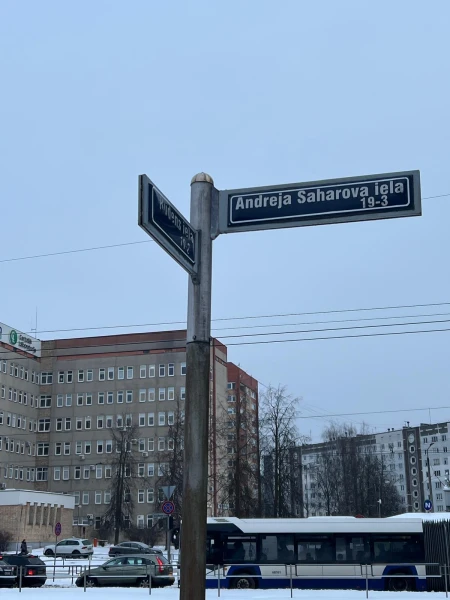
Andrei Sakharov Street (Pļavnieki, named in honor of the Soviet physicist and human rights activist) — Kārļa Skalbe Street (poet, member of the Saeima of the 19th-20th centuries).
As we can see, activists harbor some extreme antipathy towards world-renowned figures — Eisenstein, Sakharov, Tsander — proposing to replace their names with representatives of local literature or, in the case of the founder of rocket engineering, a village.
Twice Repressed
Regarding Mr. Janums, who changed his banners four times (!) under which he fought, it seems unlikely that this is a symbol of loyalty. Although one must appreciate the cynical wit suggesting placing such an odonym in a microdistrict predominantly populated by Russian speakers.
It can be assumed that the symbolic first plaques will be unveiled with the German military attaché invited, to show how Latvia respects the bearers of the glory of German arms during World War II. At least, nowhere in the EU and NATO has this happened in recent years; we will be pioneers!
Of course, the initiators of the renaming could not care less about the opinions of the residents of these streets, many of whom have never had another name — because they were built under such names. In the overwhelming majority during socialism, except for Gustavs Klucis Street.
By the way, by changing this name, as well as Jukums Vācietis, the authorities will show their true attitude towards those Latvians who suffered under Stalin in the late 1930s, regarding which there is even an official mourning date in December in the Republic of Latvia, flags are displayed.
Return of Historical Names
It is also proposed to change a whole series of odonyms that were changed during the previous socio-political formation. Therefore, what was will become:
-
Polu (Old Riga) — Katolu;
-
Celinieku (Sarkandaugava) — Svetcelinieku;
-
Alksnā (Old Riga) — Reformātu;
-
Meness (Center) — Debesbraukšanās;
-
Sermuliņu (Petersala) - Olafa Hermelīņa;
-
Sarkandaugavas — Adolfa Bingnera (founder of the brewery);
-
Darbā — Fabrikantam;
-
Klinģeram — Fridriha Klingera (German literary figure of the 18th-19th centuries, did not live in Riga);
-
Kreslas — Davida Ilkēna (Baltic German lawyer of the 16th-18th centuries).
Well, it turns out just wonderful. It seems that a street in the Old Town, named in honor of the friendly Polish people, will now be — Katolu? And do the historians know that there is already one in the Latgale suburb? There will be joy for taxi passengers, especially if the driver turns out to be, as is often the case now — not local.
In addition to everything, when implementing the above lists, all property documents, legal entity registrations, and similar matters will have to be updated with the new names. Many thousands of people will be affected by such an excursion into history.
However, the Trend
In recent years, a mass process of changing street names has been launched in Latvia. Thus, there are no longer streets named Maskavas (Moscow), Gogola, Puskin, Pikula, Brantkalna, and others in Riga. The names of parts of streets are also being changed – Nīcgales and Antonijas.
And in Preiļi, for example, the street named after Sorokin has been eliminated. Sorokin was far from politics — he created a successful collective farm in the poor Latgale. Only his surname did not make it.