The readiness of residents of Latvia for non-military resistance in conditions of war or occupation is currently insufficient, claims researcher Vitaly Rakstins from the University of Stradina in Riga.
Speaking at the conference "January Barricades of 1991 as a Manifestation of Popular Resistance to Totalitarian Regimes and Lessons for Today," Rakstins noted that the topic of nonviolent resistance is sensitive, as on one hand, the state has a position on defending territory "from the first centimeter," while on the other hand, there is a concept of national defense.
According to the concept, it is prescribed to defend until the last drop of blood and the last centimeter.
Rakstins reminded that a regulatory framework had previously been established, stipulating that the armed forces should begin to fight without waiting for specific decisions from officials. The new laws for the first time defined the role of society and granted the armed forces the authority to begin preparing society to provide support.
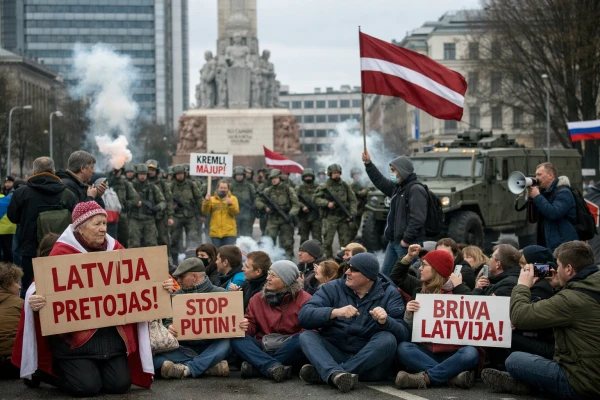
The researcher explained that nonviolent resistance can be both active and passive; however, the main challenge is to achieve mass participation similar to that which occurred during the barricades and the Baltic Way.
He expressed concern about the skills and knowledge of the population, asserting that currently, most people who wish to participate in measures to defend the state are untrained and insufficiently informed.
The expert also emphasized that the readiness of society to resist can serve as a deterrent element, as the enemy's awareness that society is prepared to confront them through non-military means can alter their calculations.
Rakstins cited Ukraine as an example, pointing out that Russia did not anticipate the active involvement of Ukrainian society in defending the state.
He stressed that Latvia needs to learn from Ukraine about nonviolent resistance, including ensuring the transfer of knowledge about what is happening in temporarily occupied territories. Rakstins added that one should not wait for the "hour X," as some measures of nonviolent resistance can be implemented already now, in the context of hybrid warfare.
Rakstins believes that more thought should be given to people who would like to help in the defense of the state but are not ready to join the National Guard or become reservists. He noted that about 4% of the population is fighting in the Ukrainian Defense Forces, but resistance is being carried out on a much broader level.
The expert emphasized that to engage society, the necessary skills and abilities must be provided, as modern warfare is technological in nature, and such specific knowledge cannot be acquired independently by individuals. He noted that training the population during wartime will be impossible, so knowledge must be passed on already now.
Citizens should also report suspicious actions and items, as the enemy tests vulnerabilities.