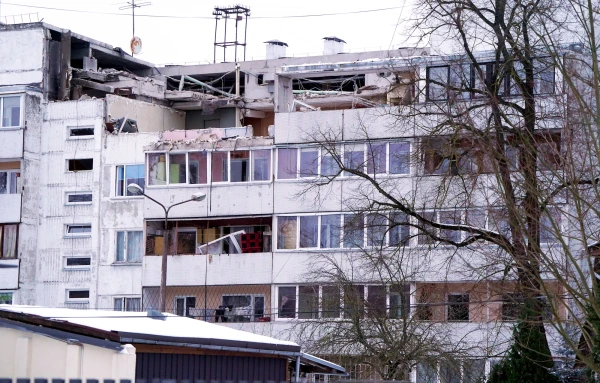
In the building on Bauskas Street in Riga, which was damaged by an explosion in early January, about 45% of the apartments were insured, reported LETA by the president of the Latvian Insurance Association (LAA) Janis Abashin.
He noted that various crises and accidents regularly occur in Latvia — rivers overflow, hurricanes and heavy rains rage, private and apartment buildings are flooded, and devastating fires break out. People are evacuated, municipalities seek temporary housing, and the state provides emergency assistance. Each such case serves as a lesson and makes one think about whether residents have done everything possible to protect themselves and their loved ones.
On January 2, 2024, there was a gas explosion in an apartment building on Bauskas Street in Riga. According to Abashin, this served as a reminder of how vulnerable everyday safety can be. Two people died in the tragedy, others were injured, and more than 70 residents were left homeless.
According to information collected by the Latvian Insurance Association (LAA), about 45% of the apartments were insured.
Abashin pointed out that there are various reasons for such a low percentage of insurance: some could not afford it, others had different priorities, and some simply believed that nothing would happen to their home.
"Unfortunately, living in an apartment building, we can only somewhat control our own behavior, but not the behavior of our neighbors, which significantly increases risks. Irresponsible or reckless actions by one neighbor can have consequences for the entire building," emphasized Abashin, adding that the tragedy on Bauskas Street proved that work with gas and other hazardous equipment should be carried out exclusively by professionals.
According to him, the incident also clearly demonstrated the difference between insured and uninsured residents. Those whose apartments were insured received initial assistance in the first days — payments for the purchase of essential items, coverage of daily expenses, or provision of temporary housing. The insurance company allowed the victims to stabilize the situation more quickly after the shock.
State and municipal assistance only covers basic needs, while complete protection and long-term financial stability are best ensured by personal responsibility and insurance.
Abashin noted that the exact extent of the damage will be determined by the conclusions of construction specialists and experts. If the building can be restored, the insurance will cover both the repair of specific apartments and the restoration of structural elements of the building in proportion to the ownership share. In the event that restoration is impossible, insurers will pay the market value of the apartments or provide for the purchase of similar housing.
"Insurance of the entire building structure is of particular importance. If it had been insured, the costs of restoration would have been covered by the insurance company. Otherwise, the math is harsh: insured residents will be helped by insurers, while others will have to pay themselves," explained the president of the LAA.
He emphasized that the situation in which the actions of one owner or tenant can render a building uninhabitable is a clear example of the necessity of such insurance for almost any apartment building.
Abashin also noted that providing temporary housing is an important support for the affected. If this is provided for in the contract (and most often it is), insurance companies compensate for the costs of renting similar housing, as well as cover fixed utility payments for the damaged apartment. Such support is usually provided for a certain period, for example, up to 12 months, giving people time to make informed decisions about their future.
Residents whose apartments were not insured receive primary assistance from the municipality. The Riga City Council provides opportunities for temporary accommodation, while the Riga Social Service offers crisis assistance to cover urgent needs. However, this assistance is often limited in time and scope compared to the options provided by insurance.
"This raises an uncomfortable but important question — should those residents who could take care of their property by obtaining insurance also be entitled to state support on equal terms? It is clear that assistance is vital for socially vulnerable groups, but should it be provided to absolutely everyone?" asked Abashin.
He emphasized that in the context of financial literacy, discussions usually revolve around loans, savings, and investments, but insurance is also a foundation of financial security and a tool for state development that is underestimated. At the same time, Latvia significantly lags behind the EU average in terms of property insurance levels. According to Eurobarometer, an average of 62% of residents in Europe have home insurance, while in Latvia, only about 50% of residential properties are insured, despite a fairly wide range of insurance products.
"Most residents of Latvia live with limited savings, and income stability often remains fragile. In such conditions, unforeseen events — illness, job loss, or damage to property — can lead to long-term financial consequences," noted Abashin, adding that perhaps some residents of the building on Bauskas Street without insurance will not have the means to invest in the restoration of the building and will depend on state support.
"This highlights the gap between insured and uninsured residents in crisis situations," stated the head of the LAA. He reminded that insurance is not a luxury, but a part of the public safety infrastructure.
According to him, if we talk about financial literacy and sustainable development in Latvia, insurance should take center stage in this discussion.
It was previously reported that the risk insurance company "BTA Baltic Insurance Company" insured nine apartments in the building affected by the explosion, the Latvian branch of the insurance company "Swedbank P&C Insurance" also insured nine, the company "Balta," part of the PZU group, insured eight, "Compensa Vienna Insurance Group" insured three, "If P&C Insurance" insured two, and "Gjensidige" insured one.
As previously reported, the explosion in the five-story residential building in Torņakalns occurred on Friday, January 2, due to a damaged gas pipeline that was illegally installed. As a result, the upper floors and the roof of the building collapsed, residents were evacuated, several people were injured, and two died. The municipality provides the affected with the opportunity for temporary accommodation.