
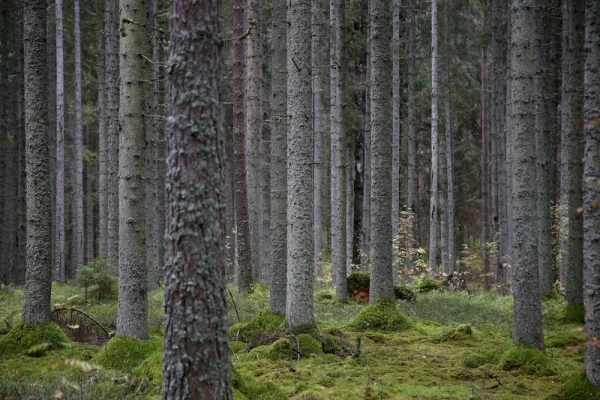
The dynamics of forest fund expansion in the European Union are extremely uneven. As fresh Eurostat data from last year shows, key factors here remain not only climate but also the species composition of trees along with the age of the stands.
Portugal topped the European ranking with a net increase relative to the total timber stock reaching 11.1%. Denmark (7.6%) and Ireland (6.8%) also made it to the top three. At the opposite end was Malta, where not a single cubic meter of forest was added over the year. The lowest growth rates were also noted in Cyprus (1.6%), Estonia, and Bulgaria (both at 1.8%).
Latvia, with a rate of around 3%, remains at the upper part of the list. Only nine EU countries show a more active increase in forest areas than our republic.
European statistics confirm a long-term trend: Latvia's forest fund has been steadily increasing over the past 35 years. In 1990, timber stocks in the country were estimated at 442 million cubic meters, and by 2025, this figure is expected to rise to 655 million cubic meters.
When calculating net growth, experts take into account not only the natural development of trees but also the volumes of logging and natural losses. By the end of 2023, 17 countries showed positive dynamics. Leading the way again were Ireland (+3.6%), Denmark (+3.2%), and Cyprus (+1.6%). However, in several countries, forest volumes, on the contrary, decreased: Lithuania saw a decline of 1.8%, the Czech Republic - 1.7%, and neighboring Estonia - 0.6%.










Leave a comment