
In the comments to the article on a popular Latvian portal, many residents of Latvia who studied during the USSR unexpectedly praise the Soviet education system, noting its practicality and real benefits for life, writes Otkrito.lv.
Everyone who studied in school during the Soviet Union remembers not only the subjects but also the level of requirements, the grading system, and the practical focus of education. Many disciplines that existed then have completely disappeared from the school curriculum today.
The portal LA.lv published material about subjects that were studied in Soviet schools but are no longer taught: for example, the basics of Marxism-Leninism, calligraphy, civil defense, ethics, drawing, and astronomy. However, the comments from readers sparked much more interest than the historical excursion itself. Most of the commentators—residents of Latvia who studied in the USSR—rated Soviet education positively, only noting the ideological component. They emphasize that school provided practical skills that were genuinely helpful in life.
One commentator writes: “During the USSR, education was organized in such a way that intelligent and aware individuals graduated from schools. In independent Latvia, education has degraded to the level of a baseboard.”
Many recall military training, which was mandatory for all students: “Military training in high school was for everyone—both boys and girls. Girls were additionally taught medicine. Girls disassembled and assembled the Kalashnikov rifle almost as quickly as boys.”
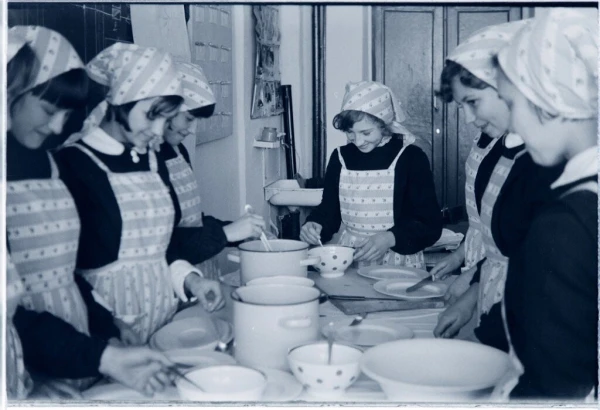
The practical focus of labor and home economics subjects is specifically noted: “There was no ideological content in labor lessons. Girls were taught to sew, knit, and cook. Everything had to be mastered at a fairly high level—from samples to finished products.”
Other commentators emphasize that the skills were universal: “Boys learned to work with wood and metal, use tools, and solder. Girls also knew a lot. As a result, they did not grow into helpless individuals who cannot fix a faucet or repair furniture.”
Many good words were said about subjects that today have either disappeared or been minimized: “Calligraphy, astronomy, and drawing were necessary subjects. They were very helpful in technical universities. I still understand technical documentation thanks to the Soviet school.”
Commentators also note the high level of laboratory work: “There were full-fledged laboratory works in physics and chemistry, equipped classrooms, real reagents, and instruments. This was real education, not a formality.”
Criticism of the modern school is particularly harsh: “Now children and adults write crookedly, without punctuation, without meaning. The use of phones and computers has set back the development of language. Critical thinking has been destroyed.”
Some commentators emphasize that ideology did not hinder those who could think independently: “Ideology did not affect me. There were reasonable parents who taught me to think. It depends on the person what they will take away as useful and how valuable it will become.












Leave a comment