The current spectacle consists of office jokes, sea voyages, and frivolous adventures.
In Moscow, applause is ringing for the third installment of the popular franchise 'Holop', directed by Klim Shipenko and featuring a whole array of stars in leading roles. The first two films, released during the New Year holidays, collectively grossed a solid 7 billion rubles. There was hope that audiences would flock to the generously funded (budget 1.2 billion) and widely advertised third part of 'Holop', released in a large number of copies on the eve of Russia Day. However, the results of the three festive days brought rather contradictory outcomes.
Yes, 'Holop 3', having earned 262.8 million rubles, topped the box office from June 11 to 14. But, firstly, the film earned significantly less during this time than 'Holop 2' did on its first day of release (319 million). Moreover, the American musical film 'Michael' was not far behind the third installment of 'Holop'. In its eighth week of screenings, the fictionalized biopic of pop king Michael Jackson earned 250 million, and its total box office in Russia approached 1.4 billion rubles.
Film industry analyst Sergey Lavrov does not predict that the third 'Holop' will even earn half of that amount. To break even, the film needs to collect 2.5 billion rubles, as half of the revenue goes to the cinemas. It turns out that participating in the New Year battle, when the screens are purposefully cleared of foreign films, is not the same as competing head-to-head with a Hollywood blockbuster that has broken into our official distribution and has grossed nearly a billion dollars worldwide to date.
So why, one might ask, did the audience respond with a certain coolness to the new 'Holop'? Is it due to the short summer period in our northern latitudes, when people prefer outdoor activities to going to the cinema? Or did 'Michael' draw a significant portion of the audience? Or was it the high ticket prices (in Moscow, the average ticket for the third 'Holop' cost 784 rubles)?
As many likely remember, in the first 'Holop', the unruly rich kid Grisha (Milosh Bikovich) was reformed with a whip and a lash during the times of serfdom. In the second 'Holop', the now more grounded Grisha was trying to reason with the spoiled rich girl Katya (Aglaya Tarasova), who was sent back to 1812 and was set up to attempt an assassination on Bonaparte for patriotic purposes. In the third 'Holop', the couple in need of correction is the married pair — Boris and Elena Vyazemsky (Pavel Priluchny and Kristina Asmus), who have long grown tired of each other and regularly engage in fights that result in broken antiques.
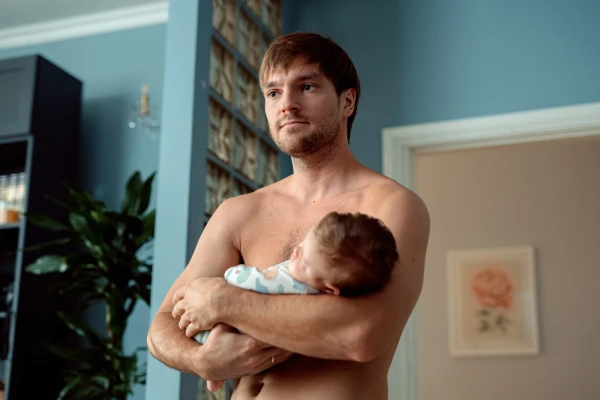
By the will of the film's authors, they plan to divorce and divide their hard-earned family business. This situation seriously worries the couple's children, who turn to Grisha (played again by Bikovich, only now more seasoned) and his team, led by the experimental psychologist Lev Arnoldovich (Ivan Okhlobystin), asking for help to save their parents' crumbling marriage. The advanced youngsters, who read English fluently, prefer to finance the special operation with bitcoins that have mysteriously appeared to them. Since Grisha's business is running smoothly, the couple is immediately sent back to the era of Peter I, where businessman Boris finds himself a powerless serf, and former singer Elena turns into a debauched countess, waking up in the same bed with a stable hand...
In the third 'Holop', the humor has practically evaporated, and there is little to say about the novelty of the plot twists, the truth of the situations and characters, or the overall believability of what is happening on screen.
The current spectacle consists of office jokes, sea voyages, and frivolous adventures in the palace of the Turkish sultan, with running, jumping, and stunts, resulting in the main characters becoming white, fluffy, and loving spouses again. Simultaneously, the romantic relationship between Grisha and single mother Vera (Anna Chipovskaya) will develop, culminating in a lavish wedding with dancing to the vocals and choreography of singer Yolka. Grisha's father (Alexander Samoylenko) and his wife (Maria Mironova) will gift him a little brother. Such a persistent apologia for family values, which, judging by the results of the first days of release, did not particularly ignite the mass audience.
Most likely, there will not be a fourth 'Holop', which producers and the director have been quietly discussing, and the audience is not inclined to be upset about it. The franchise has considerably exhausted itself by the third installment. Unless the authors come up with the idea of sending the rich kids for correction not to the past but to the future next time, which, I do not rule out, could refresh the 'holopiada'.