
Researchers proposed an unusual way to estimate the maximum duration of human existence. The theory, known as the 'Doomsday Argument,' allows for a 95% probability to determine the upper limit of our civilization's history. However, many scientists believe such calculations are overly simplistic. This is reported by Daily Mail citing the work of scientists and a publication in Scientific American.
The study is based on the so-called Copernican principle — the idea that humanity does not occupy any special position in the universe. The authors of the work from the University of Milan suggested that modern humans do not live in a unique period of history, but are instead at a random point in the overall existence of the human race.
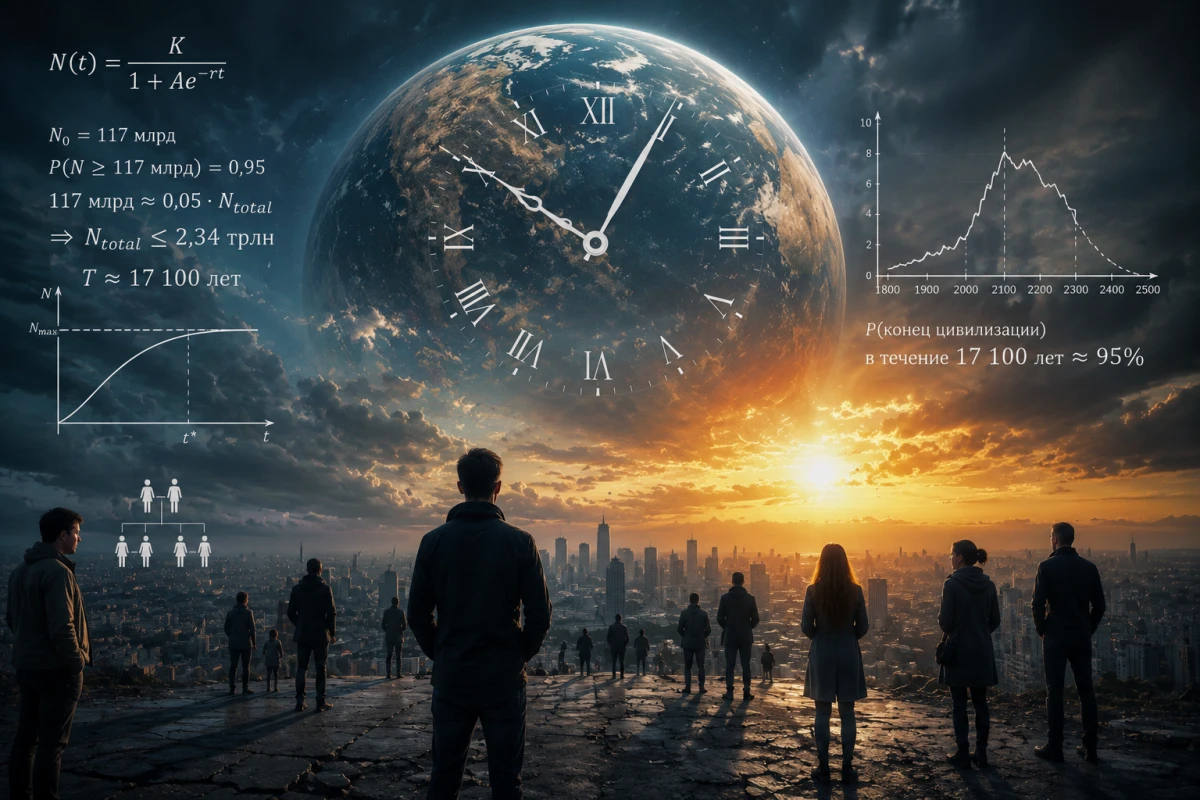
For their calculations, the scientists used an estimate of the total number of people who have ever lived on Earth. According to modern estimates, approximately 117 billion people have been born throughout human history.
Next, the researchers made a statistical assumption: with a 95% probability, the current number of people who have ever existed is at least 5% of the total number of people who will ever be born.
To explain their logic, the authors provide an example with two boxes filled with numbered balls. If a person randomly draws a ball numbered 4, it is much more likely that it is from a box with ten balls rather than one with a hundred thousand. By analogy, the scientists suggest that if 117 billion people have already been born, the probability of tens of trillions of new people appearing in the future is relatively low.
Based on this model, the researchers concluded that the total number of people who will ever live on Earth is highly unlikely to exceed 2.34 trillion people.
If current demographic trends are maintained, this limit could be reached in about 17,100 years. This timeframe is what proponents of the theory refer to as the statistical upper limit of human existence.
At the same time, the authors emphasize that this is not a precise prediction of a global catastrophe. The model merely shows the likelihood that the history of humanity will not be infinitely long. The reasons for the potential disappearance of civilization could theoretically include climate change, major wars, pandemics, or other global crises.
Additionally, the researchers considered an alternative scenario in which, due to ecological problems, the Earth's population limit would decrease to two billion people. In this case, the planet's population could begin to decline rapidly in the coming decades. However, the authors themselves describe this option as hypothetical and emphasize that it serves only to demonstrate the sensitivity of demographic models to external factors.
"The most provocative part of our article is dedicated to hypothetical future scenarios," the researchers note.
Many experts are skeptical of such calculations. In their opinion, the model does not take into account numerous factors that could radically change the future of humanity, including the colonization of other planets, breakthroughs in medicine, the development of artificial intelligence, and new survival technologies.
The 'Doomsday Argument' theory remains one of the most controversial concepts in modern science. Its authors do not claim that humanity will indeed disappear in 17,000 years, but merely propose a statistical model for assessing the future. Nevertheless, the work once again reminds us of how uncertain the long-term future of civilization remains and how greatly it can be influenced by decisions made today.















Leave a comment