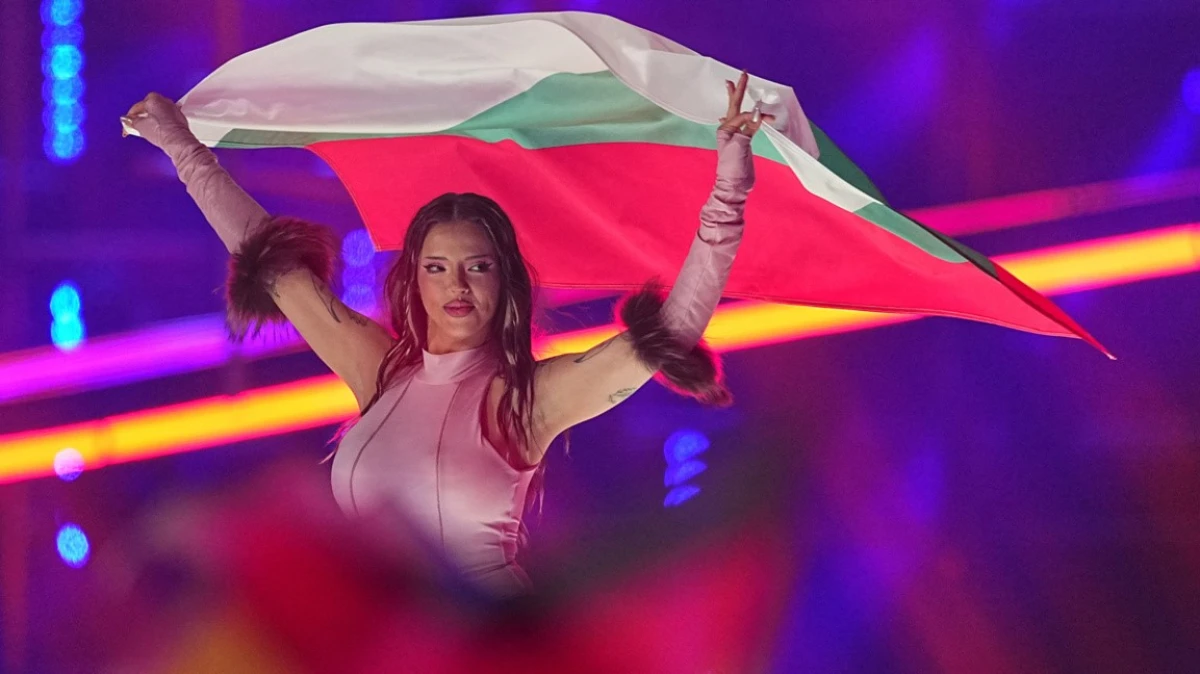
Bulgaria's historic victory at Eurovision was brought by singer Dara with the composition "Bangaranga." Its title translates as "chaos." Why it succeeded is analyzed in DW's top 10 participants of the contest.
Bulgaria's victory at the Eurovision contest, which concluded in Vienna on the night of May 17, was sensational for several reasons. First of all, this is Bulgaria's first victory at Eurovision. The country has participated in the contest since 2005, with two brief interruptions. During all this time, representatives of Bulgaria failed to advance past the semifinals ten out of fifteen times.
Sensational Victory for Bulgaria
The second reason is that Dara (the stage name of 27-year-old Darina Yotova) overtook the two main favorites of the contest in the final stretch. Bookmakers rated the chances of the Finnish duo Linda Lampenius and singer Pete Parkkonen at 40 percent for victory, and half that for Delta Goodrem from Australia, who was predicted to take second place.
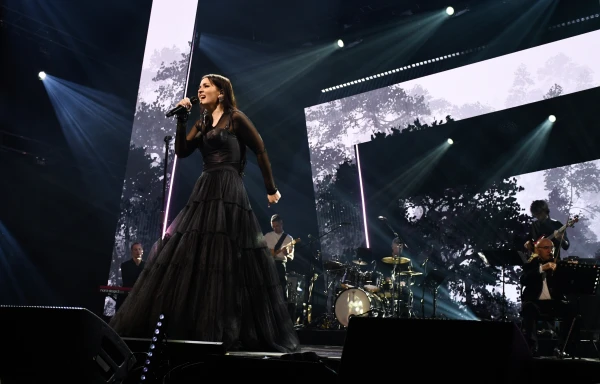
Dara with dancers on the Eurovision stage in ViennaDara with dancers on the Eurovision stage in Vienna Dara and dancers: how to create chaos at Eurovision? Photo: Martin Meissner/AP Photo/picture alliance
But Dara won, both in the voting results of the national juries and in the voting results of the viewers. It is a rare case at Eurovision when these results coincide, and the distribution of points among the top ten finalists was so tight.
It turns out that the main loser was not Look mum No Computer - the stage name of British Sam Battle, who took last place, 25th, in the final. The bookmakers lost! Their predictions failed to foresee the winner. However, this may also indicate the unpredictability of Eurovision, which should certainly be regarded as one of the merits of the contest.
What Bulgaria and Greece Have in Common at Eurovision
"Bangaranga," like "Ferto" ("Bring") by Greek Akylas, who took 10th place, were the most unusual compositions at this year's contest. Their main feature is radical musical breaks: from ringtone and folk to rap and melodic pop. A challenge not for the faint-hearted, but in the TikTok era, it was appreciated by both the audience and the jury.
The composition and staging of "Bangaranga" (the title can be translated from Jamaican slang as "chaos") turned out to be more modern than the ethnic mix of the Greek entry. This is largely thanks to Swedish director Fredrik Ridman, who has staged performances for several Eurovision winners, as well as one of the co-authors of the song, Greek Dimitris Kontopoulos. He has written many successful compositions for contest participants. In Russia, Kontopoulos is known for his collaboration with Philip Kirkorov and with his protégé at Eurovision, for example, with Sergey Lazarev. Like Kirkorov, Darina was born in Varna. Reports from Russia suggest that Kirkorov's team, the "Dream Team," was involved in preparing the Bulgarian performer for the contest.
Finally, Dara's victory was sensational also because right after her success in the national selection, she was hit by a wave of powerful hate on social media. She seriously considered withdrawing from the contest in Vienna, where she ultimately won. The singer from Bulgaria received 516 points, surpassing Israeli musician Noam Be'tan, who took second place at Eurovision, by 173 points.
Israel's Success at Eurovision
Noam Be'tan faced significant pressure before and during the contest. However, he did not falter despite calls for Israel's disqualification from Eurovision and attempts to disrupt his performance on stage. With the ballad "Michelle," Noam Be'tan repeated last year's success for Israel at the contest and took second place. Importantly, the gap in scores between national juries and viewers was not as significant as at Eurovision-2025.
The third place went to Romania's Alexandra Capitanescu with the pop-rock aria "Choke Me" - both a tribute to modern staging and partly a scandal caused by the title, which translates as "Choke Me." Critics accused the Romanian performer of allegedly glorifying the dangerous sexual practice of choking. Alexandra claims that it is a metaphor for emotional suppression.
The Downfall of Contest Favorites
One of the bookmakers' favorites, Delta Goodrem from Australia, with a classic pop ballad for the contest, "Eclipse," ended up in "only" fourth place. But this is undoubtedly a success. Australia first participated in Eurovision in 2015, right here at the Wiener Stadthalle stage. Guy Sebastian then took fifth place.
This time, fifth place went to 58-year-old winner of the San Remo music festival, Italian Sal Da Vinci. His performance of "Per sempre si" ("Yes Forever") serves as a reminder that Eurovision began in 1956 as a variety song contest. The Italians managed to modernize the retro composition about how life without a loved one is meaningless in a light and humorous way.
The Finnish duo consisting of violinist Linda Lampenius and singer Pete Parkkonen, with their dramatic pop ballad "Liekinheitin" ("Flamethrower") - the main contender for victory in Eurovision-2026 according to bookmakers - ultimately took sixth place. It has often happened at the contest that a participant who was a favorite for too long ended up losing significantly. Regardless, the Finnish entry will certainly go down in history for its live violin solos performed on stage by Linda Lampenius.
In Vienna, there was much talk about her, less about Pete Parkkonen. After the final, the singer looked very tired. Before getting on the bus that took the Finnish delegation to the hotel, when a DW correspondent attempted to offer words of consolation, the singer, finishing a cigarette, said, "It's all good. I'm happy."
Good Placements for Denmark, Moldova, and Ukraine
Participants from Denmark, Moldova, and Ukraine can also be happy, having taken seventh, eighth, and ninth places, respectively. Danish Søren Torpergor Lun performed a dance composition in the style of Scandinavian indie pop, "Før Vi Går Hjem" ("Before We Go Home"), in an impressive staging. This is one of the few Eurovision songs that has a chance of being heard on the radio after the contest.
It is unlikely that radio stations in Europe will play the catchy anthem "Viva Moldova" performed by rapper Satoshi, but it was appropriate on the stage of the European contest in Vienna. Vlad Sabajuk (real name Satoshi), who has made Soroca famous across the continent, is confident that this Moldovan city is just as integral a part of Europe as the Spanish Palma de Mallorca.
Support was also received from Ukraine: apparently from the Ukrainian diaspora scattered across various countries in Europe due to Russian aggression. LELÉKA entered the top ten finalists with the ethno-ballad "Ridnym" ("To My Roots"), taking ninth place overall. After the jury voting results were announced, LELÉKA was only in 15th place.
Another Failure for Germany at Eurovision
Germany, the underdog of Eurovision, can only wish for a place like that. The composition "Fire" ended up in 23rd place. Only the representatives from Austria and the United Kingdom performed worse. Thus, the jury and viewers punished Sarah Engels' performance, which turned out to be a copy of the composition "Fuego." It was performed by Eleni Foureira at Eurovision in 2018 and took second place for Cyprus.
Bulgaria's victory at the contest proves that to achieve success at Eurovision, one must not be afraid to experiment. Remakes are generally doomed to fail. But now Bulgaria faces a new challenge: to host an expensive contest during a time of political instability in the country. Traditionally, the new show takes place in the country that won Eurovision.