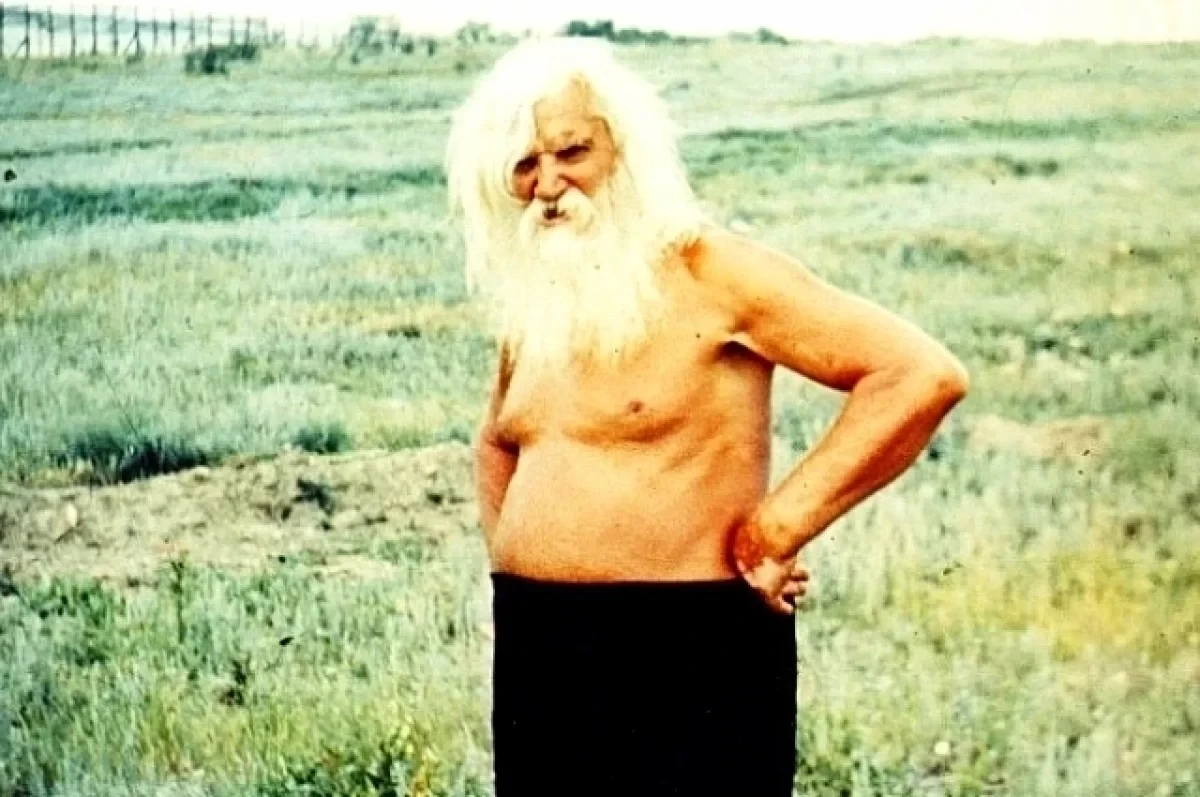
"The fact that Ivanov lived to be 85 years old is more of an exception that proves the rule. His body was non-standard, that is obvious. But making a method out of an exception is dangerous. Every year, people come to us who decided to 'live like Porfiry' — and ended up in intensive care," says doctor Vladimir Kramskoy, reflecting on the methods of the 'folk healer' Porfiry Ivanov.
He walked barefoot on the snow and believed that nature was the main healer. He gained particular popularity in the 1980s, causing unprecedented interest after a publication in the magazine "Ogonyok" in 1982.
At that time, readers inundated the editorial office with letters asking for more details about the "healing" system. But what was it: a miracle, self-suggestion, or a deception of the century? The question is debatable. However, the rumor about the elder spread very widely at that time. However, Porfiry did not have time to fully enjoy his fame — he died in April 1983. Who was this extraordinary person, and what ideas of the elder with a beard and in underpants could find real embodiment in medicine?
"Came into the world naked"
"I met Porfiry Ivanov once. He was undressed, and it did not burden him," says psychiatrist and candidate of medical sciences Yuri Ellansky.
Ivanov considered April 25, 1933, as the date of his "awakening." Before that, the 35-year-old resident of the village of Orekhovka was no different from others. But one day he asked himself the question: why do comfort and clothing not protect against diseases? The conclusion was radical: a person came into this world naked, which means nature had already given him everything he needed.
After moving to Krasny Sulin (a city in the Rostov region), he grew a beard, refused outer clothing, and went wandering around the surroundings. Barefoot, in only knee-length underpants, he walked on the snow. And he did not get sick! Then people began to flock to him. 55 years ago, students of the folk healer, about whom many tales and legends circulate, built a house near Lugansk where Porfiry Ivanov lived and received visitors.
Ivanov was even placed in psychiatric clinics with a diagnosis of schizophrenia. As priest Alexey Slyusarenko writes in his book, in 1936, Porfiry was hospitalized in the Rostov Psychoneurological Clinic.
"There is also a certificate about that treatment. Here is its content: CERTIFICATE No. 119 is given to the patient Ivanov Porfiry Korneevich stating that he was in the psychoneurological clinic due to chronic mental disorder in the form of schizophrenia. Capable of light physical labor," the author clarifies.
In total, he spent about 12 years in hospitals, places of imprisonment, and under house arrest. Critics ridiculed his methods, but the flow of followers only increased. And he kept telling everyone the same thing: pour water on yourself, walk barefoot, listen to nature.
Did Porfiry Ivanov Suffer from Schizophrenia?
Recalling his meeting with Porfiry, psychiatrist Yuri Ellansky from Timur Mamedov's clinic says he saw the elder when he came for an appointment with associate professor Oleg Yakovlevich Siletsky. This was still in 1982.
"The meeting took place at the Department of Psychiatry of the Rostov Medical Institute. They had known each other since the 1950s, and Siletsky had observed him for a long time. Associate Professor Siletsky believed that at the time of the meeting, Ivanov was in good condition, practically healthy. Previously, he had found signs of deviations in him, but they did not have the character of an acute psychotic state; they manifested more as the presence of overvalued ideas, which is not psychosis in the classical sense, and the strange behavior stemming from these ideas," the psychiatrist shared his memories.
According to him, the debate about Ivanov's illness has not subsided to this day. And it would be incorrect and unprofessional to make diagnoses retroactively now.
"His ideas live on and find followers. This means there was and is benefit for people in them," believes Yuri Yuryevich.
Porfiry Korneevich's biography has many pages that cause bewilderment and even disputes. In 1936, Porfiry Ivanov, in an outrageous appearance — barefoot and in underpants — went to Moscow. He intended to express his remarks on the Constitution to Stalin.
As Ivanov's biographer Slyusarenko clarifies, the trip to the capital took place in November. When the elder in underpants entered the carriage, the conductors were too embarrassed to ask him for a ticket. Later, Porfiry would write in his memoirs that he managed to travel cleverly, without a ticket. In Moscow, Ivanov was detained only when he queued for the registration of delegates to the congress.
An equally strange fact is that allegedly Porfiry cured himself of cancer in two weeks. This was in 1967. On September 26, Ivanov, as priest Slyusarenko writes in his book, discovered cancer in his right leg. After 15 days, the tumor, the elder wrote in his notebooks, seemingly disappeared.
At the same time, doctors are skeptical about this story considering that the ailment was never officially diagnosed at that time.
"Cryosurgery is indeed used to remove warts, papillomas, precancerous formations: liquid nitrogen at minus 196°C freezes and destroys tissue," commented doctor Vladimir Kramskoy, adding that it is unlikely that the method described by Porfiry refers specifically to this method.
The Legacy of Porfiry Ivanov
Porfiry died slowly, and after his death, he bequeathed to pour cold water on his body for three days. He also forbade anyone to mourn him. His main "legacy" became a system of rules that the elder claimed helped in healing. Many believed him, saying it helped. He urged people to give up alcohol and cigarettes, to temper themselves, and to live in harmony with nature. This had a colossal effect on many.
Today, the number of followers, by various estimates, may reach several thousand people. At the same time, there is no single organization for the "students." About 10,000 people are members of thematic groups on social networks. Several websites dedicated to Ivanov's teachings have also been created.
Ivanov's grave is modest: without a monument or cross. He found his final resting place on the edge of the cemetery of the village of Verkhny Kondryuchiy.
Cold in Medicine
Additionally, doctors do not rule out that cold can be an effective method of healing. As Vladimir Kramskoy explains, cold in medicine is a working tool.
There is also a method of cryoanalgesia: it allows blocking pain in neuralgias, phantom pains, oncological diseases — the nerve is frozen, and the pain goes away. Cryodestruction is used for cervical erosion, hemorrhoids, and inflammation of the adenoids. Local hypothermia reduces swelling and pain in injuries and joint inflammation. Therapeutic hypothermia — artificial cooling of the body to 32–34 degrees — reduces the brain's need for oxygen and decreases the risk of neurological damage.
Is Tempering by Porfiry's Method Dangerous?
Doctors agree that those who decide to temper themselves should adhere to a number of rules.
"Cold adaptation is a real physiological mechanism. With short-term cold exposure, the body releases adrenaline and noradrenaline, activates the immune response, and increases vascular tone. But the key word is short-term. Pouring icy water for 30–60 seconds is a stress that a healthy body can handle. However, walking barefoot on snow for hours, like Ivanov, is already an extreme load. For most people, this will end in frostbite and pneumonia, not enlightenment," explained Vladimir Kramskoy.
Veteran medic Tatyana Evsigneeva explained that tempering involves constantly keeping the body in tone so that infections are not scary.
"For example, swimming in an ice hole is contraindicated in a number of diseases and conditions. This is fraught with the fact that a sharp temperature drop can lead to stress for the body, exacerbation of chronic diseases, vascular spasms, or other dangerous complications. Immersing in an ice hole or pouring water on oneself is contraindicated for people with cardiovascular, central nervous system, musculoskeletal, oncological, and endocrine diseases," the medic concluded.
Thus, before starting this process, it is essential to consult with a treating physician or therapist.