
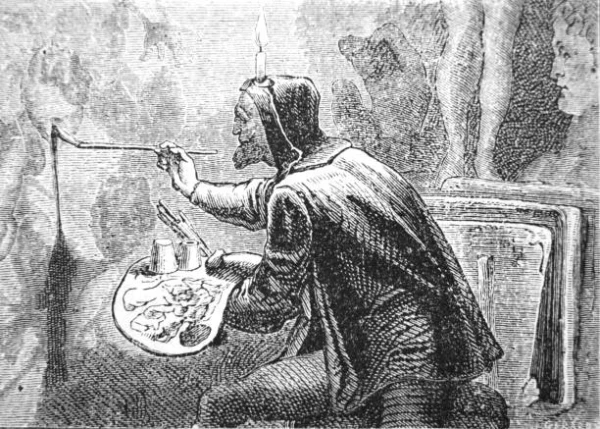
The secret room intended for storing the master's works could be located in the church.
Renaissance artist Michelangelo ordered his students to hide some of his works in a secret room to preserve them for future generations. This statement was made on Wednesday by Italian researcher Valentina Salerno. If the researcher’s hypothesis is confirmed, scientists may be able to find previously unknown works by Michelangelo.
According to the famous 16th-century art historian Giorgio Vasari, author of the renowned "Lives of the Most Excellent Painters, Sculptors, and Architects," shortly before his death in 1564, Michelangelo burned a large number of his own paintings and sketches.
However, Valentina Salerno claims to have discovered previously unknown archival documents that indicate a different fate for the paintings:
"One of the three unpublished documents I found in the archives mentions a room that was kept by the students of Michelangelo's school. Its history begins during the artist's lifetime," Salerno told AFP at a press conference in Rome.
"Inside the room, valuables are hidden. They are locked in such a way that accessing them requires a system of multiple keys. No one could enter without the consent of the others," the researcher explained.
Salerno was working on a book about Michelangelo when she came across a document indicating that in 1550 the artist joined the Brotherhood of the Holy Crucifix. This religious association operated in Rome, and the people who were close to Michelangelo in the last years of his life were also members.
Further searches took more than ten years. The researcher traced a chain of documents in various archives – in the Vatican, in different cities of Italy, as well as in European centers, including Paris.
According to her, Michelangelo devised a true "maniacal plan" to ensure that his legacy did not pass to a nephew whom the artist, according to the researcher, could not stand.
"The goal was to pass on to the poor, vulnerable, non-noble descendants the means to continue learning and to pass on art to future generations," Salerno conveys the essence of this idea.
The people involved in this scheme later created the famous Academy of Saint Luke – one of the most important artistic associations in 16th-century Rome. This academy still exists today.
Salerno suggests that the secret room intended for storing the master's works could be located in the church of San Pietro in Vincoli in central Rome. This church is known for housing one of Michelangelo's most famous sculptures – the statue of Moses.
During her research, Salerno discovered another curious detail: she found a mention of a bust in the Basilica of Sant'Agnese in Rome. This sculpture is currently attributed to an unknown master.
However, Salerno found in documents from past centuries that the white bust of Christ the Savior was directly linked to Michelangelo's name.
In the 1930s, mentions of the sculpture unexpectedly disappeared from documents. Then, in the 1980s, it reappeared in sources, but its authorship was attributed to a little-known artist.
Later, Italian authorities responsible for cultural heritage protection officially declared that the bust was created by an unknown sculptor.
Nevertheless, Salerno insists that this is an authentic work by Michelangelo. She relies not only on archival documents but also on the external resemblance to Tommaso dei Cavalieri – a young Roman aristocrat to whom Michelangelo had a strong attachment at a certain point in his life.
Currently, Salerno's research is awaiting the process of peer review.











Leave a comment