The most famous specimens are worth millions of dollars.
For many years, several European countries have disputed the right to call themselves the homeland of the legendary Stradivari violins. Researchers from Switzerland, France, and Slovenia claimed that their forests provided the material for instruments with a unique sound. Now, the story has taken a new turn. An international team studied the growth rings of nearly 300 violins made by the Italian master and determined the specific locations from which Stradivari sourced the material for his finest creations.
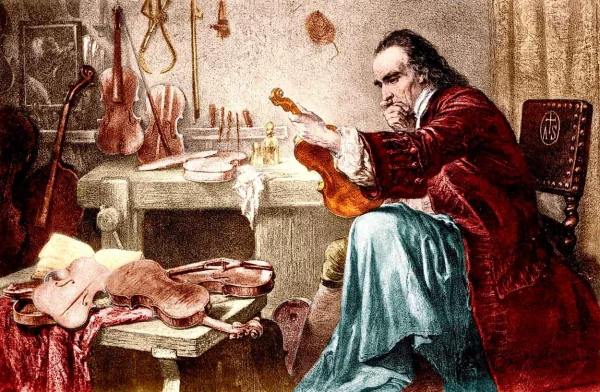
Antonio Stradivari was a master of string instrument making who lived at the turn of the 17th and 18th centuries in the Italian city of Cremona. Throughout his long life, he produced over 800 instruments. Most of them were violins, but there were also cellos, violas, guitars, and even one harp.
Today, his creations are not just musical instruments. They are artifacts, as well as investments and cultural treasures; they are used in concerts, displayed in museums, and sold at auctions. The most famous specimens are worth millions of dollars. One of the main reasons for such prices is their unique, unparalleled sound.
The top plate is especially important—it plays a key role in shaping the resonance and timbre of the instrument. Typically, the top plate is carved from spruce. The density, stiffness, and structure of the wood all directly affect the voice of the future violin. Therefore, the choice of wood was of paramount importance for Stradivari.
For a long time, it was believed that Stradivari used imported wood from Switzerland or even the Balkans. Italy was not particularly considered. However, this changed with a scientific study of growth rings by an international team of dendrochronologists led by Mauro Bernabei from the Institute of Bioeconomy at the National Research Council of Italy, published in the journal Dendrochronologia. The scientists analyzed 314 rows of growth rings on 284 Stradivari violins and discovered the geographical region where the wood used for them originated.
The science of dendrochronology studies the growth and analysis of tree rings. Each year, a tree adds a new ring. If the year was rainy and warm, the ring is wide. If it was dry, the ring is narrow. Their alternation creates a unique pattern, like a fingerprint. This pattern can determine not only the age of the tree but also the location where it grew, as the climate varies across different regions.
In simple terms, the sequence of rings in a cross-section resembles a barcode that reflects the climatic conditions of each year in the tree's life. These barcodes can be easily measured and compared.
To understand where the trees used for Stradivari violins grew, it was necessary to compare the patterns from the instruments with wood samples from different regions. Bernabei's team turned to the International Tree-Ring Data Bank, which contains information about rings from more than 6,000 locations worldwide. This database holds data not only on modern trees but also on old wood—such as construction beams used in the building of churches and castles.
The researchers grouped violins with similar rings and created an averaged sample for each group. They then compared these samples with those from the database.
For half of the violins—especially those made before 1700—the scientists could not precisely determine the region of origin, only narrowing it down to Switzerland and Austria. For the remaining specimens, they were able to pinpoint the location.

Bernabei and his colleagues found compelling matches with trees from the high-altitude forests of the Val di Fiemme in the Italian region of Trentino. Almost all violins from this group belong to the so-called golden age of Stradivari—a period from 1700 to 1725. It was during this time that the master created his best and most expensive works. The scientists suggested that, having found the ideal source of wood in Val di Fiemme, Stradivari did not change it anymore. The quality of the material allowed him to fully express his talent.
However, experts warned that it is not just about the wood. The wood itself does not guarantee outstanding sound. The secret of Stradivari's instruments lies in the combination of excellent wood and the craftsmanship that allowed for the full realization of its acoustic potential.
<iframe width="560" height="315" src="https://www.youtube.com/embed/IExvLaUoRbc?si=hr8m8OhRq0Z6TdBQ" title="YouTube video player" frameborder="0" allow="accelerometer; autoplay; clipboard-write; encrypted-media; gyroscope; picture-in-picture; web-share" referrerpolicy="strict-origin-when-cross-origin" allowfullscreen></iframe>