
In small towns, you can not only see many interesting things but also eat deliciously.
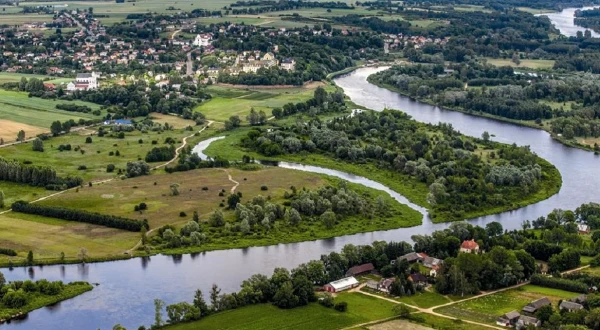
Drohiczyn is a small town in the Podlaskie region, located on a high bank of the Bug River. Its population is no more than 2,500 residents. However, tourists traveling through Podlaskie land invariably stop here.
Drohiczyn is first mentioned in the Kyiv Chronicle under the date "1142." Archaeological research provides grounds to believe that it was founded in the first half of the 11th century, on the high right bank of the Western Bug. Over the centuries, Drohiczyn has been under the rule of various princes: Western Ruthenian, Mazovian, and Lithuanian, says the mayor of the city, Wojciech Bożym.
Wojciech Bożym: "Drohiczyn is the historical capital of Podlaskie. For 300 years, it was the capital of the Podlaskie Voivodeship. I always wish the current capital of the voivodeship — Białystok — to be the capital of the Podlaskie Voivodeship for at least as many years as Drohiczyn was."
By the way, Białystok has been the capital of the region since 1919. And Drohiczyn indeed attracts with its ancient history. It played an important role in the major transit trade of Poland, Kyivan Rus, and Western European countries. About 15,000 lead commodity seals have been discovered within Drohiczyn. For comparison, the second place in the number of seal finds is held by Veliky Novgorod, with 400 seals, says the tour guide from Drohiczyn, Paulina Szymańska.
Paulina Szymańska: "When in Drohiczyn, it is worth climbing Castle Hill. Its name indicates that a castle once stood there, but unfortunately, neither its image nor description has survived. Along the way, you can also see a bunker from the Soviet era. This was a secret place where ammunition and electrical devices were stored. It is worth climbing Castle Hill to enjoy the panorama of the Bug River and the view of the Mazovian Voivodeship, which stretches along the left bank of the Bug."
The view from Castle Hill is simply stunning, breathtaking. The Bug River, which makes a sharp turn here, is one of the significant tourist attractions of Drohiczyn, asserts the mayor of the city: Wojciech Bożym: "We have organized kayaking trips on the Bug. Without the help of local entrepreneurs and our residents, we would not have been able to develop this. Now, we plan to improve the riverbank so that people can relax and camp here. So that the Bug becomes more accommodating, so to speak, for tourists."
The tour guide, however, warns: Paulina Szymańska: "The Bug is a very deceptive river. Its bed is at some points 5, and even 9 meters deep. This river should not be taken lightly. Many people have lost their lives here while rafting. The Bug is the wildest river in Europe."
Nowadays, the small Drohiczyn (population just over 2,000) is still the capital — of the Drohiczyn Roman Catholic Diocese, and it is also home to a Spiritual Seminary. Tourists traveling through Podlaskie land invariably stop in Drohiczyn to visit the diocesan museum, says its director, Father Zenon Chumaj.
Zenon Chumaj: "Visitors come to us from all over Poland, as well as from abroad. Although, it must be said that our museum does not have masterpieces of visual art, we do have paintings of quite a high level, as well as unique collections of religious cult items. First of all, this is a collection of liturgical vestments for priests: rare ornates, richly decorated, from the late 16th to early 20th centuries. You will see how well everything has been preserved: the vestments have not yet been restored, and they are already over 400 years old. For example, the vestments that once belonged to the Radziwiłł family from the church in the area of Mir, which is now Belarus. According to tradition, the ornate was sewn from the cloak of Prince Mikołaj Krzysztof Radziwiłł, nicknamed Orphan."
In the diocesan museum in Drohiczyn, there is the largest permanently exhibited collection in Europe and the world, not only of vestments but also of woven belts that were once worn by the Polish nobility — each measuring 3.5 meters in length. Director Father Zenon Chumaj says that there are also items of religious cult made of metals, mainly silver, that evoke pride: Zenon Chumaj: "The collection of monstrances can be called a gem. Each of them is a work of art and attracts the eye. There is a monstrance of the Uniate rite. Only five or six of these have survived in Poland. This is a unique item because in the Eastern rite — Orthodox or Greek Catholic — there is no tradition of adoration (veneration of the Holy Gifts). And in the Podlaskie region, at the request of the faithful, this element of the cult was introduced in churches, borrowing it from the Latin rite. In the tsarist times, when Uniates were persecuted, these monstrances were destroyed. Therefore, only a few remain not only in our region but also in Poland in general. We have a monstrance from the church in the area of Merniki."
Unique on a global scale is a monstrance from the time of World War II, says the museum director: Zenon Chumaj: "It was made by participants of the Warsaw Uprising. A group of residents from the Bielany district of the capital, after the suppression of the uprising, ended up in a concentration camp in the city of Lübeck in Germany. They secretly made a monstrance, using fragments of a British plane that was shot down by the Nazis. This monstrance is not only an example of craftsmanship and skill but also a testament to the great faith, courage, and patriotism of the Poles. It is a unique exhibit on a global scale. A documentary film has even been made about it."
But that’s not all the attractions of the city: Paulina Szymańska: "In Drohiczyn, you will see many wooden houses, mainly from the early 20th century. This is a unique phenomenon in Poland. When tourists from the western part of the country come to us, they are very surprised because you won’t find such houses there anymore. In Drohiczyn, there are three Catholic churches and an Orthodox church. The churches were built in the 17th-18th centuries when the city was the capital of the Podlaskie Voivodeship: the cathedral, a church that once belonged to a Franciscan monastery, and a church of a Benedictine women's monastery. All the churches have withstood the tests of history. Imagine that both the Germans during the occupation and the Soviet authorities turned them into stables and garbage dumps — they used our churches like barbarians."
It is worth visiting the historical and cultural park "Bug — the Borderland of Cultures and Religions": Paulina Szymańska: "The park has two objects, the first — wooden, which houses the only museum in Poland dedicated to canoeing and kayaking. The second object — stone, on the first floor there is an exhibition of 44 motorcycles. All of them are from a private collection, which consists of more than 200 motorcycles. The exhibition features unique and rare ones. If you type the names of some motorcycles into an internet search engine, you won’t get any results: for example, the Armor from 1914 or the Klement motorcycle from 1927. These are our gems. On the second floor of the stone object, there are permanent exhibitions: archaeological, ethnographic, and postage stamps.
"In Drohiczyn, you can not only see many interesting things but also eat deliciously," assures the mayor of the city. Wojciech Bożym: "In recent years, we have observed that tourism is developing in the commune, particularly thanks to the Culinary Route of Eastern Poland, which was created at the initiative of the marshals of three voivodeships: Podkarpackie, Lublin, and Podlaskie. The goal of this project is to promote traditional, almost forgotten Polish food products and dishes that our grandmothers and great-grandmothers used to cook, and they were very tasty."
It is only worth adding that the hospitality of the residents of Drohiczyn, as well as the entire Podlaskie region, is unmatched, so we invite you, dear radio listeners, to visit this city and region.








Leave a comment