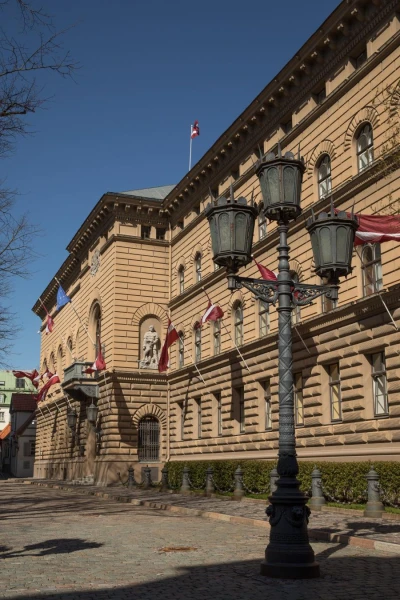
The Saeima building, constructed in 1867 as the House of Livonian Nobility, is located on the site of the ancient cemetery of St. James's Cathedral, writes Otkrito.lv. Although this burial site spans several centuries, it emits what is known as negative energy. What do clairvoyants and paranormal specialists say about this and how might it reflect on the work and well-being of the deputies?
During archaeological excavations conducted seven and a half years ago near St. James's Church, literally at the doors of the Saeima, an extensive medieval cemetery was discovered, and there are reasons to believe that human bones still rest under the cobblestones in the direction of Klostera and Jekaba streets. Archaeologist Arthur Thomson, under whose supervision the excavations took place, stated at the time that a full archaeological study near the church or within the church had not actually been conducted before. The historical excavations were prompted by the fact that workers digging trenches for engineering communications near the church wall stumbled upon human bones. During the excavations led by Arthur Thomson, about 300 burials were recorded — some bones were reburied, while others were handed over for further study to the bioarchaeological laboratory of the Institute of History of the University of Latvia.
Bone Chamber Under the Saeima and the Cathedral
The territory of the cemetery, extending towards the Saeima, was considered part of the burial ground for poor parishioners. In turn, the sunny southern side facing the Dome Cathedral was considered more prestigious. The House of Livonian Nobility, the current Saeima, built in the mid-19th century, was erected right on top of the cemetery.
During the excavations, the last, concluding phase of the medieval cemetery was revealed — mainly the 17th century and a little of the 18th century, that is, the very top layer. After that, the cultural layer practically ceased to accumulate. The layer of burials begins just below the cobblestones, at a depth of about 1.7–1.8 meters towards the Saeima. The deepest point of the excavations reached just over three meters. This allowed for the establishment of 10–11 levels of burials, with the last reached dating to about the 15th century, but they did not dig deeper. The layer from the 13th–14th centuries remained untouched, however, it was evidenced by individual items that over time ended up in the upper layers of soil.
There were not particularly many finds — tiles and fragments of ceramics, Riga coins from the 16th century, and Swedish shillings from the 17th century. In Christian traditions, when buried in a shroud, burial items were rarely found — occasionally a simple clasp or a knife. Later, archaeological excavations continued in St. James's Cathedral itself.
Three years ago, representatives of the Catholic Church stated that to express due respect for the bones and skulls found during the major renovation of the cathedral's floor, the first ossuary in Latvia would be created in the cathedral — a bone chamber.
However, it is much more interesting how the ancient medieval cemetery affects what happens in the Saeima building and the work of the deputies.
Binary Energies
Valery Paramonov, the head of the Latvian Association of Esoterics and Parapsychology, emphasizes that both humans and the Earth function in a binary energy system — with positive (plus) and negative (minus) polarity: any place where people live or work accumulates a certain energetic and informational imprint, and places where cemeteries once were or tragic historical events occurred have particularly strong influences.
photo: press photoValery Paramonov, head of the Latvian Association of Esoterics and Parapsychology. If a building is constructed on a site where a cemetery once existed, that place retains information about the people buried there. He refers to cases where archaeological excavations uncovered trenches with hundreds of bones — for example, about 300 burials in one location. Such places, in his opinion, cannot be considered "neutral." An energetic field remains at burial sites, which can influence the buildings erected there and the people working or living in them. If this energy is negative or "unprocessed," it can cause tension, conflicts, or even health problems, including thoughts of suicide.
The fact that the building of the Latvian Saeima is constructed on the site of an ancient cemetery may influence both the energy of the building itself and the decisions and processes occurring within it. The historical layer of the place — especially if it is associated with burials — creates a background that affects the thinking and behavior of people. If this background is negative, it can contribute to disagreements, destructive decisions, or overall tension.
Valery Paramonov repeatedly emphasizes that the thought and intention of a person (goal) are of crucial importance. A person is a binary being, existing between plus and minus. If a person consciously or unconsciously "chooses" negative thinking, they amplify the negative energy. The accumulation of such negative energy can manifest on a physical level — for example, in the form of oncological diseases or alcoholism. Therefore, it is important to work with one's thoughts, discipline, and cleanse them.
Spires of Sanctuaries Neutralize Negativity
In contrast to secular buildings constructed on cemeteries, Valery Paramonov cites sacred places — churches, monasteries, such as the Vatican, the Pskovo-Pechersky Monastery, the Kyiv-Pechersk Lavra, and others. In such places, services are regularly held, sanctities are used, bells ring — and this creates a positive, cleansing energy.
The service occurring in churches is a way to neutralize the negative background. In ordinary apartments and offices, there is no such work with energy, so negativity can accumulate there. He recommends using candles or incense as a symbolic method of cleansing the home, as well as blessing the premises with a clergyman.
The positive energetic influence of the church on buildings constructed on ancient cemeteries extends beyond the temple walls (this depends on the height of the temple tower) — within a radius of 500 or even 1000 meters. Two Catholic churches are located near the Saeima — St. James's Cathedral and the Church of Mary Magdalene, which can neutralize negative energy.
"The Remains Should Be Collected"
The clairvoyant Agnese Ziediņa believes that it should not be the case that the location of a building on the site of an ancient cemetery causes negative influence: "It shouldn't be like that. The remains should be collected and respectfully reburied in some other, neutral place. From a purely ethical point of view, it is wrong to walk over bones every day."
Sensitive individuals may find it difficult to be in a building constructed on the site of an ancient cemetery, as the remains of the deceased carry quite heavy energy. Such people may complain of fatigue, weakness, poor health, inexplicable anxiety, and worry. It may be hard to concentrate. Sometimes unexplained physical symptoms may arise. However, less sensitive people generally do not experience any unpleasant emotions. And the influence is no different from if people were working in some museum where human remains are present," says Agnese Ziediņa.
"Then We Would Have to Demolish All of Latvia!"
A representative of the Ezoterika Tev website stated that she sees no problem in some buildings and structures in Latvia being built on centuries-old cemeteries, as there were no churches in Latvia that were not located near cemeteries. If we did not want to see any buildings "on bones," we would essentially have to demolish almost all of Latvia — not just the Saeima building, because historically, it is unlikely that there is a place where someone has not died or been buried.
For example, a kindergarten in Rujiena or an art school in Agenskalns are located near cemeteries; multi-storey buildings in Purvciems would have a bad aura, as they are built on the site of a former swamp where people died at different times and as a result of various events. In turn, thousands of soldiers died on the banks of the Little Jugla during World War I, and today private residential areas stretch there.
Of course, there are clairvoyants and seers who make money by reporting scary and sensational news in the series "everything is bad.lv." But this is not serious, because it is not an issue worth "breaking spears" over. If some member of parliament commits bad deeds and "is not in tune with their head," then the problem is not that the parliament building is built "on bones."