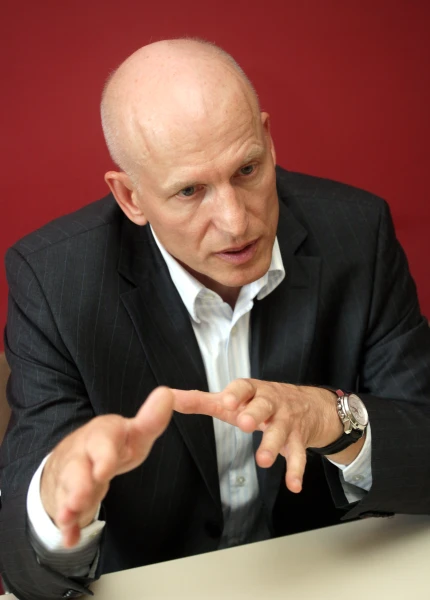
Russian director Alexander Pasechnik, born in 1978, wrote an emotional post on Telegram - he compared Soviet and Russian cinema and made disheartening conclusions about the images through which youth is educated. Soviet cinema embodied the ideal of kindness, while Russian cinema embodies degradation, the director believes.
Russian director Alexander Pasechnik writes, quote:
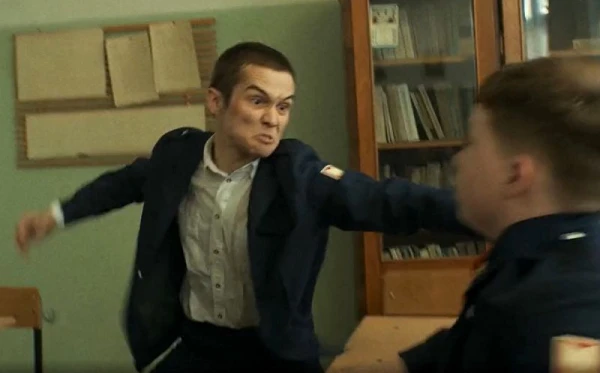
"Russian 'KinoPoisk' ranked 'Word of the Guy. Blood on the Asphalt' as the best Russian series in recent years. For me, this sounds like a verdict on Russian cinema. The country of Pushkin and Gogol, Shukshin and Tarkovsky has sunk to the level of thugs and criminal subculture. There is nothing more to glorify, nothing to be proud of.
Cinema is certainly a mirror reflection of society, but only partially. If we talk about cinema as an art form, not as a commercial product, it must, it simply must - soften people's hearts, call for good, show positive examples. Cinema without a moral idea turns into a tool for dehumanization!
It is precisely dehumanization that Georgy Kryzhovnikov, a successful director of modern Russia, is engaged in with his 'Gorko' and 'Word of the Guy'. Audience success is now the main measure of art. For this, any piece of crap can be smeared on a plate and presented to the content consumer: Eat up, gentlemen!
What bothers me the most about such films? Firstly, the predominance in modern Russian cinema of stories that depict the degradation of personality rather than its ascension. Secondly, the justification of evil. It seems that the authors of the series 'Word of the Guy' condemn evil in the end, but this constant savoring of darkness, trash, and baseness trains the viewer to think that this is how it should be, that this is how it was and will always be. In any case, during the viewing, the audience falls in love with and empathizes with THIS kind of hero. And his image in this form and his actions are ATTRACTIVE and serve as a model to imitate for the viewer.
Gogol, in an attempt to show the moral rebirth of Chichikov, tore up and burned the second volume of Dead Souls. But the genius writer at least set such a task. An incredibly difficult creative task. Dostoevsky dealt with this as well, for example, in the novel 'The Idiot', showing the moral image of Prince Myshkin.
In Soviet cinema, a cohort of actors emerged who managed to convincingly embody the Ideal of their generation. These include Vyacheslav Tikhonov, Yuri Solomin, Smoktunovsky, Nikulin, Shukshin, and Papanov.
This is exactly why we love Soviet cinema - for the kindness and depth of the images. For the striving for the Ideal. This is why Soviet cinema became great and is known throughout the world.
'Word of the Guy' is degradation wrapped in an attractive cover. Instead of the maturation and coming of age of a boy, we see his moral decline. A series of spiritual substitutions is happening in the minds of the younger generation. Evil has become attractive, charming. It is romanticized and no longer seems so repulsive. Thieves, bandits, and criminals have become the heroes of our time. Meanwhile, the state shyly blurs out smoking people on screen. It makes one want to remind of the words from the Gospel: 'Blind leaders, straining out a gnat and swallowing a camel!'
PS. Yes, I watched all the episodes very carefully until the end. And now, come on, tell me, a film director by education, that I am wrong and that I 'did not watch but condemn.' However, this is just my purely personal opinion. If you like it - keep eating.