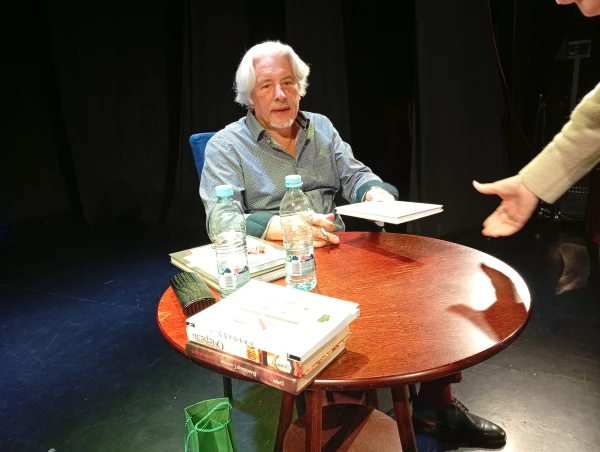
Vladimir Sorokin is perhaps the most famous contemporary writer in the world writing in Russian. He recently visited Riga for a creative meeting that took place at the Riga Jewish Community House. And presented... “The Tale.”
From classics to social realism. And back
Vladimir Georgievich was born near Moscow 70 years ago. A Russian writer, screenwriter, and playwright, artist. One of the most prominent representatives of postmodernism, conceptualism, and social art in Russian literature. The author of eleven novels, as well as a number of novellas, short stories, plays, and screenplays.
He gained fame for his provocative and satirical works that combine elements of dystopia (“Day of the Oprichnik”), alternative history and science fiction (“Blue Lard”), and grotesque (“Norma”). One of Sorokin's recognizable literary techniques is stylistic mimicry; in his novels, he imitates various literary styles, from social realism to classical Russian prose.
As a writer, he formed among artists and writers of the Moscow underground of the late 1970s and 1980s. In 1985, the first collection of six of Sorokin's short stories was published in the Paris magazine “Syntax.”
“The Children of Rosenthal”
The first official publication in the USSR dates back to 1989, when the Riga magazine “Rodnik” published several of the writer's stories in its November issue. Shortly thereafter, Sorokin's stories began appearing in Russian magazines and almanacs. He has long lived in Berlin.
In Russia, Vladimir Sorokin's works have repeatedly become the subject of public discussion. On March 23, 2005, the world premiere of the opera “The Children of Rosenthal” by composer Leonid Desyatnikov, with a libretto by Sorokin, took place at the Bolshoi Theatre in Russia. The opera tells the story of clones (“doubles”) of great composers — Wagner, Verdi, Mussorgsky, Tchaikovsky, Mozart — created by Alex Rosenthal, a scientist who fled from Nazi Germany to the USSR.
It was this opera that Vladimir first recalled when he took to the Riga stage. “I am very glad to be back in your wonderful city,” he said. “The last time I was here, to my shame, was a long time ago, probably 18 years ago. It was actually related to the Bolshoi Theatre's tour. ‘The Children of Rosenthal’ is infamous and dearly loved.”
“How beautiful are our native trash heaps!”
And then about “The Tale”... An amazing read! To fit so much into 140 pages! A tale of how after a nuclear war, Vanya wanders through the trash heaps (“How beautiful our native trash heaps are in spring!” – this is how the little book begins).
Through the tale – into postmodernism in various styles. Vanya meets a three-headed dragon, three heads named Lev, Fedor, Anton. They clearly evoke Tolstoy, Dostoevsky, Chekhov. Moreover, the final Chekhov and his “Cherry Orchard” – in 2096 on Mars, in the form of dramaturgy, where a monument to Elon stands (guess who?). Meanwhile, the heroine of the play Ranevskaya pays with Ilons, while Lopakhin shouts that “All of Mars is our garden!” Utopia and dystopia. Science fiction. Tragicomedy. Grotesque. A little sadness. A fairy tale. And all of Russia under this soft cover.
Russia of the past, present, and future. Not to mention what an amazing literary language all this is written in. And that “The Tale” is one of those rare cases nowadays when you want to read books.
“When we talk about something being fairy-tale-like, that life has become fairy-tale-like, we immediately imply something good by default,” says the writer. “It seems to me that our current life is very far from being good, but it is extremely fairy-tale-like. And I would say that not only in Russia, but actually we are all living in such a fairy-tale unpredictable era. And as Vitya Yurofeev said, we do not know what will happen to us this evening.”
Three Heroes
The main character is either Ivanushka the Fool or Ivan Tsarevich. He dreams of happiness coming into his life and finds three magical helpers – Lev, Fedor, Anton.
“And they are all bearded,” smiles Sorokin. “But with beards of different configurations. They even meet, probably, first-graders in classes where their portraits hang. And you haven’t read it yet, you can’t imagine what it is. But you already know what they look like and that they are great. And somewhere above you, they hover. Moreover, Marx and Engels are no longer there, but these are still here. They are at the level of such mythological beings. But if you go into any Western bookstore, you will see books by these bearded men. And they are still being sold, printed. And, in fact, films are being made about them, plays are being staged. They are still discussed. They are referenced not only by philosophers but also by politicians. This indicates that these three heroes are indeed powerful people. This is classical Russian literature, which is already part of world culture. And it cannot be pushed out from there. Fortunately. Because I really love good literature. And this is still good literature.”
“This is a very good story”
Sorokin did not forget that his first publication in the USSR happened precisely in Riga, in the progressive literary magazine “Rodnik.”
“I am very grateful to it – it was indeed a spring, a living word. A lot of new and relevant things were published there. Although the very first publication was in 1985 in Paris, in the émigré publishing house “Syntax.” That happened, and I calmed down. Moreover, it was Paris, not the least place.
And in the Soviet Union, four years later, there were stories in “Rodnik.” I cannot say that it radically influenced me. It is not publication that has a radical influence, but when some smart person says, ‘Volodya, this is a very good story,’ and that is more powerful than any publication. This was said to me by Erik Bulatov, who recently left this world.”
A few words about the stage. The third part of “The Tale” is so theatrically described, even scenographically! Are you planning a production? Especially considering that in 2003, at the theater directed by Alvis Hermanis, the Sorokin work “Dostoevsky trip” was staged by director Girts Ecis.
“Yes, actually, this is the Chekhov part. On Mars. In some future. In a correctional colony, they are staging “The Cherry Orchard.” The thing is, I am not much of a theatergoer. I cannot say that it is my favorite genre. For me, it is a dangerous genre. And Hermanis is a magnificent director. He also staged “Ice.” And someone will probably stage the Martian “Cherry Orchard.” But I will never be involved in that.”
...And about money. “In our family, there were never any spare funds. They were for living. We could never save anything for a rainy day. This is the life of a writer who does not write detective stories, romance novels, or genre works. I really write literature for my readers. Not for everyone, actually. That’s why I remain hungry. Although there has always been enough for bread. Thank God!