They tried to literally squeeze the maximum out of the available resources in a poor country.
Everyone who has faced renovation and chose parquet as a flooring option knows that while it looks quite beautiful, it is not cheap and requires complicated maintenance. Even in the USSR, it was preferred, as parquet was laid in a herringbone pattern in hastily built Khrushchyovkas even back then.
The thing is that at the time of mass construction of Khrushchyovkas, there were simply no good, safe, and durable synthetic coverings. Wood for parquet was considered a cheap resource. In the USSR, parquet was regarded as an attribute of "cultural" urban housing. Unlike linoleum or fragile tiles, parquet could be relatively easily restored.
The Soviet Union was a "forest" state. Forests, which occupied a significant part of the area, were massively cut down for road construction, building new settlements, etc. For this reason, there was no shortage of wood in the USSR.
Moreover, much of it was a byproduct of production and was considered a cheap resource, as logging was often done by prisoners who were not paid for this work.
At the same time, during the Soviet era, the quality chemical industry developed significantly slower. Thus, by the time of mass construction of Khrushchyovkas (the late 1950s and 1960s), there were simply no good, safe, and durable synthetic coverings available on an industrial scale.
Linoleum was produced, but it was extremely scarce. Moreover, it was made on a fabric base using phenolic resins, had a sharp unpleasant smell, and low wear resistance.
Thus, the construction industry preferred the cheaper and more environmentally friendly parquet. Although its installation and maintenance were significantly more complicated. It is worth adding that there were two other alternatives — painted boards and ceramic tiles. But there were nuances — tiles were very expensive to produce and not very high quality – they easily broke from being hit by something heavy. And boards were associated with rural houses, as they had a rather unesthetic appearance.
Therefore, among all flooring options, parquet won in all parameters. Even in Stalin's times, artistic parquet with complex patterns was laid on the floor, while for "Khrushchyovkas" and later "Brezhnevkas," a standardized and maximally technological option was already used.
Such parquet was made from small wooden strips, and its production was streamlined at woodworking plants. This allowed for the use of not only high-quality wood but also relatively easy installation of parquet flooring in rooms of various sizes.
The next step was panel parquet. At factories, parquet strips were glued onto a base of particleboard or cheap boards. Such panels, measuring, for example, 50x50 cm, were significantly faster and easier to lay than each strip individually. The mass production technology was aimed at reducing costs and speeding up construction.
In the 1950s and 1960s, mass construction had not only a utilitarian but also an ideological goal: to provide each Soviet family, which often lived in barracks or communal apartments, with a separate apartment. It was meant to symbolize a new and higher standard of living.
Parquet, in turn, was considered an attribute of "cultural" urban housing. It was a step forward, a standard of improvement. Soviet construction philosophy was largely based on principles of practicality. This means that they tried to literally squeeze the maximum out of the available resources.
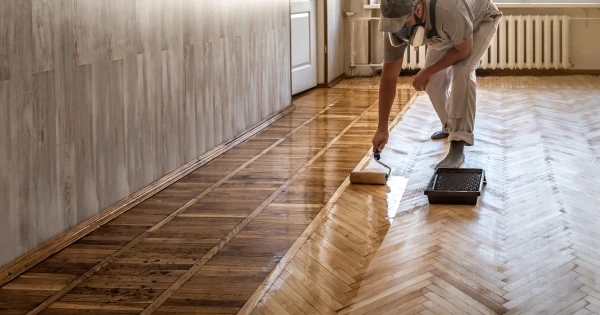
Unlike linoleum or fragile tiles, parquet could be relatively easily restored. It was sanded (the upper damaged layer of varnish and wood was removed) and re-coated with varnish. This procedure could be performed 5-7 times, thus returning the floor to almost its original appearance.
However, in the 1980s, when the Soviet Union was already close to collapse, the chemical industry began to develop rapidly, and linoleum started to be produced in abundance. And although it had a rather unesthetic appearance, it began to be used to cover floors in many apartments to simplify maintenance of the housing.