
Aborigines did not eat each other, science has established.
For a long time, scientists believed that the hundreds of giant statues on Easter Island were created by members of the local community under the leadership of a single chief. However, the authors of a new study have called this hypothesis into question. A detailed three-dimensional map of the main stone quarry on the island pointed to a more complex picture. It is likely that the monuments were the result of creativity and competition among small independent groups.
Easter Island, or Rapa Nui, is one of the most remote inhabited islands in the world. The nearest inhabited islands, Pitcairn, are located almost two thousand kilometers away. According to archaeological data, the first people arrived on Easter Island between the 12th and 13th centuries.
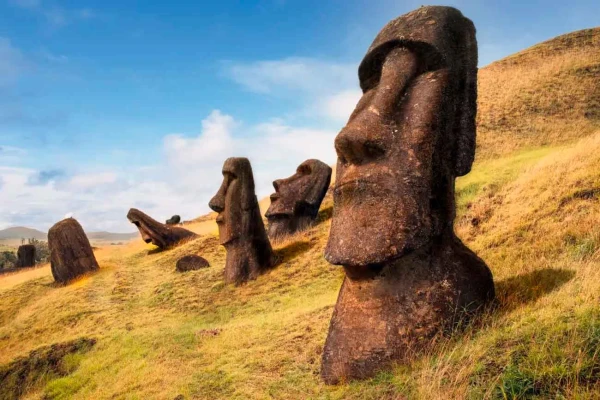
The main attraction of the island is the monolithic stone statues known as moai, which were created between the 13th and 17th centuries. To date, more than 900 statues have been discovered. The average height of a moai is about four meters, and its weight often exceeds 12 tons. Almost all moai were carved from volcanic tuff in the quarry of Rano Raraku, from where they were transported and placed on stone platforms (ahu) in various parts of the island.
Moai are generally considered to embody the "frozen faces" of revered ancestors, chiefs, or important clan members of the island — that is, these statues likely symbolized and immortalized power and lineage. It is assumed that the statues played the role of guardians and sources of "mana" (spiritual power) for the community.
For a long time, scientists debated who led the construction of the stone figures and how a small population could organize such a massive effort. According to a popular version in the scientific community, the work was carried out centrally, under the overall leadership of a single ruler. But other researchers doubt this: the moai look too different, as if they were made by different masters.
To resolve the mystery of the labor organization of the moai creators, a group of scientists led by Carl Lipo from Binghamton University in the U.S. conducted an analysis of the main quarry on the island, Rano Raraku. The researchers used drones and photogrammetry methods to create the first high-detail three-dimensional model of the quarry. This map allowed them to see every slope and traces of work. It became a kind of open book for the scientists.
Lipo and his colleagues analyzed every detail of the monument. They recorded 426 moai at various stages of completion, 341 trenches carved by ancient masters around the stone blocks (the trench outlined the shape of the future statue). Such a trench outlined the shape of the future statue. That is, these are traces of the beginning of work on the moai. In addition, they found 133 empty niches in the rock from which statues had already been extracted, as well as five stone pillars that served as anchor points. Ropes were tied to them to carefully lower the carved statue down the slope.
The analysis of the three-dimensional model showed that the quarry was divided into 30 separate work areas or zones. In each zone, Lipo's team discovered carving techniques and stone processing features unique to that area.
Lipo explained that all stages of creating a statue — from the first cut to the final touches — took place within the boundaries of one zone. If compared to modern examples, this resembles a network of independent workshops rather than a system where everything is directed by one center and where statues move from one department to another, like on an assembly line.
The new data fits well with what was already known about life on Easter Island. Previously, the same team of researchers proved that transporting the enormous moai did not require the labor of a thousand workers. A few people could "rock" the statue from side to side and literally "lead" it forward using ropes. Thus, transportation did not require centralized leadership and vast human resources.
For many years, the history of Easter Island was presented by scientists as a negative example of societal development and decline. Allegedly, its inhabitants deforested their lands, exhausted the soil, and then killed each other in wars, leading to famine and cannibalism. The authors of the new study assert that it was not like that at all.
From ethnographic records, it follows that Europeans brought previously unknown diseases to the Rapa Nui — and the population began to decline. In the 1860s, Peruvian slave traders attacked Rapa Nui and kidnapped at least a third of the inhabitants. Then a smallpox epidemic began on the island, after which only about 110 people remained alive.
In 2012, American archaeologists Carl Lipo and Terry Hunt, using a method previously proposed by Thor Heyerdahl, proved that moving the enormous moai a few hundred meters required the strength of 18 people and three ropes. This undermined the main hypothesis of a densely populated island during its peak (the period of statue construction).












Leave a comment