Maggie was not averse to a bit of mysticism.
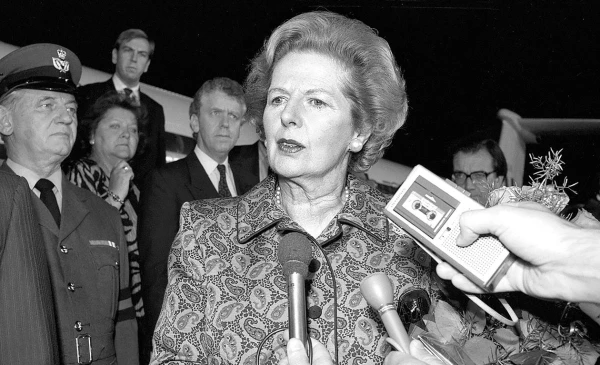
On October 13, Margaret Thatcher, the legendary Prime Minister of the United Kingdom and the first woman to lead one of the world's major powers, would have turned 100. Tough, authoritative, convinced of her almost messianic correctness, and literally obsessed with politics, she held office for 11 years – longer than any other head of the British government in the 20th and (so far) 21st centuries.
She entered history as the author of radical neoliberal reforms aimed at modernizing the British economy, which ultimately shattered the lives of hundreds of thousands of people. Under her leadership, in 1982, the Falklands War began between the United Kingdom and Argentina over a group of islands in the South Atlantic. And Thatcher won. As an authoritarian leader, she restored Britain's spirit of greatness, even though the once-mighty empire had crumbled and lost its former power. Her political style was dubbed 'Thatcherism': it became a household term symbolizing uncompromisingness, radical market liberalism, and a sharp rejection of any hint of socialism.
From Grocery Store to Prime Minister
Margaret Roberts (her maiden name) became interested in politics from a young age. Despite her father being a grocer in the provincial town of Grantham, he actively participated in local government and even held the position of mayor for a time, was a member of the Rotary Club, a Methodist preacher, and a staunch conservative. Political and religious debates were a constant in the family.
At school, Maggie studied diligently, easily gaining admission to Oxford. Paradoxically, despite her evident interest in public affairs, she chose to study not history or, for example, sociology, but… chemistry. After university, she even worked for a plastics company. However, none of this was what she truly wanted. Her main passion was still politics. Thatcher once recalled that during her student years, she tried cigarettes but decided not to continue smoking. Not because of health concerns, but because she needed to save money for her daily copy of The Times.
At university, Maggie immediately joined the local Conservative club and became very active: she spoke at Tory rallies and meetings, 'warmed up' the audience with passionate speeches during local election campaigns. As she later admitted, 'conservatism at that time lacked fire,' which she decided to add. Enjoying political battles and striving to win every argument, she derived genuine pleasure from the 'battle of facts and figures.'
At the same time, Maggie was not averse to a bit of mysticism. At one Conservative Party reception, she was persuaded to hear a fortune-telling about her future. The fortune teller asked Margaret to remove her pearl necklace, rubbed it in her hands, and proclaimed: 'You will be great – as great as Churchill.' The rational yet ambitious Thatcher was deeply touched by this episode. From then on, she considered her necklace a talisman of luck – in difficult situations, her hand always reached for it.
At 24, Maggie became the youngest woman candidate in a regional election campaign. And she had no intention of stopping there. Her career developed rapidly. Later, when she was already a member of Parliament, the tabloid Sun noted: 'The fierce blonde is smashing everything in her path.' As Minister of Education, she implemented a tough reform of school meals, abolishing the milk provision for children from low-income families. One newspaper even ran the headline: 'Is Mrs. Thatcher even human?'
An indomitable orator, she switched positions, ministries, and cabinets, bulldozing her way through. In 1975, she became the head of the Conservative Party and finally, in 1979, after a decisive victory for the Conservatives, she obtained the coveted prime ministerial seat. Soon, the changes became apparent to everyone.
Thatcher initiated a neoliberal revolution in the economy – launching the privatization of large state enterprises, cutting government spending, and shifting the focus from real industry to financial markets. All of this ultimately destroyed the model of the 'welfare state' that the Labour Party had tried to build for many years. Terrible unemployment and social depression ensued in many industrial regions. However, such aggressive monetarism led to a rapid growth of the financial sector, and London became the capital of global capital at that time.
'The Humanity of the Russians'
Thatcher was always known for her fierce hatred of socialism and communism. She despised the USSR to the core. She recalled how, during her youth in Grantham, she went to the cinema: 'I rejoiced at seeing Soviet communism mocked in “Ninotchka,” where Garbo, the stern commissar, is captivated by a woman's hat' (referring to the 1939 Hollywood film by Ernst Lubitsch – Ed.).
She viewed the USSR solely as a threat to the West, repeatedly stating that 'only American nuclear weapons separate Europe from communist tyranny.' As Prime Minister, Thatcher, by her own admission, 'kindly' reminded the Soviet Union that supposedly 'the most convincing evidence of the goodwill inherent in the United States was that during those critical years, when only America had the military power to impose its will on the world, it refrained from doing so.' This thesis is highly questionable, not to mention Vietnam, for example. But Thatcher was generally characterized by a cynical approach to foreign policy. Just recall the Falklands or the fact that she fully justified the American nuclear bombings of Hiroshima and Nagasaki: 'Only the level of technological superiority of the Allies… could convince Japanese leaders of the hopelessness of resistance.'
Margaret Thatcher visited the USSR several times and was one of the first among Western leaders – at the dawn of 'perestroika' – to assess General Secretary of the Communist Party Mikhail Gorbachev: 'He can be dealt with!' This was later confirmed, clearly to the detriment of our country.
Her trips to the Soviet Union were accompanied by an extensive program: she met with students, pensioners, and workers. And she later recalled: 'Yet due to the official propaganda, gray streets, empty shops, and poorly maintained block houses, the humanity of the Russians shone through. I had no doubt about the authenticity of the tears when elderly people in Leningrad and Stalingrad told me about their suffering during the war.' Thatcher (like many in the West to this day) was a hostage to her own, quite conditional, perception of the USSR – for it would indeed be strange to doubt the sincerity of personal and national grief when the country lost over 27 million people in the Great Patriotic War...
Conspiracy or Strategy
Numerous conspiracy theories surrounded Margaret Thatcher. In particular, about the 'special relationship' between the United Kingdom and the United States, which became even closer under her leadership. She had a fondness for American President Ronald Reagan. They became not only allies but also good friends. Both were staunch advocates of reducing the role of the state in the economy (Thatcher admired the principles of 'Reaganomics') and uncompromising critics of the USSR.
Thatcher believed that the alliance with the USA was far more important for London than European integration. All of this gave rise to talk of some kind of 'behind-the-scenes conspiracy.' Allegedly, the British Prime Minister became a puppet of American intelligence agencies, and her reforms were part of a global program to establish control by transnational corporations. At the same time, it is sometimes claimed that Thatcher played the role of an unofficial intermediary between Washington and Moscow, preparing the ground for disarmament agreements.
But even without any conspiracy theories, it is clear that the USA and the UK had a common strategy in both economics and foreign policy. For example, they deliberately isolated and weakened the USSR. To this end, the USA seriously pressured Saudi Arabia in the 1980s to not restrain oil production, while Thatcher actively promoted the development of oil fields in England. The goal was to drive down global prices for 'black gold.' All of this, of course, could not help but affect the USSR, whose budget depended on hydrocarbon exports, which largely brought it closer to collapse.
In any case, Thatcher truly became one of the architects of what we now call neoliberal globalization. She was wholly convinced of the correctness of her worldview, where the West, and especially the Anglo-American tandem, brings light, culture, democracy, and higher values, having the moral right to uncompromisingly insist that they be shared by all and in everything... It was she who laid the foundations of the post-bipolar world order, which is now painfully being replaced by another system.
Margaret Thatcher passed away in 2013 at the age of 87. The last decade of her life – ironically – she suffered from dementia and hardly appeared in public. It can be concluded that the British political scene has yet to produce a leader comparable in scale to Baroness Thatcher. But perhaps that is for the best?