“Marty the Magnificent” (Marty Supreme). Directed by Josh Safdie, starring Timothy Chalamet, Gwyneth Paltrow, Odessa Ezayon, Kevin O’Leary, Abel Ferrara. USA, 2025.
Past the Oscar
Cinema doesn’t always end when the lights come on in the multiplex. Even those who watched “Marty the Magnificent” long before the Oscars were able to fully appreciate this story only after March 15. Only after learning that the actor who played Marty, Chalamet, missed out on the statuette – which numerous commentators had promised him in unison and for which the film was made. A film about the path to success, obsession with success, and the cost of success.

Chalamet, a 30-year-old handsome boy (that’s the title of the film with him, just so you know) with a weak chin and boundless ambitions, is one of those universal favorites that are hard not to hate. He has been drowned in admiration and praise. Films with him in the lead role have grossed over 700 million (the second “Dune”). The list of acting awards he has won is longer than Homer’s list of ships. The latest in this list are the awards preceding the Oscar and almost guaranteeing it: the Screen Actors Guild Award, the Critics' Choice Award, and the Golden Globe. All for the role of Marty Mauser in Josh Safdie’s film.
Victory at Any Cost
Josh is the older of the Safdie brothers, who gained fame in independent cinema (“Uncut Gems”). Critics have noted that an important component of Josh and Benny Safdie’s creative method is breaking the boundaries of narrative cinema, intersecting with non-cinematic reality: non-professional actors, elements of documentary filmmaking, and so on.
“Marty the Magnificent,” Josh’s first solo project, also feels cramped within the confines of the screen – despite the fact that there are far fewer political and ideological flirtations with reality here than in other Oscar favorites this year: “Battle of the Battles,” “The Sinners,” “Hamnet.” “Marty” is surprisingly ideologically barren for a critical and award-winning hit of modern times.
But the parallel between the title character, who is focused on winning at any cost, and the actor who played him was obvious to everyone, and the film’s advertising campaign deliberately blurred the lines between the character and the artist. The final victory of Marty in the ping-pong competition was supposed to rhyme with Timothy’s final victory in the competition for the Oscar.
But it didn’t.

Inflate, Steal, Abandon
The most interesting thing is that this twist is entirely in the spirit of the film, the genre of which is tragic farce.
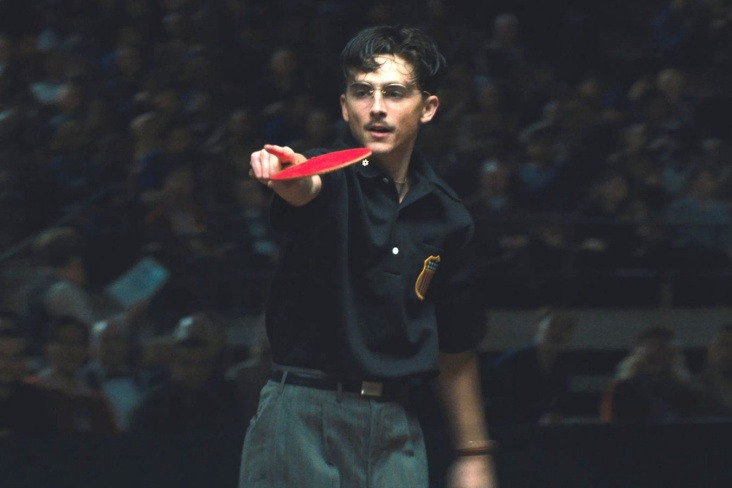
Formally, “Marty” can be called a sports drama about a young poor salesman in a shoe store, obsessed with table tennis and dreaming of beating the world champion. The paradox is that this simple, familiar scheme, where there is no room for irony of fate, and the triumphant ending is predetermined, the film fully adheres to.
But inside the honest and patriotic (the champion that Marty must beat is Japanese, and the story takes place seven years after the end of World War II) sports drama, Safdie places, like a matryoshka, a cynical rogue comedy. The hero, unwaveringly confident in himself and focused on victory, turns out to be an unscrupulous trickster, ready to inflate, steal, and abandon his pregnant girlfriend. The girlfriend (Ezayon), however, is a match for Marty: she also considers herself smarter than others, and also without any particular grounds for it.
Over Heads and Over Corpses
In general, absurdity is the main characteristic of almost all the characters in this story: almost everyone here evokes a mixture (albeit in different proportions) of disgust and pity. And the seduced movie star (Paltrow) is also absurd. Even her husband, a caricatured capitalist (played by businessman and showman Kevin O’Leary, known to America as a caricatured capitalist – this again speaks to the intersection of cinema with reality).
But first and foremost, Marty Mauser is absurd. Unlike Ostap-Suleiman-Berta-Maria-Bender-bey, this rogue is not charming, and unlike Thomas Ripley, he is unsuccessful. His overwhelming self-esteem is not compensated by self-irony and is justified nowhere but at the ping-pong table. He climbs to sports triumph over heads, and then over corpses (unless he shoots).
The Winner Gets Nothing
The epithet “Magnificent” carries a generous dose of sarcasm – which fully applies to Chalamet’s appearance, who was not afraid to grow the repulsive mustache for this role and let the makeup artists stick pimples on his face. If Timothy personally, as a hero of glamorous chronicles or Paul Atreides in his portrayal, evoked a subconscious irritation, then Mauser irritates quite openly and intentionally – and this undoubtedly counts in Chalamet’s favor.
The ruthlessness towards himself that this super-ambitious artist demonstrates here is by no means limited to the fake pimples. “Marty” is already good for giving reason to think about how repulsive this thing is – obsession with success. No matter what the preachers of the American dream, the official religion in a country where “loser” is the worst insult, might pour.
“Marty” would have been quite good if it weren’t for the final episode in the maternity ward – which noticeably smudges the overall impression with its sentimentality and didacticism. Therefore, it is probably better for those who watch the film after the Oscar ceremony – already taking into account the corrections made by life. With the understanding that the winner gets nothing.