From March 3, 2026, to February 27, 2027, the Roman Suta and Alexandra Beltsova Museum will host the exhibition "Melancholia of Imagination," revealing the features of images in the portrait painting of Alexandra Beltsova.
The theme of melancholy in European art has a long history. "Melancholy" (translated from Greek as "black bile") was considered in ancient times not only a trait inherent to one of the types of temperament but also an ailment negatively affecting a person's thoughts and psyche. The Renaissance changed the attitude of thinkers and artists towards melancholy, which began to be valued as a sign of genius, a thinker, a scholar. The Italian philosopher Marsilio Ficino named this type of melancholy "melancholia imaginativa".
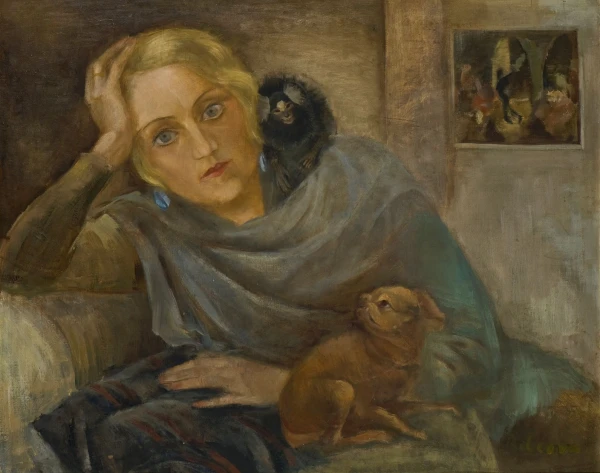
Since antiquity, a tradition of depicting melancholic images has developed in art. Ariadne, abandoned by Theseus, and Penelope, waiting for her Odysseus, or the image of Melancholy in Albrecht Dürer's famous engraving – all these figures possess a certain iconography. This is the so-called "thinker's pose": sitting with the head supported by a hand, arms crossed on the chest, head slightly bowed, eyes downcast – all these signs clearly indicate the connection of the images with melancholy.
In the portraits painted by Alexandra Beltsova (1892–1981), this tradition acquires an individual shade. The vicissitudes of the artist's life, a long illness with tuberculosis, and, to some extent, a tendency towards introversion determined the interpretation of the images that fit into the described typology. In both self-portraits and portraits of others, Beltsova emphasized a light, sad mood. Even the comedic actress Antu Klints is depicted in one of her portraits in a pose characteristic of a state of melancholy. Later, in the 1950s, Beltsova intended to show Antu Klints at work, but in the painted composition, the actress is sitting half-reclined on a sofa in a moment of contemplation, lowering her hand with a pencil and not looking at the papers lying on her lap. Similarly, melancholic philosophers and scholars in the works of old masters or the winged creative spirit from Dürer's engraving ignore their tools and, immersed in thought, await inspiration.
In the 1930s, a sense of melancholy reigned in several European metropolises. This was noted by the German philosopher Walter Benjamin and the French sociologist Émile Durkheim, who wrote about Berlin and Paris. One of the main novels of that time – "Nausea" by Jean-Paul Sartre – largely embodied the spirit of the era. Notably, initially, according to the author's intention, it was to be titled "Melancholy". Rapid industrialization, the rise of totalitarian regimes in Europe and Russia led to the carefree flâneurism characteristic of the late 19th and early 20th centuries being replaced in the 1930s by a new type of urban dweller living in a realm of melancholy.
In connection with the theme of the exhibition, one exhibit from Alexandra Beltsova's personal library is of interest. In a brochure with the Statute of the Latvian SSR (1940), a separate page was found with a quote from the novel "The Martyrs" by the French writer François-René de Chateaubriand. In a typed fragment, the main character bids farewell to the Muse – a symbol of youth and inspiration – and accepts the next stage of his creative work, which will later recount the bitterness of loss (part 2 of the novel, chapter 24). Chateaubriand's quote may indicate that Beltsova was close to the idea of melancholy as a special part of the personality of a creative individual, characteristic of the Romantic era. At the same time, it hints that the Soviet period brought the artist many experiences and disappointments, which undoubtedly influenced the message and mood of her works.
The exhibition provides a brief overview of the history of the concept of melancholy and the iconography of melancholic images, offering visitors both previously unexhibited works by Alexandra Beltsova and already known portraits that acquire new significance in the context of this theme.