Theatrical sensation: on the big stage of the New Riga Theatre, the production of "Don Quixote" was carried out by the famous Adolf Shapiro. Meanwhile, on the small stage - "The Valley of Wonders" by the no less famous Matis Kaja. Of course, all tickets for both productions are sold out.
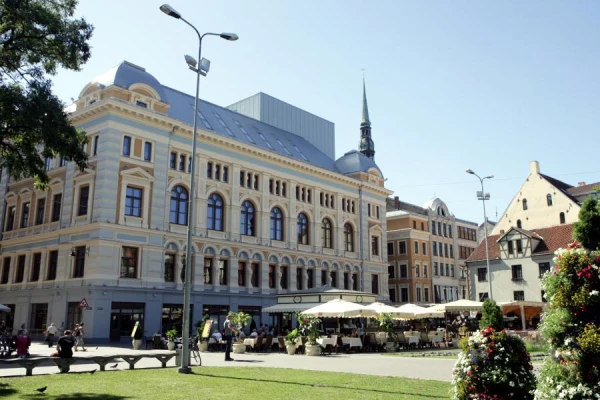
Here was the Youth Theatre
This is quite logical, as Shapiro returned for the first time in 34 years to work in the walls where he once led the Youth Theatre for almost thirty years.
The master first crossed the threshold of his former theatre back in 2015, but as a spectator - he watched "Brodsky/Baryshnikov" directed by Alvis Hermanis. It was Hermanis who persuaded the 86-year-old classic to stage a production in the reconstructed, yet familiar, walls of Adolf Yakovlevich.
The sharp pain of the closed Youth Theatre has clearly passed, and let’s not delve into why the theatre was closed in 1992. Briefly: it was not politics, nor even the weak economy at the time, but the clashing temperaments of two bright personalities - Shapiro (the director, who had one foot in Moscow even before) and Pauls (then Minister of Culture). Shall we forget?
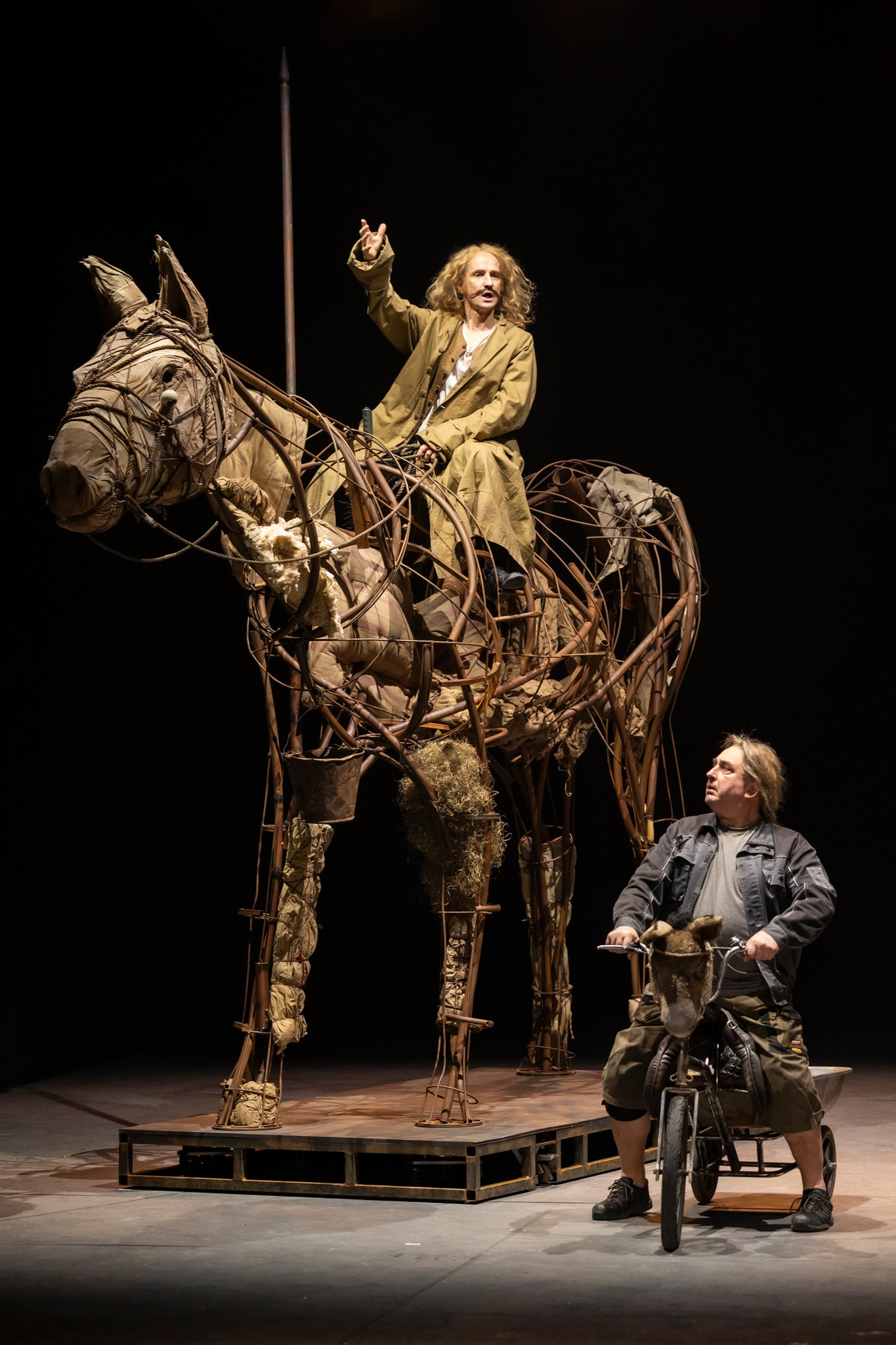
Forward, towards adventures! Photo: Janis Dejnats.
A Long Road
At the premiere in the hall, as Leo Tolstoy would write at the beginning of "War and Peace" - the essence of intellectual and social thought... of Latvia! The curtain rises, and the heroes of Cervantes' immortal novel come on stage. Silence for about ten seconds.
Just when it seemed like a minute of silence for the deceased theatre, suddenly dozens of books fall from above, which the actors then gather into garbage bags. Well, you have read "Don Quixote", right? At least the beginning of the two-volume edition? The hidalgo (artist Kaspars Znotins), sitting among numerous tomes, has read too many chivalric romances. And he sets off on a journey through La Mancha with his loyal squire Sancho Panza (the brilliant Gundars Abolins, who is also the translator into Latvian of the stage dramaturgy of the novel written by Shapiro himself).
The theatrical journey lasts three and a half hours, with an intermission. The audience erupts in applause when a huge Rocinante (Don Quixote's horse) rolls onto the stage - a construction by Martins Vilkarsis, which Don Quixote climbs up a ladder. And below him, Sancho accompanies him on a tricycle designed to look like a donkey (during the action, the tricycle's horn sounds like a donkey's bray). Magnificent!
And then there are quite a few tricks by the director - for example, apples tumble out from the rear of the constructed horse.
Measure the World with Money?
The main line of the director is the relationship between Don Quixote and Sancho Panza. The former is an elevated and romantic hero, who has invented a certain Dulcinea del Toboso and is fighting windmills (symbolized by the shadow across the entire backdrop from a spinning fan). In general, he really does seem like a madman.
The latter is an absolutely down-to-earth and quite pragmatic Sancho, a man of the plow. There is a wonderful scene when Sancho demands money from Don for his services, and the main character of the novel exclaims: how can this be, for he is a knight performing noble deeds! And what money can there be after that?
Actress Baiba Broka, in the role of the duenna, whom the hidalgo has denied physical love, addresses Sancho amidst the laughter of the audience: "Explain to me, what is the phenomenon of this Dulcinea?"
"Is there another globe?"
One of the climaxes of the slowly unfolding action is the appearance of wandering actors on a cart, inside which a lion is hiding behind a curtain (not a real one, of course, although in the novel they are quite real!). As you can understand, a pantomime "The Battle of the Great Don Quixote with Lions" is staged.
The lion cub, played by young actress Sabine Tikmane, falls dead, Don Quixote - a hero! Theatre! But in the finale, there will be no theatre, but the appearance of a real knight challenging the hidalgo to a duel. Another repetition of the constantly sounding climax of Dmitri Shostakovich's Chamber Symphony and the revolving scenography, as well as the work of lighting designer Nikas Cipruss - this has always played one of the main roles in Shapiro's theatre.
The true knight summarizes: if he wins, Don Quixote should stop wandering through La Mancha, let him stay at home. Of course, Don loses and goes home, where his loved ones, a priest, and... Sancho are around him. Don Quixote dies, Sancho brings him a globe, and the titular character says: "Is there another globe?" And he departs this world with the words: "Let’s go on a journey!"
All the characters cry, but... a minute later, this crying turns into laughter! And sheets of paper with images of the heroes of the great novel fall onto the audience in the hall. Applause!
...I remember in 1991 at the Youth Theatre, Shapiro staged "Democracy!" - a play by Joseph Brodsky. By the way, he received the right to the first production after a personal meeting with the Nobel laureate in the USA. There, at the finale, a completely naked heroine appeared, embodying that very democracy, and at that time it was an incredible innovation! In the current "Don Quixote", there are no overtly innovative solutions, but from beginning to end, the hand of the old master is felt.
From Screen to Stage
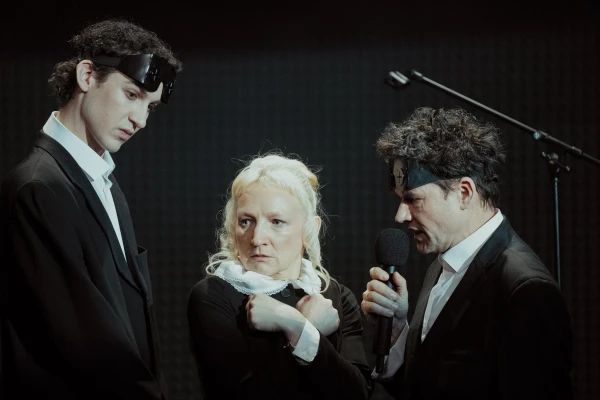
While Don Quixote was battling windmills on the big stage of the theatre, "The Valley of Wonders" was presented on the small stage, directed by Matis Kaja, an Oscar winner for co-authoring the screenplay and co-producing the animated film "Flow".
A Lot of Boredom and Attraction
After the coveted statuette, Matis is incredibly sought after in all leading theatres in Latvia, with two of his productions in the National Theatre being memorable - the provocative thriller "National Channel" (large stage) and "Bastards" (chamber hall). And now he finds himself in the most intellectual theatre in Latvia.
The "Oscar-winning" director has at his disposal a chamber hall (85 seats) and three magnificent actors from Alvis Hermanis' theatre - the experienced Guna Zarina, Vilis Daudzins, and young Gerd Laposka.
The action, lasting an hour and 40 minutes, can superficially be assessed as follows: an hour and a half of somewhat mystical boredom (the play is intellectual!) and 10 minutes of attraction! The boredom is expected here - before us is an experiment, a laboratory, and in general, a performance based on a play by the patriarch of world theatre Peter Brook, an English theatre and film director.
Global Theatre
By the way, it is interesting that Brook died only four years ago at the age of 97, and his parents were emigrants from Dvinsk (Vitebsk province) Simon (Semyon Matveyevich) Brook and Ida Yudelsone. And, by the way, Brook Jr. is a cousin of the Soviet and Russian director Valentin Pluchek, head of the Moscow Satire Theatre during the times of Papanov, Mironov...
The play for Brook's production in Paris in 1998 was completed by Marie-Hélène Etienne. The idea arose from the experimental work "I Am Not a Freak", dedicated to the problems of human memory.
The Divine in the Unusual
To understand the essence of the performance, it is necessary to study the announcement: "When you were one or two years old, your mother sang lullabies to you. You did not understand the meaning of the words she sang, but you caught the syllables like strokes of color. You caught and learned the song. Many years have passed. You still remember it in your head. And you see your mother. The performance is dedicated to the search for the divine in the unusual. About the strange nature of the human brain and very strange memory. Where we see words in colors, but can taste music. This will be a tribute to the outstanding and Latvia-related director Peter Brook in honor of his centenary, combining Sufi mythology and the exploration of a peculiar phenomenon - synesthesia."
A meditative immersion into the mysteries of studying the human brain and the transformation of the already not-so-young heroine Guna Zarina back into a cheerful girl (this is where the attraction lies, theatre!). Who in the finale bequeaths her brain for study by scientists. And you guess - is this a performance about actors, medics, or about all of us.